The deployment of Czech UH-1Y Venom helicopters to Poland marks a decisive evolution in NATO’s response to persistent low-altitude aerial threats along its eastern frontier. As drone incursions and hybrid warfare tactics continue to test alliance resilience, this move represents more than a routine rotation—it signals a tangible upgrade in capability, interoperability, and operational intent. Positioned near the Ukrainian border, these modern rotary-wing platforms are now actively engaged in counter-drone operations, replacing legacy systems and redefining how NATO confronts emerging airborne risks.
The operational context driving this deployment is both urgent and complex. Since September 2025, Polish airspace has faced repeated incursions by low-flying drones, widely attributed to Russian activity. A particularly alarming breach on September 9–10 saw over 20 unmanned aerial vehicles penetrate Polish territory, exposing vulnerabilities in detecting and intercepting small, low-signature threats. These incidents have forced NATO to rethink its layered air defense architecture, emphasizing agility, rapid response, and enhanced situational awareness at lower altitudes.
A Strategic Upgrade from Soviet Legacy to NATO-Standard Precision
The transition from the Mi-171Š helicopters to the UH-1Y Venom represents a clear break from Soviet-era systems toward a fully NATO-integrated operational framework. While the Mi-171Š remains a capable transport platform, it lacks the advanced avionics, sensor integration, and mission flexibility required for modern counter-UAS operations. The Venom, by contrast, is purpose-built for multi-role missions in contested environments, offering a level of adaptability that aligns seamlessly with NATO’s evolving doctrine.
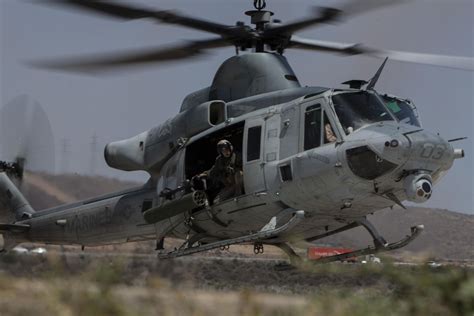
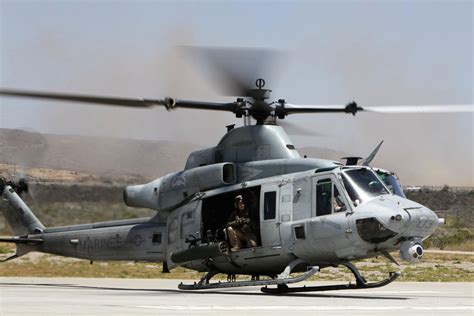
Powered by twin T700-GE-401C engines, the UH-1Y delivers a maximum speed of approximately 170 knots and a range of 325 nautical miles. These performance metrics enable rapid deployment across wide operational areas, a critical advantage when responding to unpredictable drone incursions. More importantly, the platform’s 85 percent commonality with the AH-1Z Viper simplifies logistics, maintenance, and training—an often overlooked but crucial factor in sustained operations.
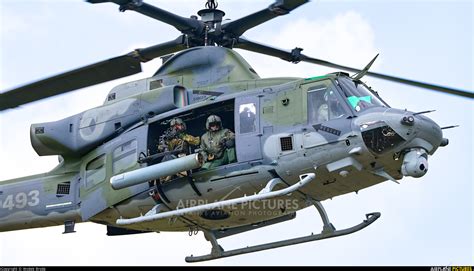
Beyond raw performance, the Venom’s digital cockpit and advanced communications suite provide enhanced situational awareness and real-time data sharing. This allows crews to integrate seamlessly with NATO’s broader command-and-control networks, ensuring that every detected threat is tracked, analyzed, and addressed within a unified operational picture.
Counter-Drone Warfare Demands Agility and Precision
The nature of the drone threat along NATO’s eastern flank is uniquely challenging. Unlike traditional aircraft, unmanned systems often operate at low altitudes, exploit terrain masking, and present minimal radar signatures. These characteristics make them difficult targets for conventional air defense systems, which are typically optimized for higher-speed, higher-altitude threats.
In this environment, the UH-1Y Venom excels as a highly responsive, flexible platform. Operating at low to medium altitudes, it can be rapidly vectored toward suspicious tracks, visually identify targets, and coordinate with ground-based air defense units. Equipped with door-mounted 12.7 mm machine guns and adaptable mission systems, the helicopter can engage threats directly if required under established rules of engagement.
This capability fills a critical gap in NATO’s layered defense structure. While fighter jets provide speed and reach, and surface-to-air systems deliver powerful interception capabilities, the Venom offers persistence and discrimination—two qualities essential for dealing with ambiguous, low-speed aerial targets. It acts as both sensor and shooter, bridging the space between detection and neutralization.
NATO Interoperability Proven in Real Operations
What sets this deployment apart is not just the hardware, but the level of operational integration achieved by Czech crews. Prior to deployment, personnel underwent specialized counter-UAS training focused on detection, tracking, and engagement of low-altitude drones. Their readiness was validated through NATO-standard evaluations, including the VORTEX exercise, where interoperability and mission effectiveness were rigorously tested.
This preparation ensures that the Czech detachment operates as a fully integrated component of NATO’s air defense network rather than a standalone unit. Communication protocols, tactical procedures, and command structures are aligned with alliance standards, enabling seamless coordination with Polish forces and other allied assets in the region.
Such interoperability is not merely symbolic—it is operationally decisive. In a fast-moving threat environment, the ability to share data, coordinate responses, and execute joint missions without friction can mean the difference between containment and escalation. The deployment demonstrates that NATO’s eastern flank is not just defended, but actively synchronized across multiple national forces.
Persistent Threat Environment Driving Tactical Evolution
The sustained presence of drone threats along Poland’s eastern border underscores a broader shift in modern warfare. Unmanned systems have become tools of strategic signaling as much as tactical disruption, probing defenses, gathering intelligence, and testing response thresholds. Their relatively low cost and high operational flexibility make them ideal instruments for gray-zone operations, where actions remain below the threshold of open conflict.
For NATO, this reality demands a recalibration of defensive priorities. Traditional air superiority alone is no longer sufficient; instead, emphasis must be placed on detecting and countering smaller, less predictable threats that exploit gaps in coverage. The deployment of UH-1Y Venoms reflects this shift, introducing a platform specifically suited to operating within these contested, ambiguous environments.
The helicopters’ ability to loiter, adapt mission profiles, and respond dynamically to emerging threats provides a level of tactical versatility that is difficult to replicate with fixed-wing aircraft or static defense systems. This makes them particularly valuable in regions where the threat landscape is constantly evolving.
Strengthening Deterrence Through Visible Capability
Beyond its immediate operational impact, the deployment carries significant strategic implications. The presence of Czech UH-1Y Venoms in Poland sends a clear message of allied cohesion and readiness. It demonstrates that NATO’s response to airspace violations is not limited to diplomatic statements but includes tangible, forward-deployed capabilities.
For Poland, the reinforcement enhances local resilience against aerial threats, providing an additional layer of protection in a region under sustained pressure. For the Czech Republic, it highlights the strategic value of its modernization efforts, showcasing how even a relatively small contingent can contribute meaningfully to collective defense.
This visible commitment to joint operations strengthens deterrence by signaling to potential adversaries that any provocation will be met with a coordinated, multinational response. It reinforces the principle that NATO’s security is indivisible, with each member contributing to and benefiting from the alliance’s collective strength.
The Venom’s Role in NATO’s Future Air Defense Strategy
Looking ahead, the deployment of UH-1Y Venoms in Poland offers a glimpse into the future of NATO’s air defense strategy. As drone technology continues to evolve, the need for adaptable, multi-role platforms will only increase. Helicopters like the Venom, with their combination of mobility, sensor integration, and mission flexibility, are well positioned to play a central role in this evolving landscape.
Their ability to operate in conjunction with both manned and unmanned systems further enhances their value. By integrating into a networked defense architecture, they can act as nodes within a broader system of sensors and shooters, contributing to a comprehensive, layered approach to airspace security.
This approach reflects a broader trend toward distributed operations, where multiple assets work in concert to detect, track, and neutralize threats across different domains. In this context, the Venom is not just a platform, but a force multiplier, enhancing the effectiveness of the entire defense network.
A Clear Signal of Readiness on NATO’s Eastern Flank
The arrival of Czech UH-1Y Venom helicopters in Poland represents a decisive step in strengthening NATO’s eastern defenses at a time of heightened tension and evolving threats. By replacing legacy systems with modern, interoperable platforms, the alliance is not only addressing immediate vulnerabilities but also building a more resilient and adaptable defense posture for the future.
In an environment defined by uncertainty and rapid technological change, the ability to respond quickly and effectively to emerging threats is paramount. The Venom’s deployment demonstrates that NATO is not merely reacting to challenges but actively shaping its defensive capabilities to meet them head-on.
As drone incursions continue to test the limits of traditional air defense, the integration of platforms like the UH-1Y ensures that NATO remains prepared to detect, deter, and defeat even the most elusive threats. This is not just an upgrade in equipment—it is a transformation in how airspace security is conceived, executed, and sustained on the alliance’s most exposed frontier.