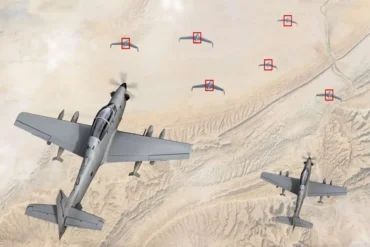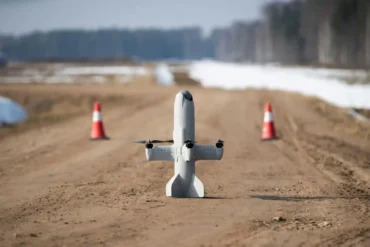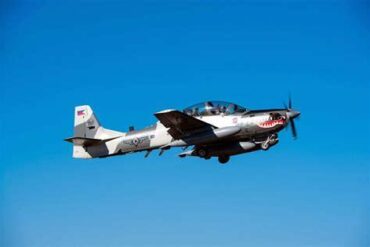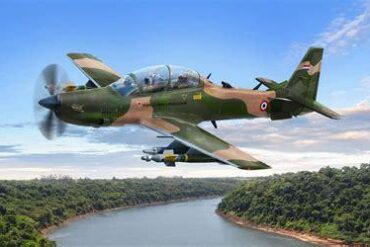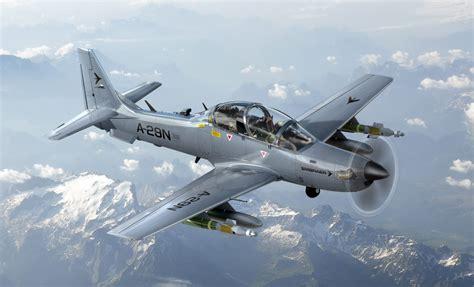
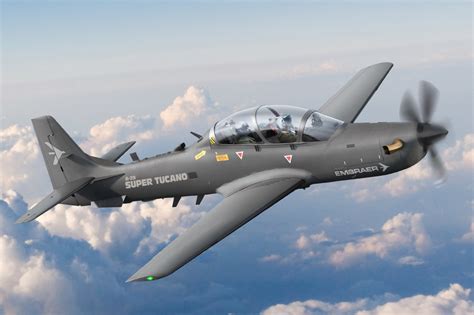
Poland is quietly but decisively rethinking how airpower should be applied in an era dominated by inexpensive, persistent, and expendable unmanned threats. In mid-January 2026, a Polish military delegation led by Major General Ireneusz Nowak traveled to Brazil to evaluate the A-29 Super Tucano, Embraer’s well-established light attack and advanced trainer aircraft, as a potential airborne solution for countering Shahed-type one-way attack drones. The visit was not symbolic. It reflected a deeper reassessment inside the Polish Air Force about how to fill the widening operational gap between high-end fighter aircraft and ground-based short-range air defenses.
Poland’s security environment has been reshaped by the war in Ukraine, where low-cost loitering munitions and surveillance drones have repeatedly demonstrated their ability to bypass or saturate traditional air defense networks. These systems do not demand sophisticated interceptors; they demand persistent presence, rapid cueing, and affordable engagement. In that context, Warsaw’s interest in the A-29 is less about rediscovering an old platform and more about adapting proven technology to a modern, data-driven air defense architecture.
The evaluation took place at Embraer Defense & Security facilities, where Polish officers conducted familiarization flights, examined multiple aircraft configurations, and reviewed operational lessons from current users, including the Portuguese Air Force. Discussions reportedly focused on operating costs, integration with existing command-and-control networks, and the feasibility of sustained counter-drone patrols without consuming frontline fighter resources. This practical, system-level focus underscores how seriously Poland is treating the counter-UAS challenge.
The strategic appeal of the Super Tucano lies in its ability to operate as an airborne “hunter” layer, positioned between long-range surface-to-air missile systems and point defenses. Shahed-type drones often fly at low to medium altitudes, follow predictable routes, and are launched in numbers designed to exhaust defenders. Engaging them with advanced fighters or expensive missiles creates an unfavorable cost exchange. A turboprop aircraft optimized for endurance, sensor-driven targeting, and gun or rocket engagements changes that equation.
The renewed attention to the A-29 also aligns with Embraer’s evolving industrial narrative. In November 2025, the company formally presented the Super Tucano as a dedicated counter-UAS platform, not merely a light attack aircraft repurposed in the field. Embraer’s concept emphasizes using existing onboard systems, augmented by specialized sensors and datalinks, to receive initial target coordinates from ground radars or external sources. This approach avoids the long development cycles associated with entirely new aircraft programs while delivering a mature capability quickly.
A Proven Airframe Reimagined for a New Threat Environment
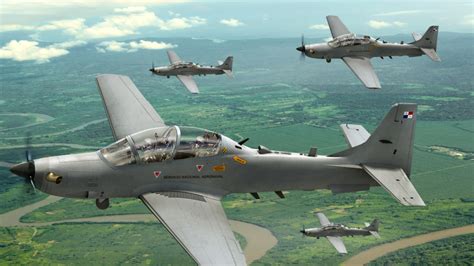
The A-29 Super Tucano, designated EMB-314, is the latest evolution of Embraer’s Tucano lineage, originally developed for advanced pilot training and light attack missions. At its core is the Pratt & Whitney Canada PT6A-68C turboprop engine, producing roughly 1,600 shaft horsepower and controlled by Full Authority Digital Engine Control. This powerplant is renowned for reliability, fuel efficiency, and ease of maintenance, qualities that become decisive when aircraft are flown daily on repetitive defensive patrols.
Structurally, the airframe is designed for durability rather than fleeting performance. It is cleared for +7G and -3.5G maneuvers and incorporates corrosion-resistant materials suitable for high-tempo operations from dispersed or austere bases. The cockpit canopy includes a windshield rated to withstand bird strikes at 270 knots, a practical feature for low-altitude interception missions where encounters with wildlife are not theoretical risks. Embraer estimates a service life of up to 18,000 hours for training profiles and around 12,000 hours for operational use, signaling that the aircraft is meant to absorb years of sustained employment.
In performance terms, the Super Tucano’s characteristics align closely with counter-drone requirements. Maximum speeds are typically cited between 520 and 593 kilometers per hour, depending on configuration, with a service ceiling of approximately 10,670 meters. Endurance can reach over six hours, allowing aircraft to loiter over threatened areas rather than sprinting between targets. With a maximum takeoff weight of around 5,200 kilograms and internal fuel capacity near 695 liters, the aircraft balances payload, range, and persistence in a way jet platforms cannot economically replicate.
Avionics and Sensors Built for Detection and Cueing
Countering small drones is less about raw speed and more about seeing first and reacting faster. The A-29’s avionics suite reflects that reality. Its glass cockpit is built around a fourth-generation Human-Machine Interface that prioritizes workload reduction and sensor fusion. Hands-On Throttle and Stick controls, a laser-based Inertial Navigation System integrated with GPS, and a Head-Up Display with an Up-Front Control Panel allow pilots to manage navigation, targeting, and communications without cognitive overload.
Two full-color multifunction displays present sensor feeds, navigation data, and mission cues in an integrated format. For night and all-weather operations, the aircraft can employ Electro-Optical and Infra-Red sensor systems capable of detecting low-contrast aerial targets against complex backgrounds. Night-vision goggle compatibility extends effectiveness into the hours when many one-way attack drones are launched to exploit reduced visual detection.
Communications and data integration are equally critical. Tactical VHF and UHF radios, combined with provisions for datalinks, enable the aircraft to receive cueing from ground-based radars or higher-level command nodes. Video recording systems support post-mission analysis, accountability, and intelligence exploitation. An On-Board Oxygen Generating System and Martin-Baker MK-10LCX ejection seats round out a cockpit designed for sustained, high-sortie operations.
Armament Flexibility and Cost-Effective Engagement
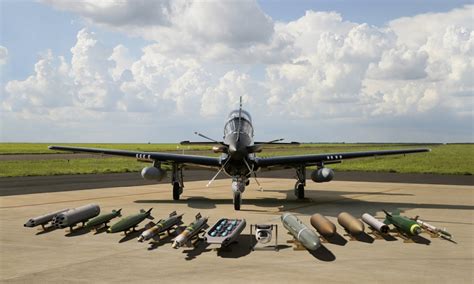
The Super Tucano’s weapons configuration is central to its appeal as a counter-drone platform. Integrated into the wings are two 12.7 mm machine guns, offering an immediately available, low-cost engagement option against slow, unarmored targets. The aircraft also features five external hardpoints with a combined payload capacity of approximately 1,500 kilograms, allowing for mission-tailored loadouts.
These hardpoints can carry rocket pods, general-purpose bombs, and precision-guided munitions. For counter-UAS missions, laser-guided rockets provide a balance between accuracy and affordability, reducing the risk of collateral damage while preserving favorable cost ratios. The platform has also demonstrated compatibility with lightweight air-to-air missiles, such as Brazil’s MAA-1 Piranha, offering an additional engagement layer when gun solutions are impractical.
This flexibility matters because Shahed-type drones vary in altitude, speed, and flight profile. Some may be best engaged with guns during terminal phases, others intercepted earlier with guided weapons. The A-29’s ability to adapt its loadout ensures that commanders are not locked into a single interception method.
Training Integration and Force Sustainability
One of the less visible but strategically important aspects of the Super Tucano is its embedded training and simulation architecture. The aircraft can simulate radar contacts, electronic warfare cues, and missile engagements through data-linked environments, allowing pilots to train for complex scenarios without expending live weapons. This dual-role capability means a single fleet can support both operational missions and pilot conversion training.
For Poland, this is more than a budgetary convenience. Counter-drone operations are manpower-intensive, requiring crews who are comfortable operating in close coordination with ground sensors and command networks. A platform that blends training and combat roles reduces the burden on frontline fighter units and preserves their readiness for higher-end contingencies.
A Layered Defense Concept Takes Shape
Embraer’s counter-UAS concept envisions the A-29 as part of a layered air defense ecosystem. Ground-based radars detect incoming drones and transmit initial coordinates via datalink. The Super Tucano, already airborne or scrambled quickly, uses its EO/IR sensors to acquire and identify targets. Engagement follows using guns or guided rockets, depending on range and context. This sequence preserves expensive surface-to-air missiles for threats that genuinely require them.
Such an approach aligns with Poland’s broader defense posture, which already emphasizes integration between air, land, and information domains. Advanced fighters like the F-35 and upgraded F-16s remain essential for deterrence and air superiority, but they are ill-suited for chasing slow, expendable drones in large numbers. A mixed force structure that includes light fixed-wing aircraft adds resilience under saturation conditions designed to overwhelm traditional defenses.
Strategic Implications for Poland and NATO
Poland’s evaluation of the A-29 Super Tucano signals a wider shift in NATO thinking, particularly on the alliance’s eastern flank. Deterrence is no longer defined solely by the ability to strike deep or dominate contested airspace; it is also defined by the capacity to endure persistent, low-cost harassment without bleeding resources. Affordable airborne counter-UAS platforms directly support that objective.
There is also an industrial dimension. Considering Brazilian aerospace solutions alongside American and European offerings reflects a pragmatic approach driven by operational urgency rather than tradition. If adopted, the Super Tucano would represent not a step backward but a recalibration toward sustainability in an era where mass and attrition have reasserted themselves as strategic factors.
Ultimately, Poland’s interest in the A-29 is not about nostalgia for turboprops but about realism. Shahed drones do not demand silver bullets. They demand presence, persistence, and smart integration. In that environment, a mature, adaptable aircraft with low operating costs and proven combat credentials becomes not an interim fix, but a strategically relevant tool for modern air defense.