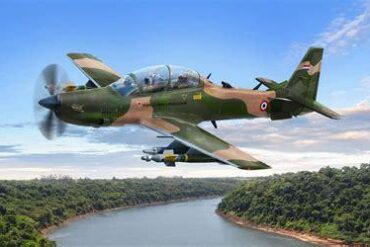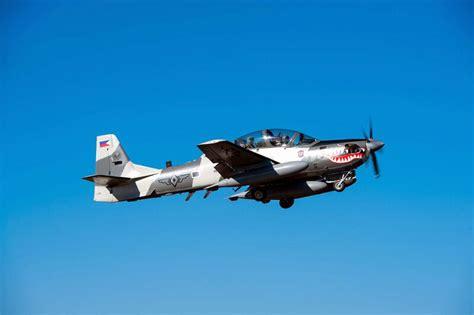
Brazil’s Embraer has formally confirmed that the Philippine Air Force (PAF) is the customer behind a previously undisclosed follow-on order for six additional A-29 Super Tucano light attack aircraft, a move that doubles the country’s fleet and cements the turboprop platform as a central pillar of Philippine air combat capability. The announcement was made on February 3, 2026, during the Singapore Airshow, one of Asia’s most closely watched defense aviation events. With this order, the PAF’s inventory of A-29s will increase from six to twelve aircraft, significantly improving operational availability, training capacity, and long-term sustainability.
The confirmation ends months of speculation surrounding Embraer’s order book and highlights the growing importance of cost-effective, mission-ready light attack aircraft in Southeast Asia’s evolving security environment. For the Philippines, a nation facing persistent internal security challenges alongside wider regional uncertainties, the A-29 Super Tucano represents a balance between affordability, endurance, and precision firepower. The follow-on purchase also signals institutional confidence in the aircraft after several years of real-world operational use.
The original batch of six A-29B Super Tucanos entered Philippine service in October 2020, assigned to the 16th Attack Squadron of the 15th Strike Wing at Edwin Andrews Air Base. From the outset, the aircraft were tasked with demanding operational roles that previously stretched an aging fleet of OV-10 Bronco aircraft. While the Super Tucano quickly demonstrated its value, the limited fleet size constrained sortie generation and pilot conversion, a problem now directly addressed by the new acquisition.
Strategic Context Behind the Follow-On Order
The Philippine Air Force’s decision to acquire additional A-29 aircraft is deeply rooted in the Armed Forces of the Philippines Modernization Program, specifically its Horizon 1 phase. As early as 2014, the Department of National Defense identified the urgent need to replace the OV-10 Bronco, a platform that had served faithfully but was increasingly difficult to sustain. The requirement emphasized close air support, armed reconnaissance, and strike coordination, while explicitly favoring turboprop solutions due to cost ceilings, endurance demands, and short-field performance requirements.
Embraer’s A-29 Super Tucano emerged as the optimal solution within these constraints. The contract for the initial six aircraft was signed in late 2017, marking a decisive shift toward modern, digitally equipped strike aviation. The follow-on order announced in 2026 demonstrates that the original selection was not merely a stopgap, but the foundation of a longer-term capability strategy.
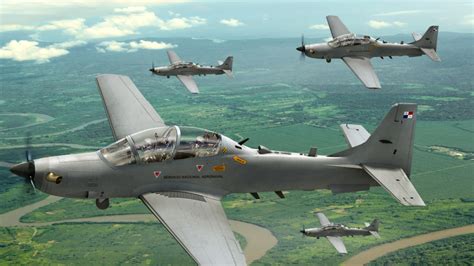
The timing of the additional order is equally significant. On December 31, 2024, the Philippine Air Force formally retired its remaining OV-10 Bronco aircraft and AH-1 Cobra attack helicopters. This retirement eliminated the last legacy attack platforms in the inventory, creating a narrow window where operational capability risked being overstretched. Contracting the additional A-29s just days earlier ensured continuity, preventing a critical gap in close air support and counterinsurgency operations.
Operational Experience Shapes Fleet Expansion
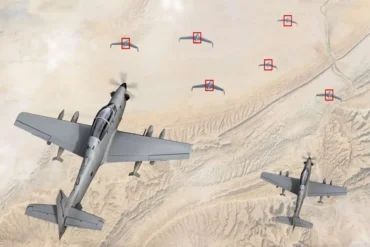
Unlike many acquisitions driven purely by projections, the Philippine Air Force’s decision is grounded in combat experience. Since entering service, the A-29 Super Tucano has been employed in strike and surveillance missions supporting internal security operations, particularly in Mindanao. The aircraft has conducted precision strikes against militant encampments, leveraging its ability to loiter for extended periods while delivering accurate fire with minimal collateral damage.
Operational commanders consistently highlighted the aircraft’s sensor integration, survivability at low altitude, and flexibility across mission profiles. However, with only six airframes available, planners were forced into a delicate balancing act between training new crews, maintaining readiness, and sustaining combat operations. Maintenance cycles further reduced availability, underscoring the need for a larger fleet to achieve true operational depth.
By expanding the fleet to twelve aircraft, the PAF gains not just numerical strength but structural resilience. Training pipelines can now operate without compromising mission readiness, while maintenance scheduling becomes more forgiving. In practical terms, this translates into more aircraft available when and where they are needed, a critical factor in a geographically dispersed archipelago.
The A-29 Super Tucano: Design Philosophy and Capabilities
The A-29 Super Tucano, also known as the EMB-314, is a combat-optimized evolution of Embraer’s earlier EMB-312 trainer. Developed in the early 1990s in response to Brazilian Air Force requirements, the aircraft was purpose-built for counterinsurgency, border surveillance, and light attack missions in challenging environments. Its design reflects lessons learned from decades of asymmetric warfare, where persistence, reliability, and adaptability matter more than raw speed.
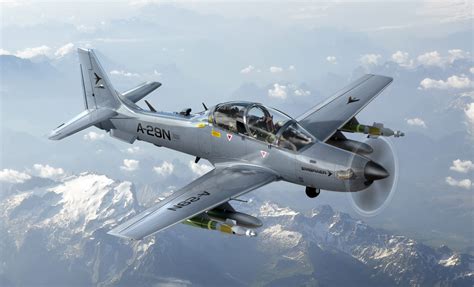
The airframe is reinforced to withstand higher g-loads and offers a fatigue life of up to 12,000 flight hours in combat use. Ballistic protection around critical areas, including the cockpit and engine, enhances survivability during low-altitude operations. The aircraft’s avionics suite supports day and night missions, with integrated navigation, weapons delivery systems, and situational awareness tools designed to reduce pilot workload.
Short takeoff and landing performance allows the A-29 to operate from semi-prepared airstrips, a vital capability in regions where infrastructure may be limited or dispersed. High heat and humidity tolerance further suit the aircraft to Southeast Asian operating conditions, aligning neatly with Philippine geographic realities.
Technical Specifications That Support Mission Flexibility
The A-29 Super Tucano is crewed by two personnel, seated in tandem on Martin-Baker Mk 10 LCX zero-zero ejection seats. Measuring 11.38 meters in length with an 11.14-meter wingspan, the aircraft balances compact dimensions with substantial payload capacity. Its maximum takeoff weight of 5,400 kg is powered by a Pratt & Whitney Canada PT6A-68C turboprop engine delivering 1,604 horsepower, driving a five-bladed Hartzell propeller optimized for efficiency and responsiveness.
Performance figures reflect the aircraft’s mission profile rather than high-speed interception. A maximum speed of 590 km/h, combined with a cruise speed of 520 km/h, allows rapid response while preserving endurance. With a combat radius of approximately 550 km and the ability to remain airborne for over eight hours when configured for endurance, the A-29 excels at persistent presence over contested areas.
Weapons, Sensors, and Survivability
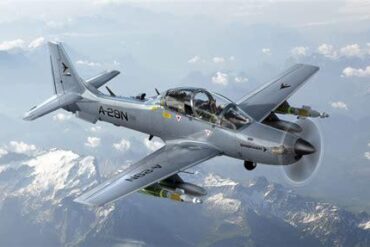
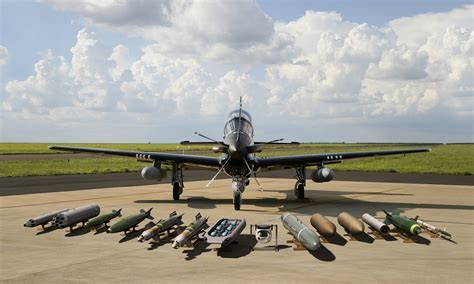
Armament is a defining strength of the Super Tucano. Two internally mounted 12.7 mm machine guns, each supplied with 200 rounds, provide immediate firepower without occupying external hardpoints. Five external stations support a total payload of up to 1,550 kg, accommodating a wide range of weapons tailored to mission needs.
These include 70 mm rocket pods, general-purpose bombs, precision-guided munitions, and air-to-air missiles such as the AIM-9L and Python series for self-defense. Air-to-ground options extend to systems like the AGM-65 Maverick and Roketsan Cirit, enhancing precision strike capability. Integrated FLIR sensors, chaff and flare dispensers, and electronic countermeasures contribute to survivability in hostile environments.
A Consolidated Capability for the Philippine Air Force
The confirmation of six additional A-29 Super Tucanos marks more than a routine procurement update. It represents a strategic consolidation of the Philippine Air Force’s light attack and close air support capability at a moment of institutional transition. By standardizing around a proven, versatile platform, the PAF reduces logistical complexity while maximizing operational return on investment.
For Embraer, the order reinforces the A-29’s reputation as a globally relevant light attack aircraft, trusted by operators who demand real-world performance rather than brochure promises. For the Philippines, it ensures that air power remains responsive, sustainable, and aligned with national defense priorities in an increasingly complex regional security landscape.