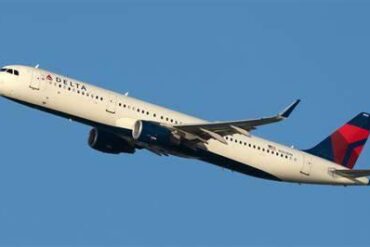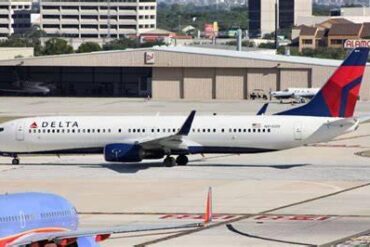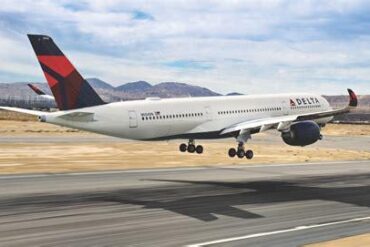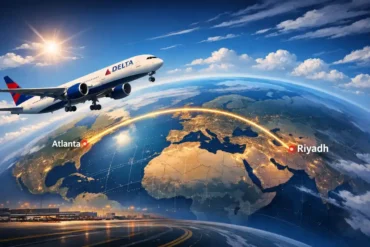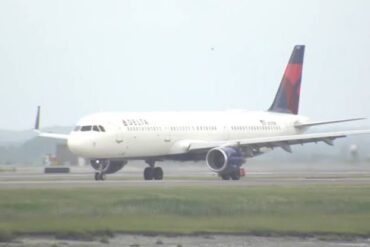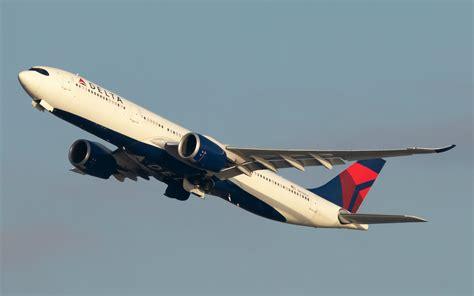
Delta Air Lines passengers expecting to arrive in Lagos instead found themselves back where they started after an extraordinary transatlantic turnaround forced an Airbus A330 to abandon its journey midway across the Atlantic Ocean. What began as a routine overnight service from Atlanta to Nigeria transformed into an eight-hour “flight to nowhere,” leaving travelers frustrated, exhausted, and searching for answers after the aircraft unexpectedly reversed course far from land.
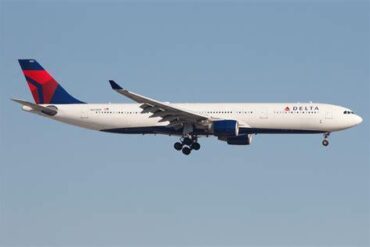
The incident involved Delta Flight DL54, a regularly scheduled long-haul service operating between Hartsfield-Jackson Atlanta International Airport and Murtala Muhammed International Airport in Lagos. The flight departed Atlanta on the evening of May 9 aboard an Airbus A330-200, one of the airline’s older widebody aircraft still heavily used across international routes linking North America with Europe, Africa, and South America.
For several hours, the journey appeared completely normal. Flight-tracking data showed the aircraft climbing to cruising altitude and continuing eastward over the Atlantic Ocean as expected. Passengers settled into what should have been an approximately 11-hour overnight crossing toward West Africa. Then, somewhere over the ocean, the situation abruptly changed.
After reaching deep into the Atlantic routing corridor, the crew initiated a full turnaround and pointed the aircraft back toward the United States instead of continuing toward Nigeria.
Delta Flight DL54 Suddenly Reversed Course Mid-Atlantic
The Airbus A330-200 reportedly climbed to around 33,000 feet before continuing several hours eastbound over the Atlantic. Flight monitoring platforms later revealed the aircraft making a dramatic course reversal roughly halfway through the journey.
Passengers onboard initially struggled to understand what was happening. Cabin screens and flight maps reportedly showed the aircraft no longer progressing toward Lagos. Instead, the jet gradually traced a westbound path back toward Georgia.
Delta later described the situation only as “operational issues,” offering limited public details about the precise cause behind the diversion. The airline did not indicate whether the issue involved a technical malfunction, maintenance concern, crew-related complication, or another operational factor. Despite the limited explanation, aviation analysts noted that airlines rarely make the costly decision to reverse a transatlantic flight unless significant concerns emerge during the crossing.
Returning to Atlanta rather than diverting to a closer airport also raised questions among observers. Several alternate airports exist along North Atlantic routings, including facilities in the Azores, Bermuda, or parts of Europe and North Africa. Yet operational logic often favors returning to a primary maintenance hub when circumstances permit.
That appears to have been the strategy behind DL54’s unusual Atlantic retreat.
Why Airlines Sometimes Return Instead Of Diverting
To ordinary passengers, turning around after several hours airborne may seem irrational. However, within airline operations, the decision can sometimes make far more sense than continuing forward.
Long-haul aircraft operate under extremely complex logistical frameworks involving maintenance support, crew scheduling, customs coordination, passenger reaccommodation, and spare aircraft availability. Once an issue develops onboard, airlines must quickly determine whether continuing the flight creates greater operational risk than returning home.
In the case of Delta’s Atlanta-to-Lagos service, Atlanta represents the airline’s largest operational hub and one of the most maintenance-capable airports in the world. Specialized technicians, replacement crews, engineering support, spare components, and passenger assistance teams are concentrated there. Returning to Atlanta gave Delta immediate access to infrastructure that may not have been available elsewhere along the route.
Industry analysts frequently describe this strategy as avoiding downstream operational collapse. A diversion to a smaller international airport can strand aircraft, delay maintenance work, disrupt crew legality limits, and leave hundreds of passengers trapped in transit zones for extended periods.
If a problem occurs before reaching the aviation industry’s so-called “point of no return,” returning to the departure hub may become the least disruptive option overall, even if passengers endure hours of wasted flying time.
Aging Airbus A330-200 Fleet Faces Growing Scrutiny
The aircraft involved in the incident was an Airbus A330-200, a model that has served as a backbone of Delta’s long-haul fleet for many years. While still highly capable and widely respected across global aviation, many of Delta’s A330-200 aircraft are now approaching or exceeding two decades of service.
Several jets in the fleet originally flew for Northwest Airlines before Delta merged with the carrier in 2008. Although airlines routinely maintain older aircraft to rigorous safety standards, aging fleets naturally attract greater scrutiny whenever operational disruptions occur.
Delta has gradually modernized portions of its international fleet with newer Airbus A330-900neo and Airbus A350 aircraft featuring improved fuel efficiency, upgraded cabin interiors, and lower maintenance requirements. Nevertheless, the A330-200 remains deeply integrated into many of Delta’s transatlantic and Africa-bound operations.
The Atlanta-to-Lagos route itself spans more than 5,000 nautical miles, making it one of Delta’s more demanding long-haul services. Flights to West Africa require careful fuel planning, precise crew scheduling, and highly coordinated operational oversight due to the limited diversion infrastructure available across portions of the Atlantic corridor.
Passengers Endured Hours Of Confusion And Delays
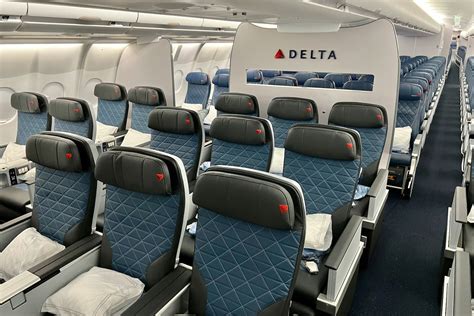
For passengers onboard DL54, the experience quickly became physically and mentally draining. Spending nearly eight hours confined inside a widebody cabin only to land back at the original departure airport created enormous frustration for travelers with business commitments, family plans, and international connections waiting in Nigeria.
Reports suggested confusion spread throughout the cabin as travelers attempted to determine why the aircraft was no longer progressing toward Africa. Some passengers reportedly learned of the diversion only after noticing the flight map display reversing direction.
The disruption extended beyond a single flight. Subsequent Lagos services reportedly faced cancellations and delays, creating ripple effects across Delta’s international schedule. Because long-haul aircraft rotations are tightly interconnected, a single disrupted route can affect multiple future departures across several continents.
For airlines, diversions involving widebody aircraft are extraordinarily expensive. Costs can include fuel dumping procedures, additional crew payments, maintenance inspections, passenger hotel accommodations, meal vouchers, missed connections, and aircraft repositioning challenges. Financial losses from a single long-haul operational disruption can rapidly escalate into hundreds of thousands of dollars.
Delta’s Diversion Joins A Growing List Of “Flights To Nowhere”
Delta’s Atlantic turnaround is not an isolated aviation anomaly. In recent years, several high-profile long-haul flights have similarly spent many hours airborne before returning to their origin airports.
One of the most notable examples occurred in 2023 when an Air New Zealand Boeing 787 flying from Auckland to New York reversed course over the Pacific after an electrical fire temporarily disrupted operations at New York JFK Airport. The aircraft ultimately spent roughly 16 hours in the air before returning to New Zealand.
Lufthansa experienced a similar event when a Boeing 747-400 operating from Frankfurt to Seoul turned back over Kazakhstan after technical complications emerged mid-flight. British Airways has also faced comparable long-haul reversals involving flights returning to London after several hours airborne due to technical concerns.
These incidents highlight the increasingly delicate balance within modern long-haul aviation. Airlines operate highly optimized global networks where even minor technical or operational disruptions can trigger cascading consequences across multiple routes and continents.
For the passengers aboard Delta Flight DL54, however, the broader operational logic likely offered little comfort. After nearly eight hours crossing the Atlantic Ocean, their long-awaited journey to Nigeria ended exactly where it began — back on the ground in Atlanta.