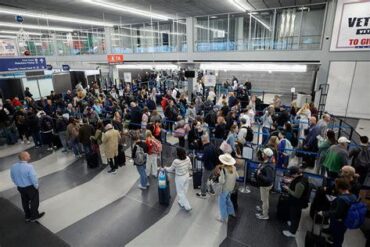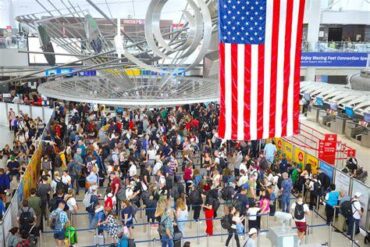
Delta Air Lines expects a $200 million pre-tax loss following the longest federal government shutdown in United States history, a 43-day political stalemate that left critical aviation functions under strain and air travel across the country disrupted. The airline, already navigating a year filled with operational challenges, revealed that the prolonged shutdown created a cascade of capacity constraints, weakened consumer confidence, and triggered thousands of cancellations that eroded revenue throughout its vast network.
The nationwide shortage of air traffic controllers, many of whom were working without pay, forced the Federal Aviation Administration to reduce service levels at major hubs. This bottleneck throttled the number of flights airlines could safely operate. Although U.S. aviation gradually returned to normal just ahead of the Thanksgiving surge, the industry’s vulnerability was exposed in stark terms. Airlines like Delta rely on thin margins, high volume, and stable demand—any disruption becomes sharply magnified.
The shutdown also slowed down booking trends across the U.S. as travelers hesitated to make plans amid uncertainty. Refunds spiked as delays and cancellations mounted. The combination of lost demand, reduced flight schedules, and elevated reimbursements pushed Delta’s projected financial impact into nine-figure territory.
The financial blow arrived at an especially symbolic moment: Delta’s 100th anniversary. Marking a century since its 1925 founding, the carrier had pushed through an already turbulent year of operational hiccups nationwide. Yet the shutdown represented a uniquely damaging disruption. At one point, the FAA ordered airlines to cancel up to 6% of their domestic flights to preserve system safety.
Delta ultimately canceled more than 2,000 flights, a rare volume for the typically resilient airline. CEO Ed Bastian voiced strong frustration, emphasizing that high-stress aviation roles should never be jeopardized by political brinkmanship. His warning underscored a broader industry concern about relying on federal systems that can grind to a halt when budget battles escalate.
Cracks in the Travel Market While Delta Pushes Ahead
Even as Delta calculates its $200 million setback, the airline is buoyed by strong forward-looking booking trends for 2026. Investor confidence reflected this optimism, with shares ticking upward mid-week. The airline’s long-term growth plans remain intact, and its history—from a crop-dusting start-up to a global aviation leader—continues to guide strategic investments in technology, loyalty programs, and premium travel products.
Delta’s 2026 strategy features its largest-ever transatlantic expansion: over 650 weekly flights to nearly 30 European destinations. Corporate travel is rebounding, and international leisure demand remains robust. Premium cabins like Delta One and Delta Premium Select are central to the airline’s profitability push. Delta is also accelerating upgrades to its Delta Sky Clubs and unveiling new Delta One Lounges, cementing a premium-forward approach.
Software Turbulence in the A320 Fleet Adds More Complexity
The shutdown was not the year’s only test. A global issue with Airbus A320 family software surfaced in late November, raising alarms across the aviation sector. Fortunately, Airbus delivered a rapid fix that minimized disruptions for operators, including Delta, which flies nearly 250 A320-series aircraft. Most flights proceeded as scheduled after maintainers implemented the software patch.
Subsequent inspections revealed that a limited number of A320 family jets manufactured in Mobile, Alabama, required checks for potential exterior panel defects. Airbus attributed this to a supplier problem that has since been corrected. Only a small number of aircraft are expected to need repair, ensuring minimal impact on Delta’s already strained operating calendar.
A Tough Year That Reinforces Aviation’s Fragile Dependence on Stability
The airline’s projected $200 million loss demonstrates how acutely the aviation sector feels the effects of federal instability. Air traffic control staffing, regulatory oversight, and airport operations depend heavily on a functioning government. Any prolonged disruption can cascade into operational paralysis, lost revenue, and a shaken travel market.
Delta, however, ends its centennial year with momentum intact and a clear vision for 2026 and beyond. Its strategic focus on international growth, premium offerings, and customer-centric technology positions the airline to move past the shutdown’s financial bruise. In an industry where uncertainty is constant, adaptability remains Delta’s most valuable asset.