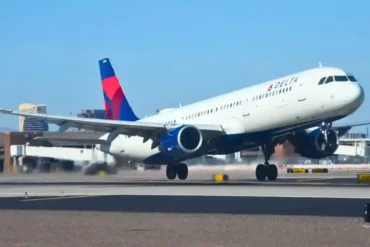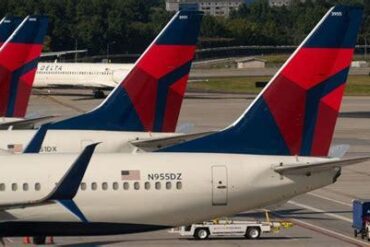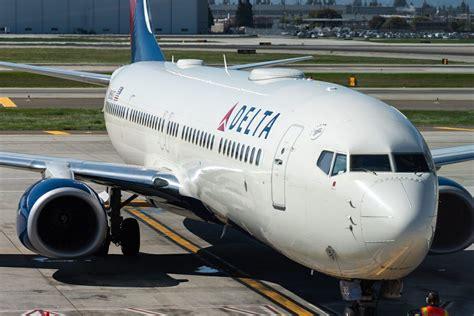
A routine arrival into New Mexico turned into a carefully managed operational disruption when a Delta Air Lines flight was forced to divert due to a sudden runway closure. The incident, involving Flight 1109, underscored how quickly conditions can shift in aviation—and how tightly calibrated airline decision-making becomes when fuel margins narrow during final approach.
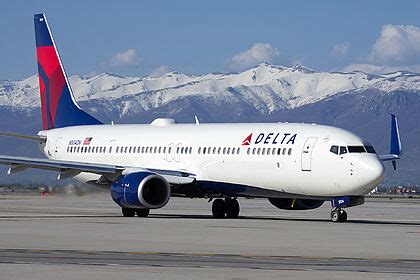
The aircraft, a Boeing 737-900ER, was carrying 178 passengers and six crew members as it approached Albuquerque International Sunport Airport (ABQ) on Friday. What began as a standard descent soon evolved into a scenario requiring swift judgment, coordination, and strict adherence to safety protocols.
Runway Closure Triggers Immediate Go-Around
As Flight 1109 neared touchdown, a mechanical issue involving another aircraft abruptly changed the landing environment. A general aviation plane reportedly lost a wheel during landing or shortly after, rendering Runway 8-26 temporarily unusable while emergency crews moved to secure and clear the area.
Passengers onboard the Delta flight experienced a sudden shift in trajectory as pilots initiated a go-around—a standard but often surprising maneuver in commercial aviation. The aircraft climbed away from the runway and entered a holding pattern while awaiting further instructions.
Despite the relatively short duration of the runway closure—estimated at approximately 15 minutes—the timing proved critical. With multiple aircraft converging within tightly spaced arrival windows, even brief interruptions can trigger cascading operational decisions.
Low Fuel Forces Strategic Diversion Decision
Fuel planning is not merely a logistical exercise—it is a regulatory cornerstone of aviation safety. Every commercial flight carries contingency reserves designed to account for delays, alternate routing, and unexpected events. However, these reserves are finite and must be managed conservatively.
In the case of Flight 1109, the crew initially entered a holding pattern above Albuquerque, buying time as ground crews worked to clear the disabled aircraft. But as minutes passed, the calculation shifted. Continuing to hold risked encroaching on mandated fuel reserves.
The decision was decisive and procedural: divert.
Rather than extend the hold and risk diminishing safety margins, pilots redirected the aircraft to Farmington Four Corners Regional Airport (FMN), located approximately 140 miles northwest. The diversion ensured that fuel levels remained well within regulated limits, prioritizing safety over schedule continuity.
This moment reflects the aviation industry’s layered safeguards in action—where pilots are trained to act early rather than react late.
Safe Landing in Farmington, But Delays Mount
Flight 1109 landed safely in Farmington without further complication. However, the operational simplicity of the diversion contrasted sharply with the logistical complexity that followed.
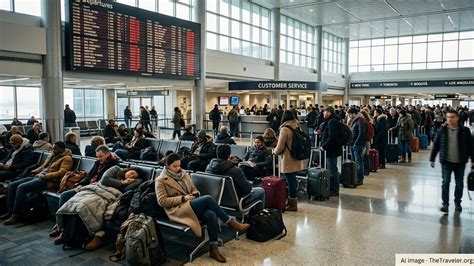
Farmington, while capable of accommodating the aircraft, is not a major commercial hub. Its passenger-handling infrastructure is limited compared to Albuquerque, creating immediate challenges for accommodating nearly 200 travelers.
Passengers remained on the ground for several hours as Delta Air Lines coordinated recovery efforts. Food was distributed, and ground transportation was arranged to move passengers back to Albuquerque—a journey that added several hours to what should have been a routine arrival.
Meanwhile, the aircraft itself later departed Farmington empty, returning to Albuquerque to resume its operational schedule. This repositioning flight allowed Delta to reintegrate the aircraft into its network, minimizing broader disruptions.
The Hidden Impact of a 15-Minute Runway Closure
At first glance, a 15-minute runway closure may appear insignificant. In reality, it represents a critical disruption within an ecosystem built on precision timing.
Airports like Albuquerque operate on tightly sequenced arrival and departure flows. Aircraft are spaced carefully to optimize runway usage while maintaining safe separation. When a runway becomes unavailable—even briefly—the entire sequence can unravel.
Inbound flights must either hold, divert, or delay departure from their origin. Each option carries operational costs and potential passenger impact. In this instance, Flight 1109 became the most visible consequence of a short-lived but strategically significant disruption.
The ripple effects extended beyond a single aircraft, affecting scheduling, ground operations, and passenger logistics across multiple touchpoints.
Why Diversions Like This Are Essential, Not Exceptional
While diversions can feel disruptive from a passenger perspective, they are an integral part of aviation safety design. The decision to divert is never taken lightly—but it is always taken early enough to preserve safety margins.
Modern flight operations are governed by strict fuel reserve requirements, including alternate airport planning and contingency allowances. These regulations ensure that aircraft are never placed in a position where fuel becomes critically low.
In this case, the diversion was not a failure of planning—it was evidence of planning working exactly as intended.
The crew of Flight 1109 followed established procedures, evaluated real-time conditions, and executed a decision that eliminated risk rather than extending uncertainty. It is a quiet demonstration of professionalism that often goes unnoticed outside aviation circles.
A System That Worked—Even If It Disrupted Plans
For passengers, the experience was undoubtedly frustrating. Delays, uncertainty, and unexpected ground transport are never welcome additions to a travel itinerary. Yet beneath the inconvenience lies a reassuring reality: the system worked.
A disabled aircraft was safely managed. A runway was cleared efficiently. A commercial flight diverted before fuel became a concern. Passengers arrived safely, albeit later than planned.
In aviation, success is often measured not by the absence of disruption, but by the effectiveness of response. Flight 1109’s diversion stands as a clear example of safety-first decision-making, where operational discipline overrides schedule pressure—exactly as it should.