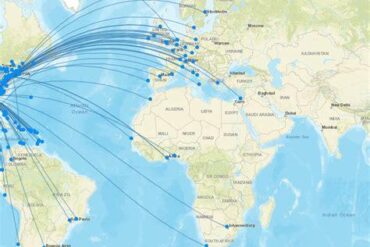
Delta Air Lines is filling long-haul aircraft at levels most global airlines would envy. Between February 2025 and January 2026, the Atlanta-based carrier transported roughly 17 million passengers across its intercontinental network, securing about one in every eight long-haul travelers flying from the United States. More remarkably, several of its flagship routes crossed the 90% load factor threshold, proving that international demand has not only recovered but intensified on strategically targeted markets.
An average long-haul load factor of 84.7% already signals a healthy network, yet Delta’s strongest performers pushed far beyond that benchmark. The airline’s busiest international links reveal a carefully engineered strategy built around constrained capacity, alliance connectivity, premium-heavy scheduling, and selective competition. Some of these routes connect giant hubs, while others succeed because Delta faces virtually no nonstop rivals at all.
The figures also highlight how modern airline profitability is no longer purely about volume. Airlines increasingly prioritize network contribution, premium yields, and connecting traffic flows rather than simply packing aircraft. Still, when flights are operating more than 90% full across an entire year, it sends a powerful message about market strength.
Delta’s top-performing routes demonstrate exactly where transatlantic and long-haul demand is surging most aggressively.
Prague Emerges As Delta’s Most In-Demand Long-Haul Route
The standout winner was Delta’s seasonal New York JFK to Prague service, which achieved a massive 94.1% load factor during the examined 12-month period. Nearly every seat aboard the Boeing 767-300ER operating the route was occupied, with approximately 59,960 passengers carried overall.
The Prague market has quietly become one of Delta’s strongest transatlantic opportunities. Since 2019, Delta has benefited from being the only airline offering nonstop service between the United States and the Czech Republic after American Airlines exited Philadelphia-Prague and United Airlines discontinued Newark-Prague operations. That monopoly environment allowed Delta to dominate premium and leisure traffic flows alike.
The route’s success also reflects changing European tourism patterns. Prague remains one of Europe’s most affordable and visually striking capitals, attracting both American leisure travelers and Central European business traffic. With limited nonstop competition, Delta gained exceptional pricing power while maintaining very high seat occupancy.

However, the competitive landscape is beginning to shift again. American Airlines is preparing to relaunch Philadelphia-Prague service, dramatically increasing available seat capacity between the two countries. Industry data already shows year-over-year capacity growth exceeding 100%, a development that could pressure Delta’s future yields and load factors.
Even so, Prague’s current performance highlights the value of underserved European destinations in Delta’s broader international strategy.
Atlanta Continues To Dominate Delta’s International Network
Atlanta appeared repeatedly throughout Delta’s highest-performing long-haul routes, reinforcing the airport’s role as the airline’s unrivaled global superhub. The massive operation enables Delta to consolidate connecting traffic from across North America before funneling passengers onto international departures.
Atlanta to Lima ranked second overall with a 91.1% load factor and more than 206,000 passengers carried. Closely behind was Atlanta to Honolulu at 90.8%, followed by Atlanta to Madrid at 90.5%.
The Lima route is especially revealing because it showcases Delta’s growing Latin American ambitions alongside partner LATAM Airlines. Nearly 80% of travelers reportedly connected through Atlanta, Lima, or both airports, underlining the importance of alliance-driven traffic flows rather than local demand alone.
Delta previously deployed its largest Airbus A350-900 variants on the route before shifting to smaller Airbus A330 aircraft configured with fewer premium seats. That adjustment reflects the airline’s increasingly precise approach to capacity management. Instead of chasing raw seat growth, Delta is tailoring aircraft configurations to maximize profitability while preserving high occupancy levels.
The Atlanta-Madrid market tells a similar story. Spain continues to experience explosive tourism demand from US travelers, while Madrid has evolved into a critical business and connecting hub for southern Europe. Delta’s daily frequencies and SkyTeam partnerships make the route particularly attractive for corporate travelers originating throughout the southeastern United States.
New York JFK Strengthens Delta’s European Presence
New York JFK remains Delta’s premier gateway for premium transatlantic flying, and several routes from the airport recorded exceptionally strong performance metrics.
Beyond Prague, Delta’s JFK to Madrid service achieved a 90.3% load factor, while JFK to Berlin reached 90.2%. JFK to Lisbon followed closely at 90%.

Berlin’s appearance among Delta’s top-performing routes is notable because the German capital historically struggled to sustain long-haul nonstop service compared with Frankfurt or Munich. Yet demand patterns have changed dramatically over the past decade. Berlin has transformed into a major technology, startup, and cultural destination, generating strong business and leisure traffic from the United States.
Lisbon’s growth reflects another major transatlantic trend. Portugal has become one of Europe’s hottest tourism markets, driven by affordability, favorable climate conditions, and increasing popularity among remote workers and luxury travelers. Delta’s near-constant full flights to Lisbon underline how aggressively US demand toward southern Europe has expanded since the pandemic recovery period.
Madrid, meanwhile, appears twice within Delta’s top five routes, signaling Spain’s extraordinary strength within the airline’s European portfolio.
Amsterdam Remains A Strategic Powerhouse For Delta And KLM
Amsterdam continues to function as one of Delta’s most important European gateways thanks to its deep partnership with KLM. Both Atlanta-Amsterdam and Orlando-Amsterdam posted load factors above 90%.
Atlanta-Amsterdam carried an enormous 487,148 passengers, making it by far the busiest route among Delta’s highest-load long-haul services. The route functions as a critical artery within the Delta-KLM transatlantic joint venture, feeding passengers throughout Europe, Africa, and the Middle East via Schiphol Airport.
Orlando-Amsterdam may appear more surprising because Orlando is neither a Delta hub nor an official focus city. Nevertheless, the route achieved a 90.1% load factor with more than 75,000 passengers.
That success stems from Orlando’s unique blend of tourism demand and international connectivity. European travelers continue flocking to Central Florida’s theme parks and cruise ports, while Delta and KLM efficiently channel connecting passengers beyond Amsterdam into broader European markets.

The route’s performance becomes even more impressive when compared with Delta’s failed Orlando-Heathrow experiment. That London service struggled badly and disappeared quickly, proving that not every major European destination guarantees success. Amsterdam works because of alliance connectivity and carefully aligned network planning.
Delta’s Fullest Long-Haul Flights Reveal Smarter Network Strategy
The broader lesson from Delta’s strongest international routes is not simply that demand is high. It is that Delta has become exceptionally disciplined in where it deploys capacity.
Rather than flooding markets with oversized aircraft and excessive frequencies, the airline increasingly focuses on routes with constrained competition, powerful alliance feed, and strong premium demand characteristics. The result is a network where multiple long-haul services routinely depart more than 90% full.
In an era where global airlines face rising operational costs and unpredictable economic conditions, Delta’s busiest long-haul routes show how strategic precision can matter more than sheer expansion. The carrier is not merely filling seats. It is building a network designed to keep aircraft full while maximizing the long-term value of every international market it serves.