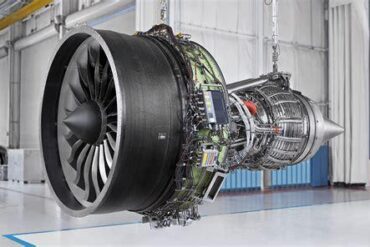
Despite the seemingly straightforward answer, the claim that the Boeing 747-8 and 787 Dreamliner are powered by the “same engine” is both technically true and fundamentally misleading. While both aircraft indeed draw power from the GEnx (General Electric Next-Generation) engine family, the engines they use—GEnx-1B and GEnx-2B67—are highly specialized variants, meticulously engineered to serve distinct aircraft architectures. Understanding how and why these engines differ requires diving into the technological evolution of each airframe, their operational needs, and how GE Aviation customized its powerplants to match them.
The Shared Bloodline: GEnx Engine Family
The GEnx engine family represents a landmark in propulsion innovation. Built upon the success of the GE90 and inspired by the demands of 21st-century aviation, the GEnx engines offer exceptional fuel efficiency, reduced emissions, and quieter operations. Both the GEnx-1B (used on the Boeing 787) and the GEnx-2B67 (exclusively for the Boeing 747-8) share a common high-pressure core and up to 80% of their Line Replaceable Units (LRUs). However, their architectural divergence begins from there.
GEnx-1B: The Electrified Heart of the 787 Dreamliner
The GEnx-1B is a purpose-built powerhouse designed for a twin-engine, long-range aircraft. The 787 Dreamliner, being a clean-sheet design, implements a “bleedless” electrical architecture, meaning most traditional pneumatic systems are replaced by electric counterparts. This allowed the GEnx-1B to drop bleed air extraction ports, reducing complexity, boosting efficiency, and supporting the aircraft’s “more-electric” philosophy.
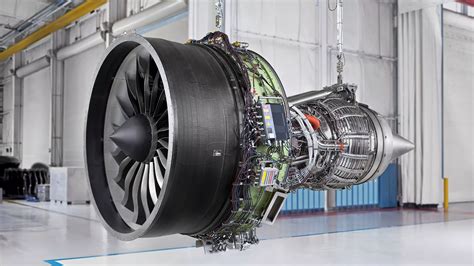
This engine is capable of 69,800 to 80,400 lbf of thrust, which is essential for a twin-engine jet that must maintain safe operation even after the loss of one engine during critical phases like takeoff. Its fan diameter of 111.1 inches and bypass ratio up to 9.6:1 enhance propulsion efficiency, resulting in a 15% fuel savings over older CF6 engines.
GEnx-2B67: Tailored Power for the 747-8
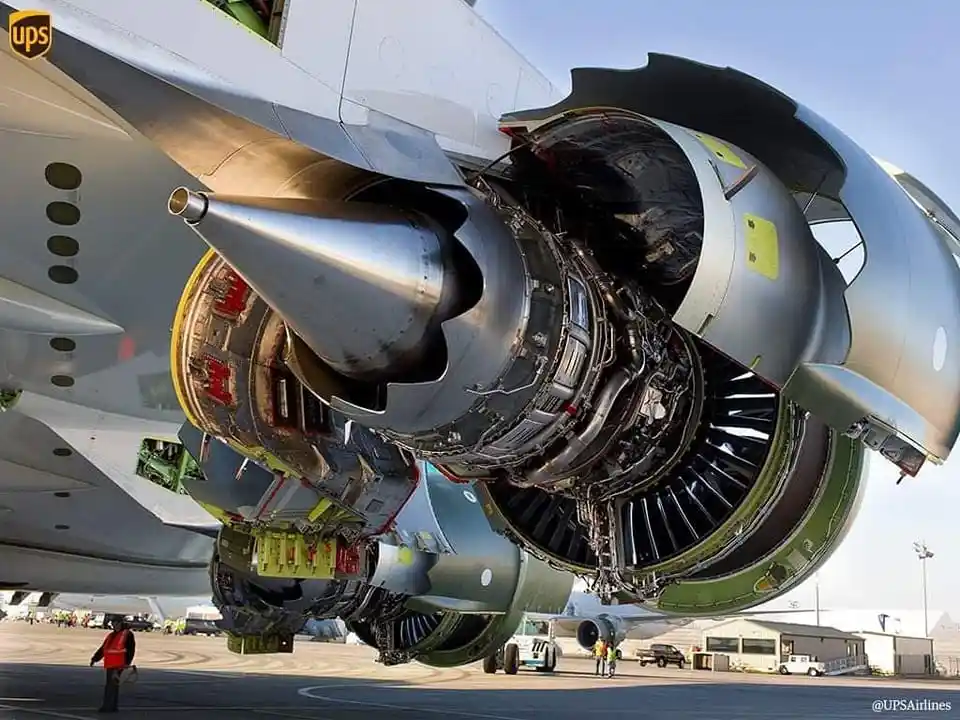
While part of the same GEnx family, the GEnx-2B67 is an adaptation of the 1B, optimized specifically for the four-engine Boeing 747-8. Given that the 747-8 uses traditional bleed air systems to power its environmental controls and engine starts, the 2B engine includes bleed air ports. This mechanical requirement immediately sets it apart from the 1B.
Additionally, to suit the 747’s larger wingspan and closer-to-ground engine mounting, the GEnx-2B features a smaller fan diameter of 104.7 inches, fewer booster and turbine stages, and delivers 66,500 lbf of thrust per engine. The aircraft’s four-engine layout distributes power needs across more units, so individual engines can be optimized for lighter internal architecture and lower individual thrust output, reducing engine weight and cost.
Engineering Differences: More Than Just Numbers
Though the two engines are siblings, their internal designs and system interfaces mark significant divergence:
- The GEnx-1B has four low-pressure compressor stages and seven turbine stages.
- The GEnx-2B67 is “de-staged” with three compressor stages and six turbine stages.
These design choices optimize the -2B for use on a quad-jet like the 747, which has different airflow and thermal characteristics compared to a twin-jet like the 787.
Noise Reduction and Aesthetic Touchpoints
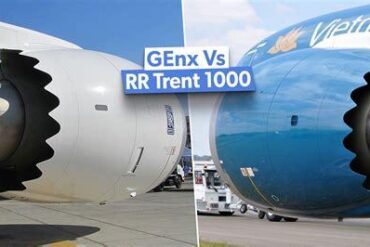
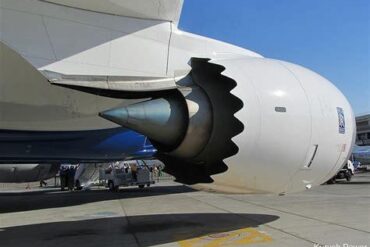
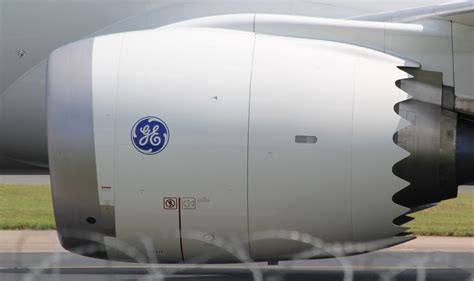
A hallmark of both engines is the serrated chevron design on their nacelles. These notched edges blend hot jet exhaust with surrounding cooler air more smoothly, significantly reducing engine noise, especially during takeoff and landing. This not only contributes to regulatory compliance but also aligns with Boeing’s goal of offering a superior passenger experience.
Operational and Maintenance Synergies
For airlines operating both aircraft types, the shared GEnx engine family provides a crucial logistical and financial advantage:
- Commonality in parts reduces inventory costs.
- Unified training for technicians boosts maintenance efficiency.
- Streamlined servicing and diagnostics reduce aircraft downtime.
These benefits were a strategic consideration when Boeing selected the GEnx family for both aircraft, despite their differing requirements.
Performance Metrics and Fuel Economy
Fuel economy is the key battleground in long-haul aviation. The 787 Dreamliner delivers an extraordinary efficiency advantage over the 747-8:
- The 747-8 consumes around 3,800 gallons of fuel per hour.
- The 787 burns closer to 2,900 gallons per hour.
In terms of passenger-specific metrics:
- The 747-8 averages 2.82 liters per 100 km per passenger.
- The 787-9 improves upon this with just 2.31 liters per 100 km per passenger.
Lower Cost per Available Seat Mile (CASM) and better environmental performance make the 787 the aircraft of choice for point-to-point international routes, whereas the 747-8 remains viable mainly for high-density, hub-to-hub connections.
Design Legacy and Material Evolution
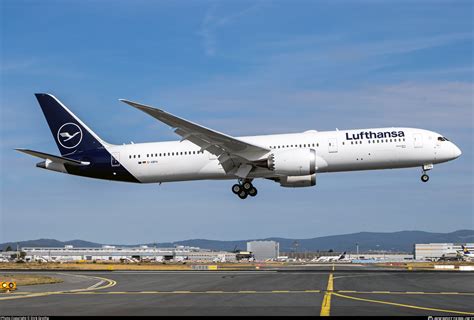
The 787 Dreamliner represents a paradigm shift in aircraft materials, boasting a structure that is 50% carbon composite by weight and 80% by volume. This construction method delivers:
- Lower airframe weight
- Higher resistance to fatigue and corrosion
- Enhanced passenger comfort with higher cabin humidity and lower cabin pressure altitudes
The 747-8, by contrast, is an evolutionary improvement on the traditional aluminum 747 airframe. While it adopted cutting-edge engines and avionics, it retains many legacy design elements—a factor that limited its long-term competitiveness.
The Airline Perspective: Fleet Strategy
Major global carriers have rapidly shifted away from four-engine aircraft. The retirement of the 747-400 fleet and limited uptake of the 747-8 passenger version reflect the industry’s cost-sensitive strategy. Airlines like British Airways and Lufthansa have replaced older 747s with 787-9 and 787-10 variants, allowing them to:
- Match transatlantic range needs
- Achieve better fuel economy and route flexibility
- Consolidate pilot training and fleet logistics
The 787’s design supports long-haul routes without the need for hub-based transfers, making it a pillar of the point-to-point revolution in commercial aviation.

The Passenger Experience: 747 Legacy vs 787 Innovation
The 747-8 remains iconic, renowned for its smooth landings, cockpit elegance, and regal presence. It holds a beloved status among aviation enthusiasts as the “Queen of the Skies.” Yet from a passenger comfort and systems perspective, the 787 outpaces it in nearly every domain:
- Cabin pressure: 6,000 ft on 787 vs. 8,000 ft on 747
- Humidity levels: 15% on 787, double that of older jets
- Noise and vibration: The 787 uses “smooth ride” technology to dampen turbulence
- Windows: Larger and electronically dimmable on the 787
These features contribute to less fatigue, improved rest, and a tangible difference in how passengers feel during and after long-haul flights.
A Technological Transition
The adoption of the GEnx engine family in both jets illustrates GE’s ability to modularize a core technology for a variety of aircraft requirements. However, the distinctive demands of the 747-8 and 787 meant that no single engine design could be universally applied without substantial modification.
- The GEnx-1B represents the cutting edge of bleedless, electric-integrated propulsion.
- The GEnx-2B67 is a more traditional, yet modernized engine that breathes life into an aircraft born of an earlier generation.
This transition also signifies a broader movement within aviation away from complex, heavy four-engine aircraft and towards efficient, twin-engine long-haul platforms capable of intercontinental flight under ETOPS certification.
Conclusion: Shared DNA, Divergent Futures
To answer the question directly: Yes, the Boeing 747-8 and 787 Dreamliner are powered by engines from the same GEnx family. But no, they do not use the same engine variant in function, design, or operation. Each is a bespoke piece of engineering, sculpted around the airframe it powers.
As aviation continues to evolve under the pressures of climate concerns, cost reductions, and passenger expectations, the 787 Dreamliner has emerged as the aircraft best poised for this future. Meanwhile, the 747-8, though a technological marvel and a historic icon, has become the swan song of the four-engine era.
The GEnx engines symbolize not just power and performance, but the philosophical shift in how the aerospace industry approaches propulsion, efficiency, and long-haul travel. Their story reflects the ongoing transformation of the skies.