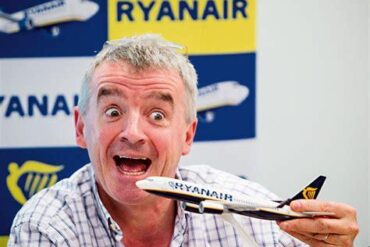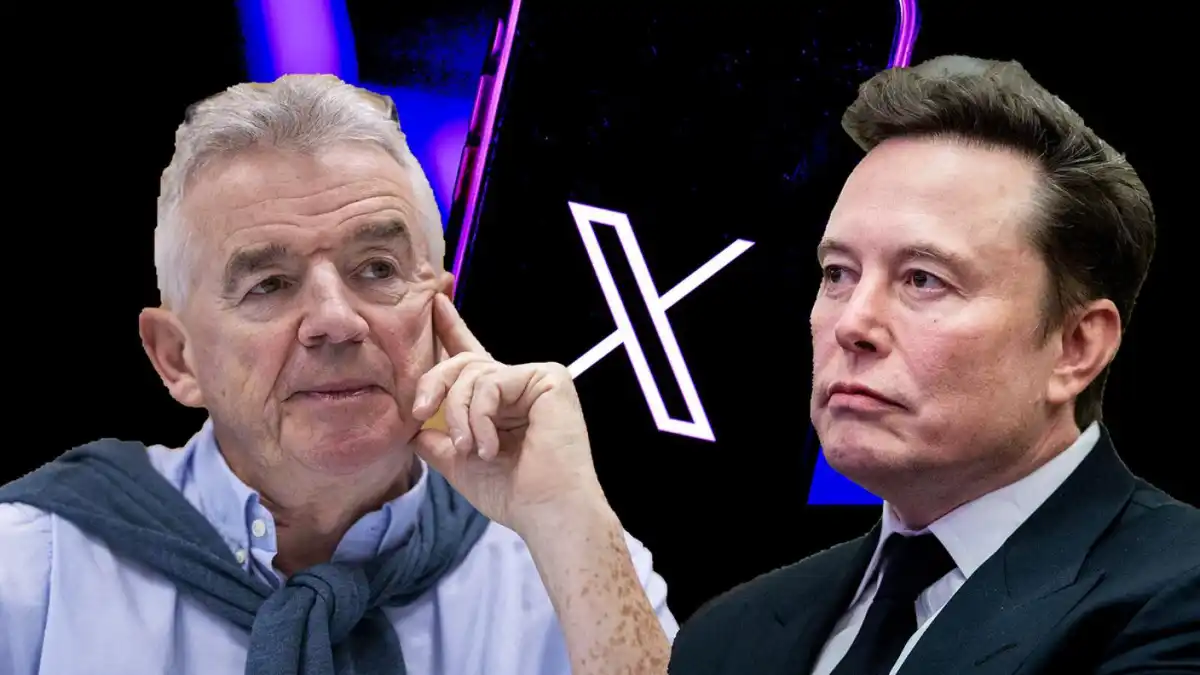
The aviation and tech worlds collided spectacularly when Elon Musk and Ryanair CEO Michael O’Leary descended into a public war of words following the airline’s rejection of Starlink in-flight Wi-Fi. What began as a technical disagreement over fuel efficiency rapidly escalated into personal insults, social media jabs, and a viral spectacle that exposed the widening cultural divide between Silicon Valley ambition and ultra-low-cost airline pragmatism.
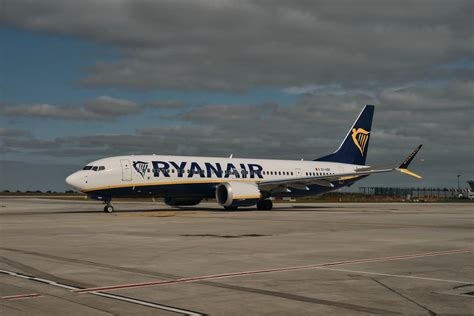
At the heart of the dispute is Ryanair’s decision not to equip its fleet with Starlink, SpaceX’s satellite internet service designed for aircraft. O’Leary dismissed the system as economically unworkable, claiming its hardware would impose unacceptable weight and drag penalties. Musk, never one to retreat from a public challenge, responded by disputing the figures and questioning the airline’s leadership judgment in blunt terms.
The clash quickly transcended engineering debates and entered the realm of personality politics. O’Leary, speaking during a radio interview, brushed off Musk’s criticism and labeled him “very wealthy, but still an idiot.” Musk retaliated on X by calling the Ryanair chief an “utter idiot,” adding that O’Leary should be fired and joking that he might buy the airline himself just to replace him. The feud became instant headline material, fueled by both men’s reputations for provocation.
Starlink, Ryanair, and the Numbers Behind the Noise
Ryanair’s objection centered on fuel economics, a non-negotiable pillar of its business model. O’Leary claimed Starlink would cause a two percent fuel penalty, translating into roughly $250 million annually and an added cost per passenger that undermines the airline’s famously thin margins. For an ultra-low-cost carrier that treats every kilogram as a liability, even marginal increases carry strategic weight.
Starlink engineers countered aggressively. Michael Nicolls, Starlink’s Vice President of Engineering, stated that internal testing showed a 0.3 percent fuel penalty on a Boeing 737-800, a fraction of Ryanair’s estimate. According to SpaceX, O’Leary’s figures reflect older, bulkier satellite systems rather than Starlink’s newer, ultra-thin antenna design engineered specifically to minimize aerodynamic drag.
Engineering Reality Versus Airline Economics
Installing Starlink requires external antennas and radomes, inevitably adding mass and altering airflow. Yet Starlink argues its hardware is significantly lighter and thinner than legacy systems, giving it a performance edge. Several airlines have publicly praised Starlink’s design, citing smoother integration and superior operational efficiency compared to traditional in-flight connectivity equipment.
Beyond fuel, performance is Starlink’s strongest card. Independent research, including a 2025 Cornell University study, found Starlink delivered download speeds exceeding 200 Mbps, with stability sufficient for streaming and video conferencing. For passengers accustomed to ground-level broadband, the experience feels transformational, redefining expectations of airborne connectivity.
Will Passengers Pay, or Walk Away?
O’Leary’s skepticism extends beyond hardware into consumer behavior. Ryanair’s CEO insists passengers will not pay even one euro for onboard Wi-Fi, especially on short-haul routes. While travelers happily use free connectivity, Ryanair’s data suggests paywalled internet remains largely ignored, making it a poor candidate for ancillary revenue generation.
Musk counters implicitly by pointing to competitive pressure. As more airlines offer free, high-speed Wi-Fi as a standard amenity, refusing to match that experience risks brand erosion. In a market where customer loyalty is increasingly shaped by digital convenience, connectivity is no longer a luxury but an expectation.
The Industry’s Direction Is Clear
Ryanair’s stance contrasts sharply with broader industry momentum. Lufthansa recently announced plans to roll out Starlink across its 850-aircraft fleet, while carriers such as Qatar Airways, United Airlines, Alaska Airlines, and airBaltic have already committed. More than 30 airlines worldwide now view Starlink as a strategic upgrade rather than a cost burden.
This divergence underscores a philosophical split. Ryanair optimizes relentlessly for price leadership, even if that means sacrificing premium features. Starlink’s growing airline clientele, however, appears willing to absorb marginal costs in exchange for differentiation and long-term passenger satisfaction.
A Feud That Reflects Bigger Tensions
The Musk–O’Leary exchange resonated because it encapsulates modern corporate conflict: data versus instinct, innovation versus austerity, and ego amplified by social media. Ryanair’s official account even mocked Musk during an X outage, prompting Musk to joke about installing a CEO named Ryan if he ever bought the airline.
Beyond the insults, the episode highlights how technology adoption in aviation is no longer purely technical. It is cultural, financial, and deeply personal at the executive level. Whether Ryanair eventually revisits Starlink remains uncertain, but the confrontation has already secured its place as one of aviation’s most revealing corporate spats of the decade.