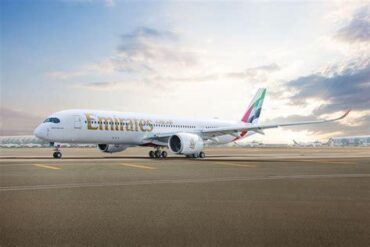
As global aviation continues pushing the boundaries of range and connectivity, Emirates remains at the forefront of ultra-long-haul travel. With one of the world’s largest fleets of widebody aircraft and a strategic hub at Dubai International Airport, the airline has built a network capable of linking distant continents through journeys that can exceed 22 hours from departure gate to arrival gate.
In 2026, Emirates will once again operate some of the longest passenger services on Earth. These flights are not necessarily the longest in pure airborne time, but they represent the carrier’s most time-intensive scheduled services when total block time—including taxiing, operational buffers, and stopovers—is measured. The result is a collection of remarkable routes connecting the Middle East with North America, South America, Oceania, and beyond.
Emirates Continues Dominating Long-Haul Aviation
Emirates occupies a unique position within the airline industry. Unlike many global carriers, it operates without a domestic network, relying almost entirely on international traffic flowing through Dubai. This model has transformed Dubai into one of the world’s most important aviation hubs and allowed Emirates to develop an unmatched long-haul network spanning six continents.
The airline’s fleet of more than 260 widebody aircraft, including the Airbus A380 and Boeing 777 family, enables high-capacity operations across exceptionally long distances. Combined with multiple daily departures and large aircraft configurations, Emirates remains one of the most influential long-haul operators in global aviation.
Its 2026 schedule demonstrates how the airline continues leveraging both nonstop and fifth-freedom routes to maximize network reach while serving markets that would otherwise be difficult to connect efficiently.
Dubai to Bogotá via Miami: Emirates’ Longest Passenger Service
The crown for Emirates’ longest scheduled passenger service belongs to the route linking Dubai (DXB) and Bogotá (BOG) via Miami (MIA). The complete journey is scheduled at up to 22 hours and 35 minutes, making it the airline’s longest operation by block time.
The service highlights Emirates’ ability to connect the Middle East directly with northern South America while also taking advantage of fifth-freedom rights between Miami and Bogotá. These traffic rights allow Emirates to sell tickets solely between the United States and Colombia, improving route economics and boosting passenger loads.
Passengers departing Dubai in the early hours of the morning arrive in Miami later the same day before continuing southward to Bogotá. The return trip follows a similar pattern, creating one of the most extensive scheduled journeys in commercial aviation.
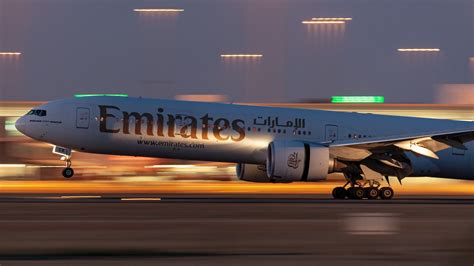
The route has become increasingly important for travelers connecting between South America, the Middle East, Asia, and Africa through Dubai. Following operational adjustments earlier in the year, daily frequencies are expected to continue, supported by Boeing 777 aircraft configured for long-range missions.
Mexico City via Barcelona Ranks Second
The second-longest Emirates service connects Dubai with Mexico City through Barcelona, reaching a maximum scheduled block time of approximately 22 hours and 15 minutes.
Since its launch, this route has served as a strategic bridge between the Gulf region and Latin America. The stop in Spain is necessary because of Mexico City’s high elevation and operational performance considerations. Emirates also benefits from fifth-freedom traffic rights between Barcelona and Mexico City, allowing the airline to compete directly within a highly valuable transatlantic market.
The route has become one of the most distinctive examples of how Emirates combines geography, aircraft performance, and commercial opportunities to expand its global reach.
South America and Oceania Feature Prominently
Third place belongs to the journey between Dubai and Buenos Aires via Rio de Janeiro, scheduled at up to 20 hours and 10 minutes. This route continues to provide a critical link between the Gulf region and Argentina while maintaining valuable traffic rights on the Brazil-Argentina sector.
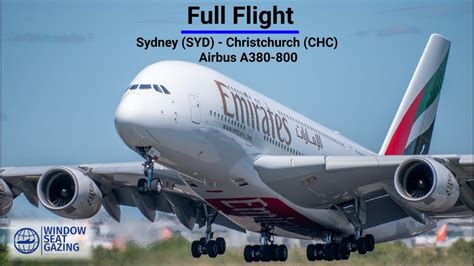
Close behind is the service connecting Christchurch and Dubai via Sydney, which reaches nearly 19 hours and 55 minutes. Operated by the Airbus A380, the flight demonstrates Emirates’ longstanding commitment to New Zealand despite intense competition across long-haul markets.
These routes showcase how stopovers can extend total travel time while simultaneously opening additional revenue opportunities through intermediate destinations.
New York via Milan Remains a Strategic Fifth-Freedom Operation
One of Emirates’ most famous routes continues to be the service linking Dubai and New York JFK via Milan Malpensa. Scheduled at up to 18 hours and 50 minutes, the route remains among the airline’s most recognizable fifth-freedom operations.
The service not only connects Dubai with New York but also serves passengers traveling solely between Italy and the United States. Operated by the Airbus A380, it combines premium demand, strong tourism traffic, and significant business travel volumes.
The route has become a symbol of Emirates’ strategy of extending its influence beyond traditional hub-and-spoke operations while strengthening its presence in important transatlantic markets.
Athens, Newark, and the Return of Ultra-Long Connectivity
The sixth-longest Emirates passenger service is the journey between Dubai and Newark via Athens, scheduled at approximately 18 hours and 40 minutes. Like the Milan-New York route, this operation benefits from fifth-freedom rights and provides travelers with additional options across the Atlantic.
The service remains particularly attractive because of its convenient overnight departure from the United States and seamless onward connections through Dubai to destinations throughout Asia, Africa, and the Indian Ocean.
Auckland Leads Emirates’ Nonstop Operations
Among purely nonstop routes, Auckland to Dubai stands out as Emirates’ longest direct flight. Scheduled at up to 17 hours and 25 minutes, it remains one of the world’s most demanding regularly operated passenger services.
The route exemplifies the capabilities of the Airbus A380 and highlights Emirates’ commitment to maintaining direct links between the Gulf region and the South Pacific. Covering vast stretches of ocean and multiple time zones, the flight offers passengers one of the most extraordinary nonstop travel experiences available.
While Emirates once operated several A380 services to Auckland through Australian gateways, the nonstop service remains the flagship connection between New Zealand and Dubai.
Los Angeles, Houston, and San Francisco Complete the Top Ten
Rounding out Emirates’ ten longest routes are three major U.S. destinations: Los Angeles, Houston, and San Francisco. These services typically range between 16 hours and 17 hours in scheduled block time and are operated by high-capacity Airbus A380 aircraft.
These routes reflect the enduring importance of the United States within Emirates’ global network. Despite increasing competition from nonstop services operated by other international airlines, Dubai remains a powerful connecting hub for travelers heading to destinations throughout Asia, Africa, and the Middle East.
As airlines continue extending aircraft capabilities and exploring new long-distance opportunities, Emirates’ 2026 network demonstrates that ultra-long-haul flying remains a cornerstone of global aviation. From Bogotá and Mexico City to Auckland and Los Angeles, the carrier continues redefining what is possible in modern air travel, connecting distant regions through some of the longest scheduled passenger journeys ever operated.