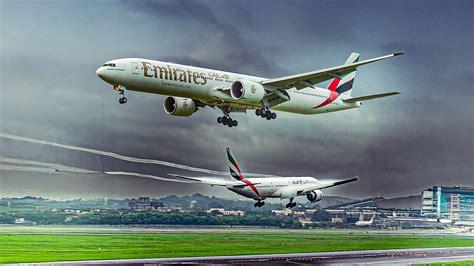
Emirates has always treated distance as a strategic instrument rather than a marketing stunt. In 2026, that philosophy is on full display across the airline’s longest nonstop Boeing 777 routes, where geography, aircraft performance, cargo economics, and passenger demand collide at the outer limits of modern long-haul flying. These routes are not accidental. They are carefully engineered outcomes of fleet planning, wind modeling, crew logistics, and an unwavering belief in Dubai’s role as a global connector.
At the heart of this strategy sits the Boeing 777, an aircraft that quietly does the hard work while the Airbus A380 steals the spotlight. The 777’s mission profile is more demanding, more flexible, and in many ways more revealing of how Emirates actually makes its network work. When a city pair stretches beyond 7,000 miles, every ton of fuel, every knot of headwind, and every kilogram of cargo matters. The 777 is the aircraft Emirates trusts when margins are thin but opportunity is vast.
These longest nonstop routes also tell a deeper story about how Emirates balances premium demand, visiting friends and relatives traffic, and high-yield cargo flows. They are long not just in distance, but in operational complexity. Some are year-round staples, others are seasonally adjusted, and a few exist because no other aircraft in the fleet can quite do the job as efficiently. Together, they form a map of Emirates’ ambition at the edges of the world.
By examining these routes through distance, block time, aircraft variant selection, and network role, a clearer picture emerges. The Boeing 777 is not simply flying far. It is holding together one of the most ambitious hub-and-spoke systems ever built.
The Boeing 777 As Emirates’ Long-Haul Workhorse
Few airlines have leaned into the Boeing 777 as deeply as Emirates. With a fleet dominated by the 777-300ER and reinforced by a smaller but critical group of 777-200LR aircraft, Emirates uses the type as the structural backbone of its long-haul operation. In 2026, this fleet composition allows the airline to stretch nonstop reach across continents while still protecting cargo payload and cabin density.
The 777-300ER does most of the heavy lifting. Its combination of long range, high seat count, and generous belly cargo capacity makes it ideal for routes where Emirates needs both volume and flexibility. These aircraft appear on some of the airline’s longest sectors not because they are extreme-range specialists, but because their overall economics remain compelling even at the edge of their performance envelope.
The 777-200LR plays a more surgical role. Designed specifically for ultra-long-range missions, it provides additional fuel capacity and stronger performance margins in challenging wind conditions. On certain routes, particularly those heading westbound into persistent headwinds, the -200LR becomes the difference between a profitable nonstop and an operational headache.
Cabin consistency is an evolving story. Emirates’ large-scale refurbishment program means passengers can encounter markedly different onboard products depending on the aircraft assigned. Refitted 777s introduce a four-cabin layout, bringing Premium Economy into the equation and reshaping how these ultra-long routes are monetized. On flights lasting 15 hours or more, that cabin mix matters enormously.
Ultra-Long-Haul Economics From Dubai
Dubai’s geographic position is both a gift and a constraint. While it enables one-stop connectivity between much of the world, the longest nonstop routes push beyond the comfortable midpoint of global aviation. Emirates accepts this challenge because nonstop service carries strategic weight that goes far beyond raw distance.
Ultra-long-haul flights demand careful planning around fuel burn and winds. Seasonal jet streams can add significant block time westbound, turning a nominal 16-hour sector into something closer to 17 or 18 hours. That affects crew duty limits, rest planning, and diversion strategy. Emirates mitigates these risks with conservative fuel planning and aircraft selection that preserves payload even on bad wind days.
Cargo plays an outsized role. On many of these longest routes, belly cargo revenue is not optional; it is foundational. High-value goods, pharmaceuticals, and time-sensitive shipments help offset the elevated operating costs of ultra-long-haul flying. This is where the Boeing 777’s cargo capacity becomes a decisive advantage over smaller long-range aircraft.
These routes also feed Dubai’s connection banks with precision. Arrival times are designed to maximize onward connectivity across Asia, Africa, and Europe. Even at extreme distances, the flights are not isolated point-to-point services. They are carefully woven into a broader network tapestry.
Dallas–Fort Worth: Emirates’ Longest 777 Route In 2026
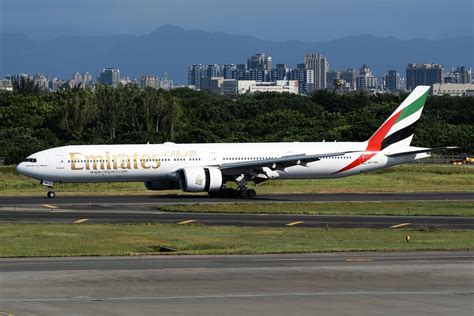
The crown jewel of Emirates’ Boeing 777 network in 2026 is the Dubai–Dallas/Fort Worth route. At approximately 8,038 miles, it stands as the airline’s longest scheduled nonstop service operated by the 777. This route is a daily operation, and its sheer scale reveals how confident Emirates is in both the aircraft and the market.
Dallas/Fort Worth is not just a large metropolitan area. It is a powerful business hub with deep energy, technology, and manufacturing ties to the Middle East and South Asia. Premium demand supports the forward cabins, while cargo flows remain consistently strong in both directions.
Operationally, this route tests every aspect of long-haul planning. Westbound flights into North America face stubborn headwinds, making block times highly variable. Emirates relies on the 777’s robust performance and careful fuel planning to maintain reliability without sacrificing payload. That balance is the reason the route remains viable year-round.
Miami And Orlando: Florida’s Long-Haul Twin Anchors
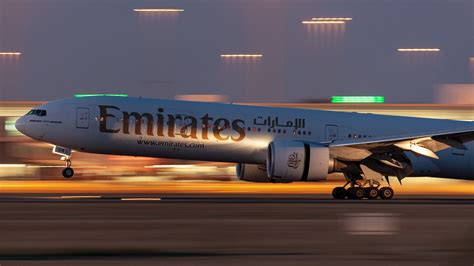
Florida plays an unusually prominent role in Emirates’ longest 777 routes. Miami–Dubai, at roughly 7,833 miles, operates daily and blends business travel, tourism, and strong cargo demand. Miami’s role as a gateway to Latin America adds a layer of connecting traffic that further strengthens the route’s economics.
Orlando–Dubai, at around 7,754 miles, tells a slightly different story. While premium demand is thinner than in Miami, the route benefits from heavy leisure traffic and steady cargo volumes. Fewer annual rotations reflect seasonal demand patterns, but each flight carries significant seat and cargo capacity.
These Florida routes underline Emirates’ willingness to serve non-traditional long-haul markets when the overall network logic makes sense. They also highlight how the Boeing 777 enables flexibility in markets that would struggle to support larger aircraft like the Airbus A380.
Australia And The Pacific: Long Distance, High Discipline
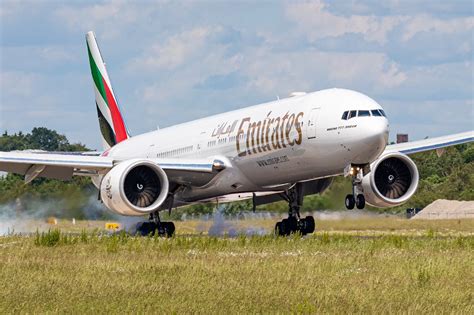
Australia remains one of the most demanding theaters for long-haul aviation, and Emirates’ Brisbane–Dubai service, stretching approximately 7,442 miles, exemplifies that challenge. The route operates at the edge of practical range while maintaining strong cargo loads, particularly on the return leg.
Further north, Seattle–Dubai emerges as a technically fascinating operation at about 7,425 miles. This route is split between the 777-300ER and the 777-200LR, a rare example of mixed-variant deployment on a single ultra-long-haul sector. Seasonal winds and payload sensitivity dictate which aircraft is optimal at different times of the year.
These Pacific-facing routes demand extreme discipline in fuel planning and crew management. Emirates uses them to fine-tune sleep cycles onboard, aligning rest periods with arrival times that maximize connection efficiency in Dubai.
South America And North America: Strategic Reach Over Sheer Distance
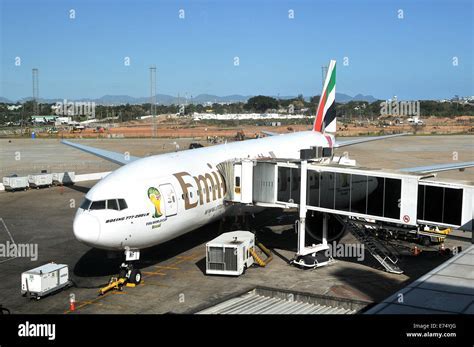
Routes like Dubai–Rio de Janeiro, spanning roughly 7,383 miles, demonstrate that Emirates’ longest 777 flights are not just about distance records. Rio offers strong VFR traffic, tourism demand, and valuable cargo flows, making it a logical anchor in South America despite the route’s length.
In North America, Chicago O’Hare and Boston Logan fall slightly shorter in distance but remain firmly within the airline’s ultra-long-haul category. These cities deliver consistent premium demand and act as major cargo gateways, reinforcing the Boeing 777’s role as a versatile long-haul platform.
Montreal Trudeau adds another layer of diversity, connecting the Middle East with Eastern Canada through a route that balances seasonal demand swings with year-round strategic value.
Distance Versus Volume: What The Longest Routes Really Reveal
A key insight from analyzing Emirates’ longest Boeing 777 routes is that distance alone does not define importance. Some shorter routes generate far more available seat miles simply through frequency. High-volume services to cities like Manila or Cape Town illustrate how Emirates prioritizes throughput and network density over raw mileage.
Ultra-long-haul routes, by contrast, are precision tools. They open markets that would otherwise require inconvenient connections and reinforce Dubai’s status as a truly global hub. Their value lies as much in what they enable elsewhere in the network as in their standalone performance.
The Boeing 777 makes this possible by offering a rare blend of range, capacity, and operational resilience. It can be upgauged, downgauged, or substituted more easily than the Airbus A380, giving Emirates a critical buffer against demand volatility and operational disruptions.
Fleet Evolution And The Road Beyond 2026
Looking ahead, Emirates’ investment in its Boeing 777 fleet shows no signs of slowing. A multi-billion-dollar refurbishment program is extending the life of existing aircraft while aligning cabin products with modern expectations. Each refurbished 777 strengthens the airline’s ability to monetize long-haul routes more effectively.
The impending arrival of the Boeing 777X family will eventually reshape this landscape. With greater range, improved fuel efficiency, and enhanced passenger comfort, the 777X promises to push nonstop possibilities even further. Until then, the current generation of 777s remains the quiet engine behind Emirates’ longest and most demanding routes.
Why The Boeing 777 Still Defines Emirates’ Reach
The Boeing 777 may not carry the spectacle of onboard showers or the visual drama of double-deck cabins, but it carries something arguably more important: network credibility. On the longest nonstop routes in 2026, it proves that Emirates can connect almost any two points on the globe with consistency and scale.
These routes are not vanity projects. They are carefully calibrated expressions of fleet strategy, market understanding, and operational mastery. Without the Boeing 777, Emirates’ global footprint would shrink dramatically, and its hub model would lose much of its power.
In the end, the longest nonstop Boeing 777 routes are not about how far the aircraft can fly. They are about how intelligently Emirates chooses to fly them, turning extreme distance into sustainable advantage.