For more than five decades, the idea of routinely flying a passenger aircraft faster than the speed of sound over the United States has been effectively grounded by regulation. That could finally change. The Federal Aviation Administration (FAA) is proposing to replace the country’s long-standing speed-based prohibition on civil supersonic flight over land with a performance-based noise standard, potentially opening American skies to a new generation of faster-than-sound airliners.
The change is significant because the existing rule does not care how quiet a supersonic aircraft might be. Under 14 CFR 91.817, civil aircraft generally cannot exceed Mach 1 over US land unless they receive specific authorization from the FAA Administrator. The regulation was created when sonic booms were associated with disruptive military testing, rattling windows and alarming communities. More than half a century later, aircraft designers are trying to solve precisely that problem with new aerodynamic concepts, advanced propulsion technology, and carefully controlled flight profiles.
The FAA’s proposal, published on July 2, 2026, would establish a maximum ground-level sonic boom overpressure of 0.11 pounds per square foot for permitted supersonic operations. That represents a fundamental change in philosophy. Instead of asking whether an airplane is flying faster than sound, regulators would ask what effect that flight actually has on people and property below. If finalized, the approach could give commercial manufacturers a realistic regulatory pathway to operate supersonically across parts of the continental United States.
Why the FAA Banned Supersonic Flight Over US Land
The roots of the restriction stretch back to the 1960s, when the FAA and US Air Force conducted Operation Bongo II, a six-month experiment over Oklahoma City. Beginning in February 1964, military aircraft flew supersonically over the city as many as eight times a day to determine how the public would react to repeated sonic booms.
The results were politically damaging. The test generated 1,253 recorded sonic booms, while the FAA received more than 15,000 formal complaints. Residents reported rattling windows, cracked plaster and other disturbances. Nearly 10,000 complaints involved alleged property damage, and formal claims eventually totaled $12,845. Although the FAA rejected the overwhelming majority of those claims, the controversy demonstrated how quickly public opposition could become a major obstacle to supersonic aviation.
The political consequences extended beyond the immediate experiment. Public resistance contributed to the cancellation of federal funding for the Boeing 2707 supersonic transport program in 1971, effectively ending America’s attempt to develop a domestic competitor to Concorde. Two years later, the FAA formalized the land-based prohibition under 14 CFR 91.817.
The rule was straightforward because the technology of the era was straightforward: if a civil aircraft exceeded Mach 1 over US land, it was prohibited. There was no need to calculate whether a particular aircraft generated a relatively mild sonic signature or whether its flight path could keep the pressure wave away from populated areas. Mach 1 itself became the regulatory dividing line.
Concorde Was Limited by America’s Supersonic Rules
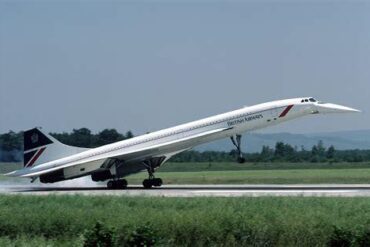
The consequences were particularly visible with Concorde, the aircraft that became the world’s most famous commercial supersonic airliner. British Airways and Air France could fly the aircraft at supersonic speeds across the Atlantic, but they could not simply continue flying at Mach 2 after crossing the American coastline.
Instead, Concorde operated at subsonic speeds over US land before accelerating once it reached the Atlantic. The restriction affected flights serving destinations including New York John F. Kennedy International Airport and Washington Dulles International Airport, adding operational complexity and reducing some of the potential time savings that made Concorde attractive.
The limitation also prevented something that would have been commercially fascinating: a truly supersonic domestic US service. A theoretical New York-to-Los Angeles flight at approximately Mach 2 could have covered the distance in roughly two and a half hours under suitable conditions. Yet such a service would have sent conventional sonic booms across thousands of miles of populated and rural territory, making it impossible under the existing framework.
For 53 years, that basic regulatory reality remained unchanged even as conventional aviation evolved dramatically.
The FAA’s New 0.11 lb Per Square Foot Noise Standard
The proposed rule changes the central question from speed to environmental performance. Rather than automatically banning a civil aircraft because it crosses Mach 1, the FAA would allow supersonic flight over land when the resulting sonic boom at the ground remains below the proposed 0.11 lb per square foot overpressure limit.
That threshold is dramatically below the pressure associated with a conventional sonic boom. Traditional supersonic aircraft can produce ground-level overpressures around 1.0 to 2.0 lb per square foot, producing the familiar sharp crack capable of startling people and shaking windows. The FAA’s proposed threshold is roughly 10 to 20 times lower.
At substantially reduced pressure levels, the experience on the ground could be very different. Instead of a sharp explosive crack, people might perceive a softer thump or distant rumble. That distinction is crucial because the goal of modern low-boom research is not necessarily to eliminate every acoustic effect. The objective is to reduce the effect enough that routine supersonic flight becomes socially and environmentally acceptable.
However, the proposed number is not the end of the debate. A pressure measurement does not necessarily describe how people perceive a sound. The character, frequency and duration of the noise can influence whether residents consider an event tolerable or annoying. That issue emerged prominently during the public comment process.
Why NASA’s X-59 Matters to the FAA Rule
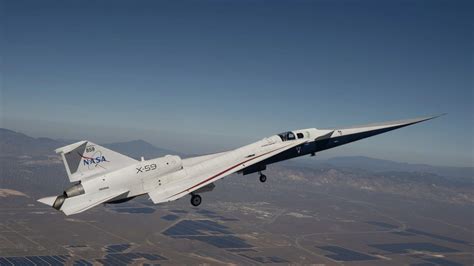
The timing of the FAA proposal is closely connected to NASA’s X-59, an experimental aircraft designed specifically to investigate quieter supersonic flight. Built by Lockheed Martin’s Skunk Works, the aircraft is approximately 99.7 feet long and 29.5 feet wide and looks radically different from a conventional fighter or airliner.
Its unusually long nose and carefully shaped fuselage are not simply aesthetic choices. They are intended to manipulate the aircraft’s shock waves so they do not combine into one powerful sonic boom. The aircraft’s top-mounted engine inlet and aerodynamic configuration are part of the same strategy, allowing the individual pressure waves to dissipate through the atmosphere rather than forming the concentrated boom traditionally associated with supersonic flight.
The X-59 completed its first supersonic flight on June 5, 2026, reaching Mach 1.077 at 43,400 feet over Edwards Air Force Base in California. One week later, it reached its target mission conditions of Mach 1.4 at 55,030 feet, an important milestone because those conditions are representative of the eventual community testing campaign.
NASA’s research is designed to provide something the aviation industry has lacked for decades: real-world evidence about how people respond to a dramatically reduced sonic signature. The aircraft will eventually fly over selected US communities while microphones measure the sound on the ground and residents provide feedback about what they hear.
X-59 Could Help Define the Future of Quiet Supersonic Flight
The X-59 program is being conducted in stages. Initial flight testing focuses on expanding the aircraft’s operating envelope and verifying its handling, propulsion and systems. Acoustic testing then examines the actual pressure signature produced by the aircraft, including measurements made with specialized equipment carried by an F-15 chase aircraft.
The most important stage will involve community overflights. NASA intends to collect acoustic measurements while surveying residents about their perception of the aircraft’s sound. The resulting data could influence both the FAA’s regulatory process and broader international standards for supersonic aviation.
This matters because the FAA’s proposed 0.11 lb per square foot threshold is not simply an engineering target. It is ultimately an attempt to establish a level of noise that regulators believe can coexist with communities. If research shows that people find a particular acoustic signature objectionable despite its low measured pressure, regulators may have to reconsider how the standard is defined.
Researchers at Purdue University raised exactly this concern during the FAA’s public comment period. Professor William Crossley argued that a simple pressure measurement may not adequately capture perceived annoyance and suggested that a standard based on decibels or dBA could potentially provide a better representation of what people actually experience.
The distinction could become one of the most important technical questions in the entire rulemaking process.
Boom Supersonic Has a Different Strategy for Overland Flight
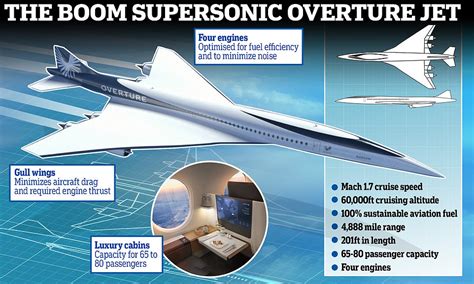
While NASA’s X-59 is designed around shaping shock waves, Boom Supersonic is pursuing another approach with its Overture airliner. The aircraft is designed to carry approximately 64 to 80 passengers at Mach 1.7 and achieve a range of about 4,250 nautical miles.
Boom has already attracted commitments from major airlines. United Airlines has ordered 15 aircraft with options for another 35, while American Airlines has ordered 20 and Japan Airlines has committed to 20. Together, those agreements represent approximately 130 aircraft, although the orders and options remain subject to the commercial and development conditions associated with a new aircraft program.
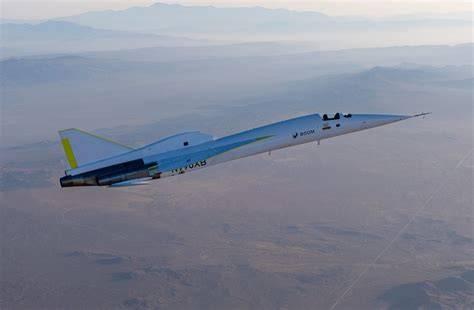
The company has also completed its final assembly facility in Greensboro, North Carolina, and its XB-1 demonstrator broke the sound barrier in January 2025. Those milestones make Boom one of the most visible potential beneficiaries of a change in US supersonic regulations.
Its approach to quieter overland operation includes a concept known as Boomless Cruise. Rather than relying entirely on an airframe that prevents shock waves from combining, the concept uses specific combinations of altitude, speed and atmospheric conditions in which shock waves can refract upward rather than reaching the ground with significant strength.
That creates a potentially powerful operational advantage, but it also introduces uncertainty. The atmosphere is not static. Temperature, pressure, wind, humidity, terrain and altitude can change the way pressure waves travel. An aircraft might therefore need sophisticated flight planning and operational restrictions to ensure that its ground-level signature remains below the FAA’s eventual limit.
Trump’s Executive Order Accelerated the Supersonic Push
The regulatory effort also has a significant political component. President Donald Trump signed an executive order titled “Leading the World in Supersonic Flight” on June 6, 2025, directing the FAA to pursue repeal of the overland supersonic prohibition and calling for federal coordination on supersonic research and testing.
The order set an ambitious December 3, 2025 deadline for the FAA to repeal the existing prohibition. That deadline passed without a final regulatory change. The eventual NPRM arrived roughly seven months later, illustrating just how complicated it is to replace a simple 53-year-old prohibition with a technically defensible performance standard.
The proposed rule must address much more than a single noise number. It needs to establish how supersonic aircraft would be certified, under what operating conditions they could fly, how their acoustic performance would be demonstrated, and how early commercial operations would be managed while standards continue to evolve.
Congress is also pushing the issue through the Supersonic Aviation Modernization Act, or SAM Act. The bipartisan legislation would establish statutory deadlines for creating a supersonic regulatory framework, potentially adding pressure if the FAA process encounters further delays.
What the FAA Proposal Could Mean for US Airlines
If the final rule remains broadly similar to the proposal, the biggest change for airlines would not happen overnight. There are currently no certified commercial supersonic airliners ready to begin scheduled US domestic operations. Instead, the rule would remove a major regulatory barrier for aircraft programs that are still being developed and tested.
For airlines, the opportunity could eventually extend well beyond saving an hour or two on individual routes. Supersonic aircraft could change the economics of premium travel by making distant business markets more accessible within a single working day. A flight that once required an overnight stay could potentially become a much shorter trip, particularly on long domestic or transcontinental routes.
The commercial challenge, however, will be substantial. Supersonic aircraft generally require more energy than subsonic aircraft, have specialized aerodynamic requirements, and carry fewer passengers than today’s largest widebody jets. Airlines will therefore need to charge enough for the time savings and premium experience to justify the higher operating costs.
That is why the FAA’s proposal matters even before the first commercial passenger boards an Overture. Regulation determines whether the business case can exist at all.
The Biggest Obstacles Are Still Ahead
Replacing the ban does not mean every supersonic aircraft will immediately receive permission to fly across the country. Manufacturers will still need to demonstrate that their aircraft satisfy the final noise requirements, meet safety certification standards, and operate within whatever altitude, routing and atmospheric restrictions regulators establish.
Community acceptance could also become decisive. The history of Operation Bongo II demonstrates that technically permissible noise can still become politically unacceptable if residents believe they are being subjected to frequent disturbances. A successful future for supersonic aviation therefore depends on proving not only that quieter flight is possible, but that communities are willing to live with it.
The FAA’s public comment period closed on August 17, 2026, after attracting responses from manufacturers, airlines, environmental organizations, community groups, researchers and members of the public. The agency is targeting a final rule by mid-2027.
That timetable leaves the industry with a critical period in which aircraft development, acoustic testing and regulatory decisions will increasingly converge.
Supersonic Aviation Could Finally Break Free From a 53-Year-Old Rule
The FAA’s proposal represents one of the most consequential attempts to rethink American aviation regulation in decades. The 1973 rule was created for an era when a sonic boom was essentially synonymous with disruptive supersonic flight. Today’s aircraft designers are challenging that assumption by attempting to control the pressure waves themselves or keep them from reaching the ground.
The distinction between “supersonic” and “loud” could therefore become the defining idea behind the next generation of passenger aircraft. An airplane can travel faster than Mach 1 without necessarily creating the same acoustic disturbance that doomed earlier efforts to normalize supersonic flight over populated areas.
Much still has to happen before passengers can board a commercial supersonic aircraft for a flight across the United States. The FAA must finalize the rule, manufacturers must certify suitable aircraft, operators must prove compliance, and communities must accept the resulting noise environment. But for the first time since Concorde and the Boeing 2707 era, the regulatory framework itself may be changing to accommodate technological progress rather than simply prohibit it.
If the FAA ultimately adopts a workable performance-based standard, commercial supersonic aviation in the United States could move from a historical curiosity to a realistic part of the airline industry. The sound of that transformation may not be the deafening crack remembered from the 1960s. It could be something much quieter—and potentially far more important.