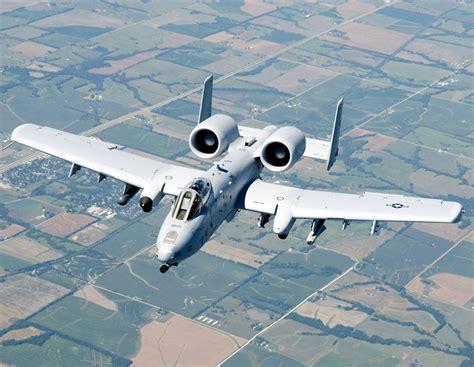
The Fairchild Republic A-10 Thunderbolt II, widely known by its beloved nickname “Warthog,” remains a singular masterpiece in the realm of modern military aviation. Engineered explicitly for close air support (CAS), the A-10 was born from the urgent need to protect ground troops during the high-intensity warfare scenarios that emerged in the late 20th century. Since entering service in October 1977, the A-10 has become synonymous with aerial resilience, lethality, and mission-focused efficiency.
Initially crafted to replace the vulnerable A-1 Skyraider after lessons learned from Vietnam, the A-10 was the first U.S. Air Force aircraft purpose-built for CAS missions. The A-X program, initiated in 1966, outlined exacting criteria: a subsonic aircraft capable of surviving battlefield conditions while delivering overwhelming firepower against enemy armor. The resulting prototype, YA-10, outperformed Northrop’s YA-9 and was officially selected in January 1973, leading to full-scale production by March 1976. Fairchild Republic produced 716 A-10s between 1972 and 1984.
An Engineering Marvel Built Around a Gun
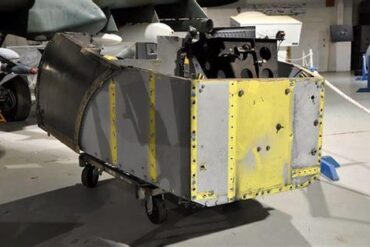
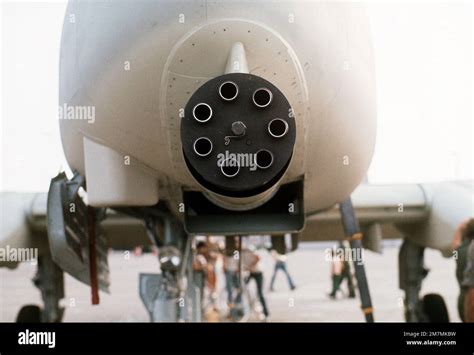
Central to the A-10’s fearsome reputation is its iconic GAU-8/A Avenger cannon, a 30 mm seven-barrel Gatling-style rotary autocannon capable of firing 3,900 rounds per minute. This brutal weapon—specifically designed to obliterate armored vehicles—sits at the heart of the aircraft, with the fuselage literally constructed around it. With 1,174 rounds of depleted uranium or high-explosive incendiary ammunition stored in an armored drum, the GAU-8 can be fired in sustained bursts while the aircraft slants into a dive at 4,000 feet, turning battlefield tanks into scrap metal in seconds.
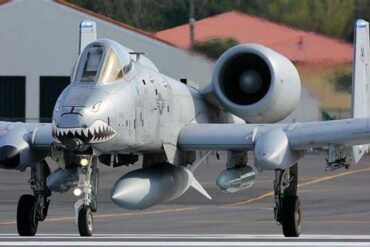
The nose gear is intentionally offset to allow proper cannon alignment with the aircraft’s centerline, preserving balance and accuracy during intense maneuvers. This design decision epitomizes the aircraft’s ruthless dedication to its primary purpose: obliterating enemy armor and protecting friendly forces.
Exceptional Survivability in Hostile Skies
The A-10’s design philosophy revolves around battlefield resilience. Its titanium armor “bathtub” surrounds the pilot and critical flight systems with 1,200 pounds of protective plating. The Warthog can fly—and land—even with severe damage thanks to redundant hydraulic systems and manual reversion flight control capability.
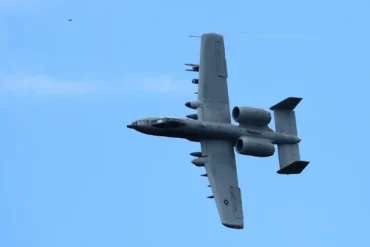
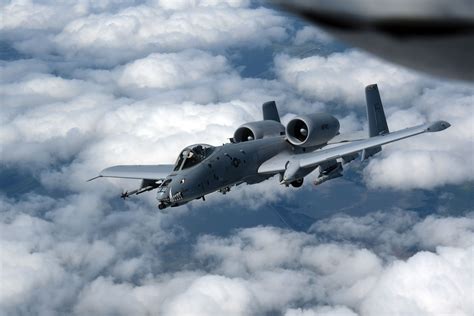
Its straight, large-area wings and low-pressure tires allow the A-10 to operate from short, unprepared, or semi-prepared runways, often directly from forward bases close to the frontlines. The twin General Electric TF34-GE-100 turbofan engines, mounted high on the fuselage, minimize the risk of foreign object damage (FOD) and reduce the aircraft’s infrared signature, making it less vulnerable to heat-seeking missiles.
The A-10 also employs self-sealing fuel tanks, foam-lined cells, armored ammunition storage, and countermeasures like chaff and flares, further amplifying its in-theater longevity.
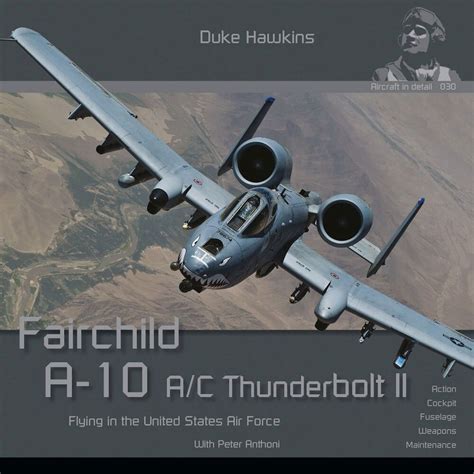
Lethal Versatility in the Air
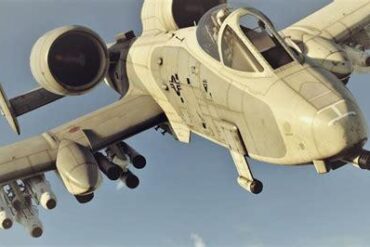
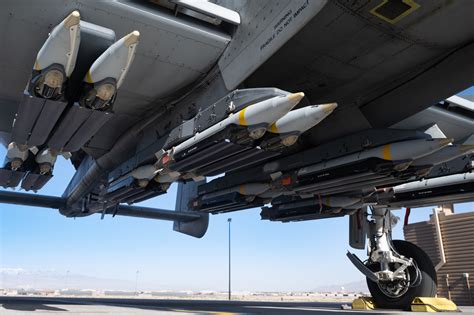
Beyond its signature gun, the A-10 carries an extensive array of external munitions. It features 11 hardpoints with the capacity to carry up to 16,000 pounds of ordnance. This includes:
- AGM-65 Maverick missiles (TV and infrared-guided)
- Hydra 70 rocket pods
- Cluster munitions and general-purpose bombs
- JDAM and Small Diameter Bombs (SDB) for precision strike
- ALQ-131 ECM pods for electronic warfare
- AIM-9 Sidewinders for self-defense
With such diversity, the A-10 is capable of annihilating armor columns, neutralizing enemy bunkers, suppressing enemy air defenses, and even performing air-to-air combat under certain circumstances.
Distinctive Camouflage and Battlefield Presence
The Warthog’s visual appearance has evolved over decades. Its original European Woodland camouflage eventually gave way to the two-tone gray Compass Ghost scheme more suited for modern conflict zones. Some A-10s boast false canopy paint under the fuselage to confuse adversaries during dogfights, and many feature personalized nose art—from shark mouths to war-themed murals—evoking WWII-style traditions.
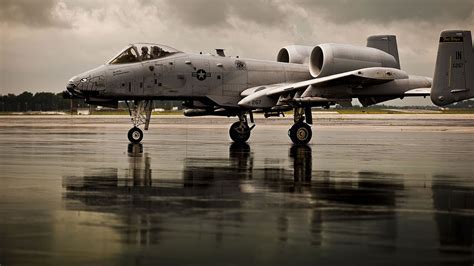
This combination of visual menace and deadly functionality contributes to the A-10’s iconic presence. The psychological impact of hearing the distinctive “BRRRRT” of its cannon is well-documented among both friendly troops and enemy forces alike.
Operational Brilliance Across Decades of Conflict
Since achieving Initial Operational Capability (IOC) in October 1977, the A-10 has carved a legendary combat record:
- Operation Desert Storm (1991): 8,100 sorties, including the first A-10 air-to-air kill (Iraqi helicopter, February 6)
- Balkans Conflicts: Supported NATO in Bosnia (1994–95) and Kosovo (1999)
- Afghanistan War (2002–): Provided vital CAS in mountainous terrain
- Iraq War (2003–2011): Operated in both urban and desert environments
- Libya (2011) and ISIL Campaign (2014–): Continued precision strikes and persistent loitering capabilities
One of the most dramatic examples of A-10 resilience occurred in April 2003, when Captain Kim Campbell successfully flew her A-10 back to base in Baghdad after sustaining severe structural damage, utilizing manual flight reversion systems to survive.
The OA-10 and Tactical Versatility
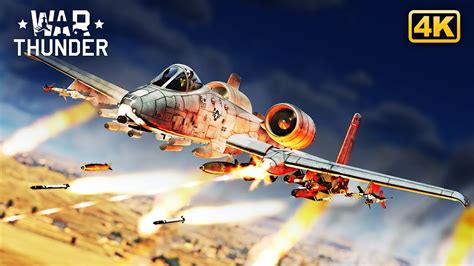
An often-overlooked variant, the OA-10, functions as a Forward Air Control (FAC) aircraft. These specially designated airframes perform target acquisition, battlefield coordination, and real-time communication with ground forces and command. The dual-role capability of certain A-10 airframes further enhances their strategic value in complex combat environments.
Evolution Through Modernization
Although originally designed with a 6,000-hour service life, the A-10 has undergone extensive structural reinforcement and fatigue testing, enabling it to fly well beyond its initial limitations. A series of major upgrades between 1978 and 1999 introduced new navigation and targeting capabilities, such as:
- Pave Penny laser tracking pod
- Inertial Navigation Systems (INS)
- LASTE (Low Altitude Safety and Targeting Enhancement) system
- GPS integration
The most significant leap occurred with the A-10C Precision Engagement Upgrade in 2005, integrating digital cockpit displays, hands-on throttle and stick (HOTAS) controls, and Link-16 datalink capability, which transformed the analog Warthog into a modern networked strike platform.
The Contested Future of the Warthog
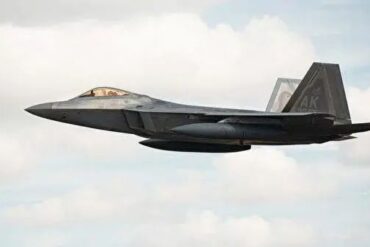
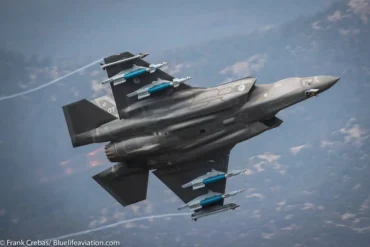
Despite its stellar track record, the A-10’s future remains a battleground within U.S. defense policy. The U.S. Air Force has repeatedly proposed retiring the A-10 in favor of the F-35 Lightning II, citing multi-role flexibility and advanced stealth. However, these plans have been met with staunch resistance from Congress, military analysts, and even ground combat veterans who argue that the F-35 cannot replicate the loiter time, ruggedness, or dedicated firepower of the A-10.
To sustain operational relevance, the Air Force began retrofitting existing A-10s with new wings under the TUSK (Thunderbolt Structural Kit) program, ensuring airframe longevity through 2035–2040. With upgraded avionics, reinforced durability, and its unmatched CAS capabilities, the A-10 continues to dominate low-altitude conflict zones.
Conclusion: A Legacy of Relentless Support
No other aircraft in history embodies the spirit of unyielding support to ground forces like the A-10 Thunderbolt II. From its armor-piercing firepower to its invulnerable design ethos, it stands not just as an aircraft, but as a symbol of tactical loyalty and battlefield superiority. While its retirement may loom on the horizon, the legacy of the Warthog will endure in the form of doctrines, memories, and legends—etched in every cratered battlefield it once soared above.