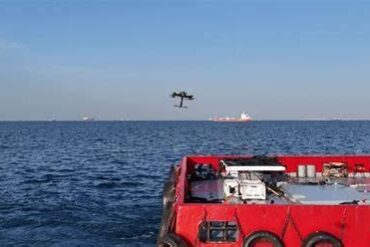
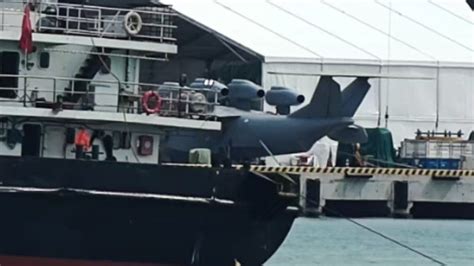
China has reignited a long-dormant chapter of Cold War aviation history with the unveiling of a massive new Ekranoplan, nicknamed the “Bohai Sea Monster.” Drawing inevitable comparisons to the Soviet Union’s legendary “Caspian Sea Monster,” this mysterious craft appeared on Chinese social media in early July 2025, prompting a flurry of speculation and analysis from defense experts worldwide.
Open-source naval analyst H.I. Sutton was among the first to highlight the vehicle, which was spotted docked along a pier in the Bohai Sea, at the northern edge of the Yellow Sea. What grabbed attention wasn’t merely its size — nearly comparable to the AG600, China’s giant amphibious aircraft — but the implication that Beijing may be positioning itself to dominate an aerial-maritime grey zone with a high-speed, stealthy transport craft.
The Rise of the Flying Boat: Understanding the Ekranoplan Phenomenon
Ekranoplans — or Ground Effect Vehicles (GEVs) — are not traditional aircraft or ships. They exploit a phenomenon known as the wing-in-ground (WIG) effect, which increases lift and reduces drag when flying just meters above a surface. This allows Ekranoplans to skim over water at speeds between 300–500 km/h, far outpacing conventional ships while avoiding the radar signatures and torpedo vulnerabilities of low-flying aircraft or naval vessels.
In design terms, China’s new Ekranoplan showcases a T-tail configuration, dual vertical stabilizers, and a compact wing layout atop a boat-like fuselage. Four jet engines are mounted above the wings, likely to prevent sea spray intake, enabling the craft to stay entirely above the waterline. While Chinese authorities have revealed no specifications, the aerodynamic design, unusual nose cone, and military-style gray paint scheme hint at both civil and military applications.
Potential uses include search and rescue, logistics resupply, and rapid troop transport—particularly in sensitive hotspots like the Taiwan Strait and the South China Sea, where China has developed and militarized artificial islands.
A Cold War Legacy: Soviet Union’s Ekranoplan Program
While China’s prototype is capturing global headlines, the origin of the Ekranoplan stretches back to the Soviet Union, which pioneered the concept in the 1960s under aviation engineer Rostislav Alexeyev. The most iconic product of this era was the “Caspian Sea Monster” or KM, which at 302 feet long and weighing over 1.1 million pounds, was the largest ground effect vehicle ever built at that time.
This behemoth, powered by 10 Dobrynin VD-7 turbojets, stunned U.S. intelligence when it was first spotted via satellite. Despite its groundbreaking speed and size, the KM crashed in 1980 due to pilot error and was never salvaged.
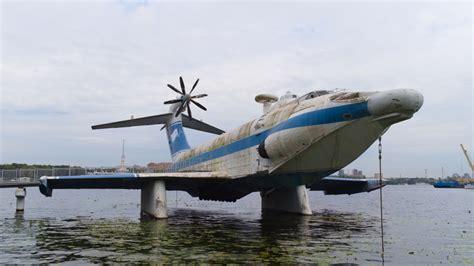
Following the KM, the Soviets developed the Lun-class MD-160, designed specifically for anti-surface warfare. Equipped with eight NK-87 turbofan engines and six P-270 Moskit (Mosquito) anti-ship missiles, it could strike NATO warships with a blend of speed and surprise. The Lun had radar and surveillance sensors integrated into its fuselage, with operations focused around the Black Sea.
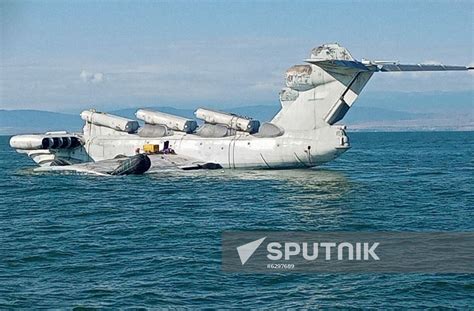
Yet, like its predecessor, the Lun-class never scaled. Only one unit was built before the program was abandoned amid the collapse of the Soviet Union. That MD-160 now rests as a decaying relic on a Russian beach, symbolic of both ambition and abandonment.
A Chinese Resurrection With Strategic Implications
Unlike the Soviets, China may be leveraging modern technology, materials, and regional priorities to bring the Ekranoplan back into strategic relevance. The Bohai Sea Monster, still unnamed officially, could serve a dual-use purpose, bridging military and humanitarian operations.
Its ability to fly just meters above the surface makes it radar-elusive, ideal for quick troop deployments across contested maritime zones or delivering supplies to island bases. Crucially, these capabilities align with China’s recent geopolitical posture, particularly its ambitions in the South China Sea and heightened tensions over Taiwan.
Its design, including the unusually efficient nose and elevated engines, suggests optimization for both speed and stealth. With the capacity to potentially rival the AG600 in payload and range, the new craft could offer a strategic mobility advantage over traditional aircraft or ships.
The American Response: DARPA’s Liberty Lifter and Its Cancellation
Not to be outdone, the United States Defense Advanced Research Projects Agency (DARPA) had launched the Liberty Lifter initiative, an ambitious program aimed at creating a low-cost, high-capacity Ekranoplan.
The contract for Phase 1 went to Aurora Flight Sciences, whose conceptual design featured a monohull seaplane with a high-wing structure. This craft was intended for heavy lift logistics, operating effectively in high sea states and dense maritime traffic zones, with advanced control systems to navigate low-altitude wave interference.
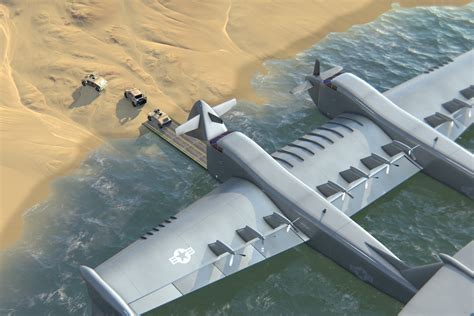
However, despite promising early-stage engineering, the Liberty Lifter project was cancelled before full-scale prototyping. The cancellation left a vacuum in the West’s response to potential Ekranoplan resurgence, giving China more room to shape this technology domain unopposed.
Why the Ekranoplan Matters in Modern Warfare
The resurgence of flying boats is not a nostalgic flex—it’s a strategic recalibration. As aerial and naval warfare becomes increasingly about speed, stealth, and access, Ekranoplans offer a low-cost, fast, hard-to-detect solution to maritime mobility.
They are immune to submarine attacks, evade sonar detection, and remain below most radar sweeps. In heavily contested regions like the Indo-Pacific, such capabilities are not just desirable—they could be decisive.
China’s version may focus initially on dual-use capabilities, but its obvious potential as a low-flying missile platform, or even as a quick-response troop carrier, is not lost on military observers. If operationalized, the craft could easily be repurposed for gray zone operations, such as landing marines on disputed islands or intercepting enemy vessels before radar contact.
Global Echoes: Ekranoplans in the 21st Century
Beyond China and Russia, there’s renewed global interest in ground effect vehicles:
- Russia’s A-050 Chaika, announced in 2017, was a 54-ton hybrid with missile-launching capabilities and a projected range of 5,000 km. Though development timelines slipped, its potential use along the Northern Sea Route remains viable.
- South Korea and Japan, facing similar maritime access challenges, have quietly studied WIG craft for rescue missions and fast ferry transport, though few prototypes have emerged.
China’s “Bohai Sea Monster” may be the first of a new generation of flying boats, purpose-built for a world where airspace is congested, and sea lanes are weaponized.
Conclusion: Ghosts of the Caspian Now Haunt the Yellow Sea
China’s mystery Ekranoplan may still be a prototype, but it marks the rebirth of a Cold War concept that once terrified NATO. It also raises fresh questions: Is this the dawn of next-generation sea-skimming warfare? Or merely a bold technology demonstrator?
While the Soviet “Caspian Sea Monster” and “Lun” languished due to political collapse and economic constraints, China’s centralized industrial planning, strategic foresight, and rising defense budgets might finally give the Ekranoplan its day in the sun.
In this era of evolving threats and distributed warfare, the flying boat may no longer be an eccentric relic of Cold War experimentation — but a quiet revolution gliding just meters above the sea.