Spain’s political establishment is facing renewed turmoil after former Prime Minister José Luis Rodríguez Zapatero became embroiled in a widening corruption investigation linked to the controversial €53 million ($60 million) government rescue of airline Plus Ultra during the COVID-19 pandemic. What was initially defended as an emergency measure to protect strategic aviation connectivity has now evolved into one of the country’s most politically explosive influence-peddling cases in years.
The investigation centers on allegations that Zapatero used his political influence and long-standing international relationships to help secure financial support for Plus Ultra, a relatively small Spanish airline whose survival package drew fierce criticism from the moment it was approved in March 2021. Prosecutors are now examining whether improper lobbying, forged documentation, and possible illegal commissions played a role in the bailout process.
At the height of the pandemic, governments across Europe rushed to stabilize airlines facing catastrophic revenue losses as global travel collapsed. Massive aid packages were issued to flag carriers and regional operators alike, often justified as necessary to preserve jobs, tourism, and national infrastructure. However, critics argue that the Plus Ultra case stood apart from other aviation rescues because of the airline’s limited footprint and controversial connections to Venezuelan business interests.
The airline operated only a small number of long-haul routes and held a marginal share of Spain’s aviation market when the bailout was approved. Opposition lawmakers questioned why such a modest carrier received tens of millions in taxpayer support while larger airlines with far greater economic importance faced stricter scrutiny.
Political pressure intensified almost immediately after the funds were authorized. Members of Spain’s conservative People’s Party argued that the rescue package lacked transparency and suggested there were hidden political motivations behind the decision. Mario Cortés, a prominent opposition figure, publicly stated at the time that there had to be “something else going on” for Plus Ultra to receive such substantial support despite its relatively minor operational scale.
That suspicion has now escalated into a formal investigation by Spain’s National Court. Authorities are reportedly examining whether Zapatero leveraged his influence to steer public funds toward the airline in exchange for benefits connected to Venezuelan financial networks. Investigators are also exploring accusations tied to document forgery and alleged participation in a criminal organization.
The scandal has become particularly damaging because Zapatero was no longer serving as Prime Minister when the bailout occurred. Although he led Spain between 2004 and 2011, prosecutors believe his political connections and international relationships may still have carried significant weight inside government circles. His ties to Venezuela have also received renewed attention, adding another layer of controversy to a case already saturated with geopolitical implications.
Searches connected to the investigation have reportedly included Zapatero’s Madrid office, signaling that authorities are treating the allegations with unusual seriousness. Spanish political observers note that investigations involving former national leaders are exceptionally rare and often reshape public confidence in state institutions.
Juanma Moreno of the People’s Party described the situation as unprecedented, warning that the inquiry could severely damage the credibility of Prime Minister Pedro Sánchez’s government. The opposition has aggressively used the scandal to portray the current administration as tolerant of opaque financial dealings and politically motivated state intervention.
Why The Plus Ultra Bailout Became So Controversial
Unlike Spain’s larger aviation groups, Plus Ultra was never considered essential to the country’s domestic transport network. Founded in 2011, the airline focused primarily on long-haul routes connecting Spain with Latin America. Its network remained comparatively small, and critics argued that its economic relevance did not justify extraordinary state assistance.
Concerns intensified because of the airline’s alleged proximity to Venezuelan-linked investors and business figures. Opposition parties repeatedly questioned whether diplomatic or ideological relationships influenced the approval process. In Spain’s highly polarized political environment, the bailout rapidly transformed from an aviation issue into a symbol of broader concerns about transparency and political favoritism.
The timing also amplified scrutiny. In early 2021, Spain was still struggling with severe economic fallout from the pandemic, with businesses collapsing across multiple sectors. Many Spaniards viewed the allocation of millions to a relatively obscure airline as difficult to justify while countless small companies received limited relief.
Investigators are now attempting to determine whether proper procedures were followed when the rescue package was approved. Central questions include whether internal evaluations accurately reflected Plus Ultra’s financial importance and whether political influence distorted the normal review process.
Plus Ultra’s Current Operations And Fleet
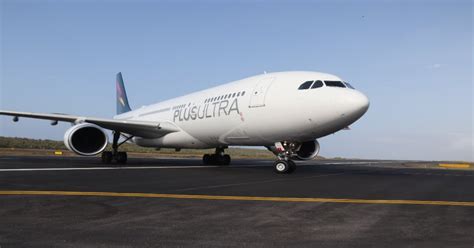
Despite the controversy, Plus Ultra remains active in the long-haul aviation market. The airline has transitioned away from the aging Airbus A340 aircraft that once made it one of Europe’s last operators of the four-engine widebody jet. Those aircraft became briefly famous during high-profile charter missions, including transporting Manchester City supporters to Istanbul for the UEFA Champions League Final in 2023.
Today, Plus Ultra operates an all-Airbus A330 fleet consisting of five A330-200 aircraft and two A330-300s. The carrier continues focusing heavily on routes between Spain and Latin America, particularly destinations with strong cultural and economic links to Madrid.
Current routes include services from Madrid to Bogotá, Buenos Aires, Caracas, Cartagena, and Lima, alongside flights from Tenerife North to Caracas. Although modest compared to Spain’s largest airlines, the carrier still maintains an important niche in transatlantic travel between Europe and South America.
A Scandal With National Political Consequences
The corruption probe surrounding Plus Ultra has evolved far beyond a dispute over pandemic-era airline aid. It now represents a broader test of accountability inside Spanish politics, particularly regarding how emergency public funds were distributed during one of the most chaotic periods in modern economic history.
If prosecutors uncover evidence of influence peddling or illegal financial arrangements, the fallout could reverberate throughout Spain’s political system for years. The investigation has already reignited fierce debate over government transparency, the relationship between politics and business, and the risks of emergency spending carried out under crisis conditions.
For Zapatero, the coming testimony before Spain’s National Court may prove decisive. For Spain, the case threatens to become a defining political scandal in the post-pandemic era.