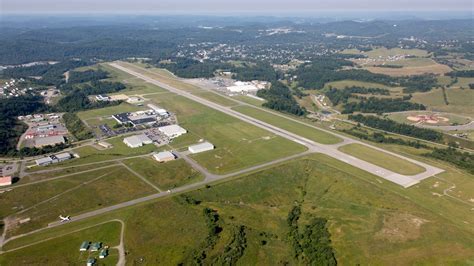
Halifax Stanfield International Airport (IATA: YHZ, ICAO: CYHZ) stands as a vital transportation hub not just for Halifax, Nova Scotia, but for the broader Maritime region. As part of Canada’s National Airports System, this airport blends a rich historical legacy with ongoing innovation and expansion, serving millions of passengers annually while acting as a logistical nexus for cargo and charter operations. Operated by the Halifax International Airport Authority (HIAA) since 2000, it bears the name of former Nova Scotia Premier Robert Stanfield, a tribute to regional leadership and progress.
The airport lies in the rural community of Goffs, strategically located for both domestic and international connectivity. With nearly 4 million passengers passing through its terminals in 2024, Halifax Stanfield has become an indispensable link between Atlantic Canada and the world.
Origins and Historical Evolution of YHZ
The airport’s history stretches back to the 1930s, when the original Chebucto Field opened in 1931. Though it closed in 1941, it laid the foundation for the aviation infrastructure that followed. During and after World War II, RCAF Shearwater temporarily served civil aviation needs until a more suitable site near Kelly Lake was selected in 1954.
Construction commenced in 1955 under Diamond Construction, with terminal design handled by Gilleland & Strutt. On August 1, 1960, Halifax International Airport officially opened its doors. The inaugural day featured two major milestones: the first TCA Viscount passenger flight departed at 4:50 a.m., followed just an hour later by the first overseas flight. The project’s cost, around $18 million, represented a significant federal investment into Atlantic Canadian connectivity.
Over the next several decades, the airport expanded repeatedly—in 1966, 1976, 1988, 1994, and 1998—with passenger traffic soaring from 180,000 annually in its early days to 2.5 million by 1990.
Transition to HIAA and Global Visibility
A pivotal moment came in 1995, when the Halifax International Airport Authority was formed. By February 1, 2000, HIAA had officially taken control of airport operations. Just over a year later, Halifax Stanfield played a heroic role in Operation Yellow Ribbon following the September 11, 2001 terrorist attacks in the United States. With airspace rapidly closing, Halifax accepted 47 diverted flights, sheltering more than 7,300 passengers. A memorial ceremony held on September 14, 2001, stands as a testament to the airport’s compassion and logistical readiness.
Renaming and Accolades
In the years that followed, the airport earned both national and international recognition. The terminal was named after Robert Stanfield in 2005, and the entire facility followed suit in 2007. Between 2005 and 2011, Halifax Stanfield received multiple IATA and ACI awards for best airport under 5 million passengers, underscoring its operational excellence.
Terminal Complex and Passenger Facilities
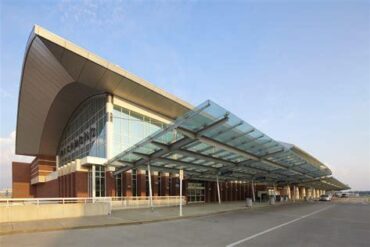
The terminal, originally constructed in 1960, was a cutting-edge facility for its time, boasting the first escalators in Nova Scotia, customs and immigration areas, a control tower, and public observation decks. Since 2000, over $200 million has been invested in expanding and modernizing the airport’s infrastructure.
Key expansions include:
- 2001: International arrivals area and U.S. customs preclearance.
- 2002: Expanded domestic departures.
- 2003: Opening of Airport Square and a new observation deck.
- 2005: South holdroom and three new jet bridges.
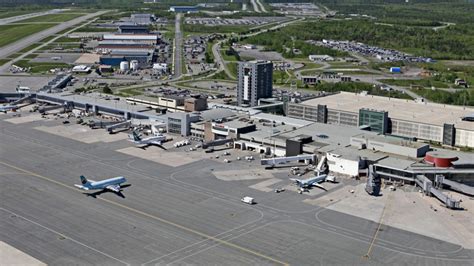
Today, the terminal offers 32 gates, including 13 equipped with airbridges. Several gates are designed as swing gates for flexibility between domestic and international/U.S. operations.

Runways, Taxiways, and Airside Infrastructure
The airport has two perpendicular runways:
- Runway 05/23: Extended in 2012 to a length of 3,200 meters, supporting wide-body international operations.
- Runway 14/32: Measures 2,346 meters, accommodating regional and medium-haul traffic.
The taxiway system has been strategically expanded—first in 1982 and then again in 2010—to improve ground traffic efficiency. A cargo apron, added in 2016, supports the airport’s growing role as a freight hub. The entire facility spans 2,372 acres, providing ample space for future expansion.
Hotel and On-Site Amenities
After several stalled efforts—such as the 1990 Pegasus project and a 2008–10 Sheraton proposal—the airport finally welcomed the Alt Hotel in 2013. This 14-story, 169-room establishment includes a conference center, fitness facilities, a pool, and a 24-hour café, offering convenience to travelers and business visitors alike.
Aviation Services and Emergency Readiness
Multiple fixed-base operators (FBOs) provide ground handling, fuel, hangars, and aviation support. The Combined Services Complex (CSC), opened in 2010, is a LEED-certified facility housing fire rescue, maintenance, and Halifax Regional Police operations.
Halifax Stanfield is also designated as an abort landing site for NASA’s Space Shuttle, reflecting the airport’s technical capabilities and long runway infrastructure.
Aerotech Business Park: Aerospace Innovation Zone
Adjacent to the airport is the Aerotech Business Park, home to high-tech tenants such as Pratt & Whitney Canada and L3 Communications. The park fosters innovation in aerospace and aviation industries, creating synergies with airport operations and facilitating advanced logistics.
Master Planning and Future Development
The 2011 Master Plan outlined ambitious infrastructure upgrades, including new taxiways, advanced de-icing zones, an improved internal road network, and logistics facilities. As part of this vision, a $36 million cargo expansion launched in 2018, with funding from the federal government ($18M), Nova Scotia ($5M), and HIAA ($13M). This development further solidified Halifax Stanfield’s role in global freight logistics.
Airline Network and Passenger Destinations
Halifax Stanfield is a focus city for Air Canada, WestJet, and Porter Airlines. The airport offers both year-round and seasonal service to major destinations:
- Air Canada: Toronto, Montreal, London Heathrow, Caribbean
- Porter Airlines: Ottawa, Billy Bishop Toronto City Airport
- WestJet: Calgary, Edmonton, seasonal Europe and U.S. cities
New routes in summer 2025 will connect Halifax to Chicago-O’Hare, Hamilton, Barcelona, Reykjavík, and Zurich, strengthening its transatlantic reach.
Cargo and Charter Operations
Cargo operations are robust and growing. Air Canada Cargo, FedEx, Cargojet, and Korean Air Cargo maintain regular service, linking Halifax with Basel, Frankfurt, London Heathrow, and other international freight centers. Charter services by Cougar Helicopters, Exploits Valley Air Services, Provincial Air Ambulance, and Sable Aviation enhance regional medical and industrial logistics.
Traffic, Safety, and Incident Record
Passenger traffic surged from just over 2 million in 1987 to a record 4.32 million in 2018, with 3.98 million in 2024 post-pandemic. Aircraft movements reached 84,045 in 2017, underscoring the airport’s active operations.
Halifax Stanfield has experienced several notable incidents:
- 1965: Dart Herald crash – 8 fatalities
- 1998: Swissair Flight 111 crash – 229 fatalities
- 2004: MK Airlines 747F crash – 7 fatalities
- 2015: Air Canada Flight 624 hard landing – no fatalities
- 2018: Sky Lease Cargo 747 runway overrun – no fatalities
- 2024: PAL 2259 landing gear collapse – no injuries

Ground Transportation and Accessibility
Getting to and from Halifax Stanfield is straightforward:
- Bus: MetroX Route 320 connects the airport to the Dartmouth Bridge Terminal and Fall River, operating daily.
- Car: Located just 28 minutes from Downtown Halifax, accessible via Exit 6 off Highway 102. On-site amenities include car rental counters and Park ’N Fly long-term parking.
Final Thoughts
As the busiest airport in Atlantic Canada, Halifax Stanfield International Airport is far more than a transit point—it is a regional lifeline, economic catalyst, and international gateway. With continuous investments in infrastructure, strong community ties, and expanding global connections, it stands at the forefront of Canadian aviation. Whether welcoming travelers or shipping time-sensitive cargo, YHZ plays an indispensable role in shaping the future of Nova Scotia and beyond.