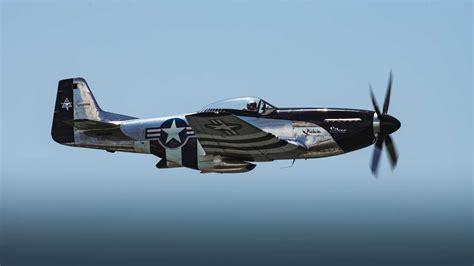
The North American P-51 Mustang remains one of the most celebrated fighter aircraft ever created, a machine so effective that it altered the balance of air power during World War II. Sleek, fast, heavily armed, and capable of escorting bombers deep into enemy territory, the Mustang earned a reputation that still echoes across aviation history. Between 1941 and 1946, a total of 15,586 P-51 Mustangs were built across multiple variants, making it one of the most important Allied fighters of the war.
What makes the Mustang remarkable is not simply the number produced, but the way the aircraft evolved from a promising design into a war-winning icon. It arrived at a critical moment when Allied bomber crews desperately needed protection over Europe. Before the Mustang, American bombers often flew beyond the protective range of escort fighters and suffered devastating losses at the hands of German interceptors. The P-51 changed that equation permanently.
The Mustang’s combination of speed, endurance, altitude performance, and firepower allowed it to escort bombers all the way to Berlin and back. Luftwaffe pilots who once preyed on vulnerable bomber formations suddenly faced aggressive, highly capable American fighters that could outfight many German aircraft while remaining over the battlefield for hours.
By the end of World War II, the P-51 had become far more than just another fighter. It symbolized Allied air superiority itself.
The Origins Of The P-51 Mustang
The Mustang’s story began not with the United States Army Air Forces, but with Britain. Early in World War II, the Royal Air Force sought additional fighter aircraft to strengthen its defenses. Initially interested in aircraft like the Curtiss P-40 Warhawk, British officials approached North American Aviation with the possibility of producing existing fighters under license.
North American Aviation believed it could create something superior in the same timeframe. Company president James H. “Dutch” Kindelberger promised a more advanced fighter design that could outperform the P-40 while using many of the same production tools and engines. The proposal impressed British officials enough that they approved an order for 320 aircraft in May 1940.
The prototype, designated the NA-73X, was developed with astonishing speed. In only 117 days, the aircraft was designed, assembled, and prepared for testing. On April 23, 1941, test pilot Louis Waite flew the first production Mustang for Britain.
Even in its early form, the Mustang demonstrated excellent low-altitude speed and aerodynamic efficiency. Engineers designed the aircraft around a laminar-flow wing, which significantly reduced drag and improved overall performance. Combined with a streamlined fuselage and powerful Allison engine, the fighter displayed exceptional handling characteristics.
Still, the early Mustang had limitations. At high altitude, where strategic bombing missions took place, performance suffered because the Allison engine lacked an advanced supercharger system. The solution to that problem would transform the aircraft into a legend.
The Merlin Engine Transformation
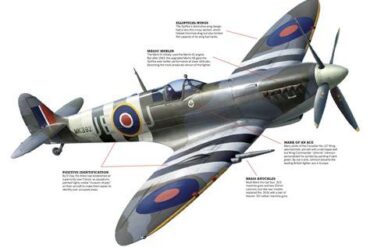
The turning point in Mustang history came when British test pilot Ronald W. Harker suggested pairing the aircraft with the legendary Rolls-Royce Merlin engine. The Merlin had already proven itself in aircraft like the Supermarine Spitfire and Hawker Hurricane, especially at high altitudes.
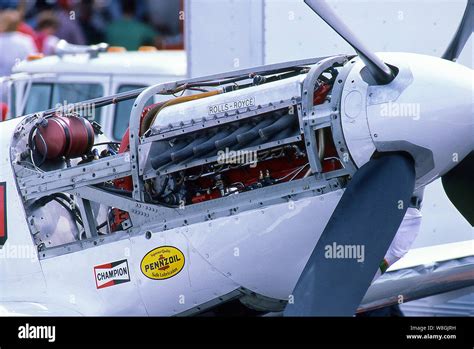
Once engineers integrated the Merlin V-1650 engine into the Mustang airframe, the fighter’s performance changed dramatically. The aircraft suddenly possessed the speed, climb rate, and altitude capability required for long-range escort missions deep inside occupied Europe.
The transformation was so successful that the Mustang evolved from a capable tactical aircraft into arguably the finest piston-engine fighter of the war.
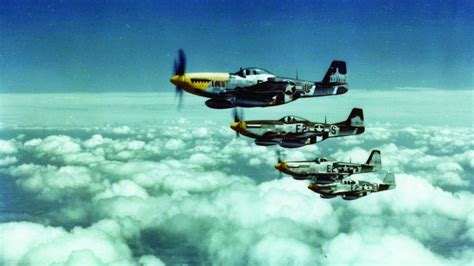
The new Merlin-powered variants, particularly the P-51B and P-51C, entered combat in late 1943. American bomber crews quickly realized they finally had a fighter capable of accompanying them throughout entire missions over Germany.
German pilots noticed the difference immediately.
Unlike earlier escorts that had to turn back due to limited range, the Mustang remained with the bombers all the way to targets in Berlin and beyond. Luftwaffe fighters could no longer attack American bombers with relative impunity.
The Mustang became known among bomber crews as the “Little Friend.” The nickname reflected genuine gratitude. Thousands of Allied airmen survived because P-51 pilots shielded them during some of the most dangerous aerial battles in history.
How Many P-51 Mustangs Were Produced?
Total production of the P-51 Mustang reached 15,586 aircraft between 1941 and 1946. Production included all major variants, from the earliest Mustang I models for Britain to the late-war P-51H.
Manufacturing occurred primarily at two facilities:
- North American Aviation’s Inglewood plant in California
- North American Aviation’s Dallas plant in Texas
Production numbers expanded rapidly as demand increased. By January 1945, the factories collectively produced an astonishing 881 Mustangs per month, one of the most efficient fighter manufacturing efforts of the war.
The production breakdown included several major versions:
- Mustang I and early Allison-powered variants
- A-36 Apache dive bombers
- P-51A
- P-51B
- P-51C
- P-51D
- P-51K
- P-51H
Among these, the P-51D became the most famous and widely produced version, with more than 8,000 examples built.
The P-51D introduced several important improvements that made it exceptionally popular among pilots. Most notably, it featured the iconic bubble canopy, which dramatically improved visibility during combat. The aircraft also carried six .50 caliber machine guns and featured upgraded avionics and gunsights.
The combination of speed, maneuverability, range, and pilot visibility made the P-51D devastatingly effective in air combat.
Why The P-51D Became The Definitive Mustang
The P-51D represented the peak of wartime Mustang development. By the time it entered large-scale service in 1944, the aircraft had matured into a complete air superiority platform.
Its specifications were extraordinary for the era. The fighter reached a maximum speed of 440 mph, climbed rapidly, and operated at altitudes approaching 42,000 feet. With external fuel tanks, the Mustang could escort bombers farther than nearly any Allied fighter before it.
The aircraft’s operational range transformed the strategic air campaign over Europe. American B-17 Flying Fortresses and B-24 Liberators could finally receive continuous fighter protection from takeoff to target and back again.
That development severely weakened the Luftwaffe.
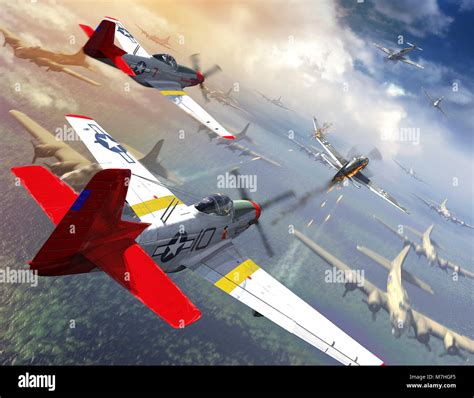
P-51 pilots aggressively hunted German fighters before they could reach bomber formations. Eventually, Mustang squadrons began sweeping ahead of bombers, attacking enemy aircraft on the ground and disrupting German airfields directly.
By 1945, Mustangs operated in almost every major USAAF fighter group in Europe.
The results were staggering. P-51 units destroyed approximately 4,950 enemy aircraft during World War II, both in aerial combat and ground attacks.
The P-51H And The End Of World War II
As the war approached its conclusion, engineers continued refining the Mustang. The ultimate piston-powered version became the P-51H, a lighter and faster evolution of the P-51D.
The P-51H weighed roughly 10 percent less than the P-51D while achieving speeds approximately 50 mph faster. Structural improvements, aerodynamic refinements, and increased power made it one of the fastest piston-engine fighters ever produced.
Unfortunately for the aircraft, timing worked against it.
The P-51H entered service too late to participate meaningfully in World War II combat. Germany had already surrendered, and Japan capitulated shortly afterward following the atomic bombings of Hiroshima and Nagasaki.
Although the aircraft missed WWII, it still served during the Korean War in the early 1950s.
Mustang Combat During The Korean War
After World War II, the United States Air Force transitioned rapidly into the jet age. Aircraft like the F-80 Shooting Star and later the F-86 Sabre represented the future of aerial warfare.
Yet the Mustang still proved useful.
Redesignated as the F-51, the fighter served extensively during the Korean War because of one critical advantage: range. Early American jets lacked the endurance necessary for many missions over Korea, especially when operating from bases in Japan.
The Mustang could remain over the battlefield longer and carry substantial ordnance for ground attack operations.
F-51 pilots flew close air support missions against North Korean forces, attacking supply lines, vehicles, troop concentrations, and infrastructure. Pilots from the United States, South Korea, Australia, and South Africa all operated Mustangs during the conflict.
However, the aircraft faced a dangerous new threat in the form of Soviet-designed MiG-15 jet fighters.
Against jet aircraft, the Mustang was badly outclassed in speed and climb performance. Although still deadly in low-level attack roles, the aging fighter could not survive prolonged engagements with modern jets.
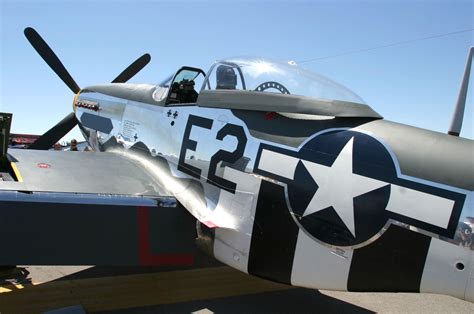
By 1953, most frontline Mustangs had been replaced by jet-powered fighter bombers.
Building The Mustang Production Machine
One reason the Mustang achieved such massive production numbers was North American Aviation’s manufacturing efficiency.
James H. Kindelberger studied advanced German aircraft factories before the United States entered the war. Using lessons learned from European production methods, he streamlined Mustang assembly operations to an extraordinary degree.
North American relocated portions of its B-25 Mitchell bomber production to Kansas while expanding Mustang manufacturing in Texas. The Dallas plant produced the P-51C variant, which was nearly identical to the California-built P-51B.
Assembly lines became so efficient that completed fighters occasionally waited for pilots rather than the other way around.
At peak wartime production, Mustangs rolled out continuously from factory doors in enormous numbers. Workers assembled engines, wings, landing gear, armament systems, and fuselage sections with relentless speed.
The Packard Motor Car Company also played a vital role by building Merlin engines under license in the United States. Without Packard’s massive engine production effort, the Mustang’s wartime success would have been impossible.
The aircraft became a symbol not only of military power but also of American industrial capacity.
The P-51 Mustang In Civilian Life
When World War II ended, thousands of surplus Mustangs flooded the civilian market. Former military fighters could sometimes be purchased surprisingly cheaply, especially during the late 1940s and early 1950s.
Many found second lives as racers.
Air racing enthusiasts modified Mustangs extensively, stripping unnecessary weight and tuning engines for maximum performance. The sleek fighter proved ideal for high-speed competition.
At events like the Reno Air Races, heavily modified P-51s reached astonishing speeds while preserving the spirit of classic piston-engine aviation.
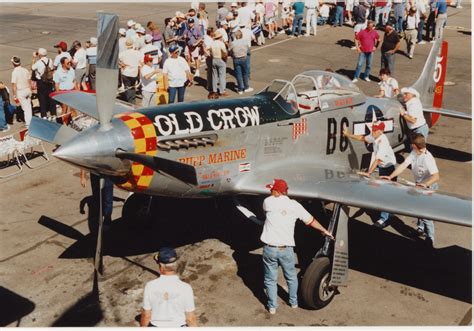
The Mustang also became central to the growing “warbird” movement. Aviation enthusiasts restored former combat aircraft not merely as museum pieces but as flying tributes to the pilots who fought during World War II.
Today, the roar of a Merlin-powered Mustang remains one of aviation’s most unforgettable sounds.
How Many P-51 Mustangs Still Exist Today?
Although over 15,000 Mustangs were built, only a fraction survive today.
According to warbird registries and restoration organizations, approximately 311 P-51 Mustangs of various conditions and configurations are known to exist. Some are fully airworthy, while others remain under restoration or preserved as static displays.
Several surviving aircraft carry authentic combat histories dating back to World War II and Korea. Others have been reconstructed using salvaged components from multiple wrecks.
Museums across the world proudly display Mustangs in historically accurate paint schemes honoring famous pilots and fighter groups. Flying examples frequently appear at airshows, where crowds gather to watch one of history’s greatest fighters return to the skies.
The Lasting Legacy Of The P-51 Mustang
The P-51 Mustang achieved something few military aircraft ever accomplish. It became more than a weapon. It became a symbol.
The fighter represented the technological ingenuity, industrial power, and tactical adaptability that helped secure Allied victory during World War II. Its arrival dramatically reduced bomber losses, weakened German air defenses, and helped establish complete Allied air superiority over Europe.
Its combat record remains extraordinary. Its design remains admired. Its sound remains unmistakable.
Even decades after the final Mustang rolled off the production line in 1946, the aircraft continues captivating historians, pilots, engineers, and aviation fans around the world.
The answer to how many P-51 Mustangs were built is impressive on its own: 15,586 aircraft. But the true significance of the Mustang lies in what those aircraft accomplished. Few fighters in history left such a profound mark on aerial warfare, and few continue inspiring admiration with the same intensity more than eighty years later.