The answer is precise and surprisingly powerful: 1,194 McDonnell Douglas MD-80 aircraft were built during the program’s production run. That number represents one of the most significant narrowbody manufacturing achievements of the late 20th century and cements the MD-80 as a defining aircraft of the jet age.
But numbers alone don’t explain why this aircraft mattered. The MD-80 was more than a stretched DC-9 with louder engines and a stubborn personality. It was a financial strategy wrapped in aluminum. It was an engineering compromise that became a commercial triumph. It was an airplane that outlived predictions, annoyed airport noise committees, and quietly shaped the economics of short- and medium-haul flying for decades.
To understand how 1,194 aircraft came off the line—and why airlines kept flying them long after their prime—we have to zoom out and see the entire arc of the program.
The Total Production Run: 1,194 Aircraft Built
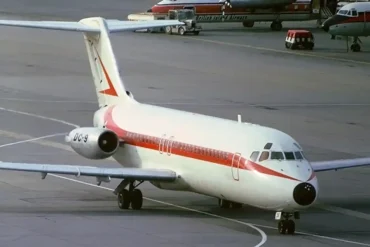
Between its introduction in the late 1970s and the end of production in 1999, McDonnell Douglas produced 1,194 MD-80 family aircraft. That figure includes all main variants under the DC-9-80 and MD-80 designation.
This production total made the MD-80 the most numerous and commercially successful branch of the original DC-9 family tree. Nearly half of all DC-9 derivatives built belonged to the -80 series. In practical terms, the MD-80 became the evolutionary peak of the DC-9 platform before aviation technology decisively moved on.
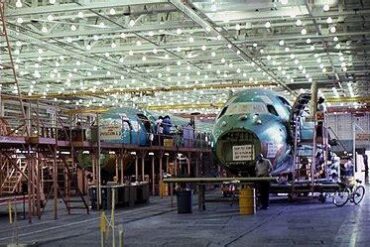
The aircraft rolled off production lines in Long Beach, California. In addition, McDonnell Douglas licensed the Shanghai Aviation Industrial Corporation to build aircraft domestically in China. This international manufacturing footprint extended the program’s global reach and reinforced its commercial significance.
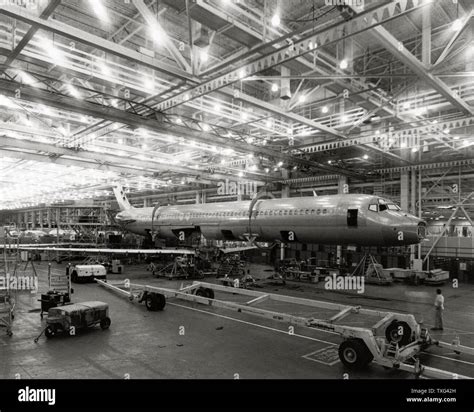
By the time production ended in 1999, the MD-80 had firmly established itself as one of the most recognizable narrowbody jets in the world. At its peak, several hundred could be airborne simultaneously across North America and Europe.
The DC-9-80: Evolution Instead of Revolution
The MD-80 did not emerge as a clean-sheet design. It evolved from the proven DC-9 airframe, first introduced in the 1960s. That decision was not an accident. It was deliberate, conservative, and financially strategic.
Developing an entirely new aircraft requires massive research, new tooling, extensive certification testing, and enormous capital. McDonnell Douglas chose instead to stretch and refine the DC-9-50. The result was the DC-9 Super 80, later branded the MD-80.
This approach provided immediate advantages:
- The company retained the existing Type Certificate, accelerating FAA certification.
- Airlines trusted the DC-9’s reliability.
- Development costs remained relatively low.
- Production infrastructure already existed.
The most visible changes included a longer fuselage, increased wing area, and upgraded Pratt & Whitney JT8D-200 series engines. These engines were still low-bypass turbofans, already becoming outdated compared to emerging high-bypass designs, but they offered improved thrust and efficiency relative to earlier DC-9 models.
The philosophy was simple: maximize return, minimize risk. That mindset helped generate nearly 1,200 aircraft orders over two decades.
Breaking Down the Variants
The 1,194 units built were distributed across several variants. Each version reflected incremental improvements rather than dramatic redesign.
MD-81 (DC-9 Super 81)
The baseline production model carried between 125 and 146 passengers. It used JT8D-209 engines and introduced the stretched fuselage configuration that defined the series.
MD-82 (DC-9 Super 82)
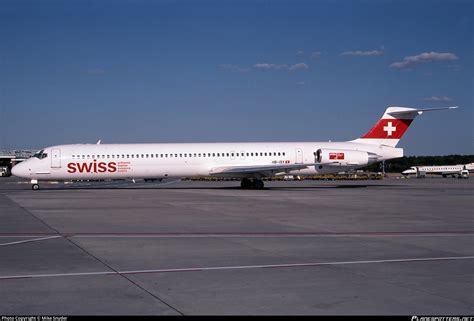
Designed with increased engine power for better hot-and-high performance, the MD-82 became particularly popular in warm-weather markets. It carried roughly 137–155 passengers and saw significant deployment in the United States and Europe.
MD-83
An extended-range variant with additional fuel capacity, strengthened landing gear, and higher thrust engines. The MD-83 allowed operators to expand route networks without stepping into widebody territory.
MD-87
A shortened fuselage version accommodating approximately 105–130 passengers. This variant targeted thinner routes while preserving fleet commonality.
MD-89 (Cancelled)
A proposed stretched model intended to carry up to 173 passengers with extended range. It never entered production, a reminder that even successful aircraft families have limits.
Each of these models contributed to the total 1,194-unit production count, forming a cohesive but flexible narrowbody family.
Why Airlines Bought Hundreds of Them
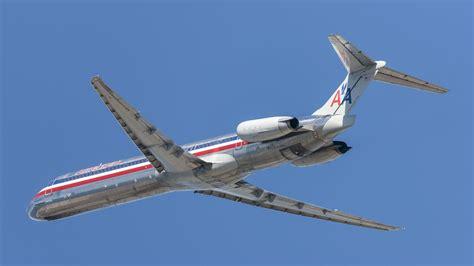
American Airlines became the largest MD-80 operator in the world. After acquiring aircraft through the TWA merger and direct purchases, American’s fleet peaked at more than 360 Super 80s, representing nearly 40% of its entire fleet at one point.
Delta Air Lines operated 243 MD-80 family aircraft throughout its history and became the final major U.S. carrier to retire the type in June 2020. That retirement marked the symbolic end of the aircraft’s dominance in North America.
Outside the United States, Alitalia was the largest MD-80 operator. The aircraft became synonymous with the Italian flag carrier, serving routes across Europe, North Africa, and the Middle East for decades. Scandinavian Airlines (SAS) also relied heavily on the MD-81 during its peak years.
Airlines kept buying and operating the MD-80 for a simple reason: economics.
The aircraft’s production costs were comparatively low. Once paid off, it became a financial asset that required no monthly lease payments. Even as fuel prices rose, the absence of debt made the aircraft profitable in many scenarios where newer jets might struggle under financing burdens.
In aviation, the cheapest airplane is often the one you already own.
Competing With the Boeing 727
In the 1970s, the Boeing 727-200 dominated the short- to medium-haul market. It was powerful, capable, and versatile. It was also thirsty.
McDonnell Douglas positioned the MD-80 as a more economical alternative. The 727 required three engines; the MD-80 needed only two. That alone reduced fuel burn significantly.
Even more consequential was the elimination of the flight engineer position. The MD-80 required a two-person cockpit crew, reducing labor costs per flight. This crew reduction improved seat-mile economics in a competitive environment where margins were razor thin.
Compared to the 727, the MD-80 offered:
- Roughly one-third lower fuel burn per seat-mile
- Reduced crew costs
- Lower maintenance complexity
- Attractive lease return flexibility
That competitive edge translated directly into sales, helping push production toward the 1,194 aircraft total.
The Technology Gap: Already Aging at Birth
Here is the paradox. The MD-80 was considered somewhat outdated almost from the moment it entered service.
While competitors eventually introduced high-bypass turbofans with dramatically improved fuel efficiency, the MD-80 retained the JT8D low-bypass engine architecture. These engines were loud, fuel-hungry by modern standards, and mechanically old-school.
Its cockpit was largely analog, sometimes described as a “hybrid” panel during later upgrades. Meanwhile, next-generation aircraft like the Boeing 737-800 and Airbus A320 adopted full glass cockpits and fly-by-wire systems.
Yet airlines continued buying and flying the MD-80 well into the 1990s.
Why?
Because financial logic often trumps technical elegance. The aircraft was durable, reliable, and fully amortized. It did not need to be cutting-edge to be profitable.
Production Ends in 1999
By the late 1990s, the industry landscape had shifted. Fuel efficiency became increasingly critical. Noise regulations tightened. Passenger expectations evolved. Airbus and Boeing dominated the next-generation narrowbody space.
McDonnell Douglas attempted to extend the family with the MD-90 and later the Boeing 717 (after the Boeing merger), but neither program replicated the MD-80’s scale of success.
In 1999, production ceased. The final tally remained fixed at 1,194 units built.
That figure closed a chapter on one of the most commercially important incremental aircraft programs in aviation history.
A Fleet That Refused to Die
Production may have stopped in 1999, but the MD-80 did not fade quietly. For years afterward, it remained a workhorse across the United States and Europe.
Delta, in particular, demonstrated the aircraft’s durability. At one point in the 2010s, nearly half of Delta’s departures from Atlanta were operated by MD-80s or MD-90s. Dispatch reliability regularly exceeded 90%, reinforcing the aircraft’s reputation as rugged and dependable.
Even as newer aircraft offered 20–25% lower fuel burn, the MD-80 remained competitive on short, high-frequency routes because ownership costs were effectively zero.
The COVID-19 pandemic ultimately accelerated its retirement. Reduced demand, fleet consolidation, rising fuel costs, and tightening environmental standards combined to retire the last major U.S. fleets in 2020.
The Legacy of 1,194 Aircraft
The question “How many McDonnell Douglas MD-80s were built?” yields a straightforward numerical answer: 1,194 aircraft.
But the deeper story reveals something more interesting. The MD-80 was a triumph of conservative engineering and financial pragmatism. It demonstrated that evolutionary design can outperform revolutionary ambition under the right economic conditions.
It was loud. It was unapologetically mechanical. Pilots often described it as “hands-on” and physically engaging to fly. Passengers either tolerated the rear-engine roar or secretly loved it.
The MD-80 family bridged eras. It connected the early jet age of the DC-9 with the modern narrowbody duopoly of Airbus and Boeing. Its production total places it firmly among the most significant narrowbody aircraft of its generation.
Aviation evolves through leaps and refinements. The MD-80 was refinement executed at scale—1,194 times—and that scale ensured its place in history.
Even today, scattered examples continue operating in limited roles around the world. Most, however, now rest in desert storage or museums, reminders of a time when analog dials, tail-mounted engines, and raw mechanical presence defined short-haul flying.
Numbers matter. In this case, the number is 1,194. But the real achievement was not the quantity. It was how long those 1,194 machines shaped the rhythm of commercial aviation across continents.