Total Production of the B-25 Mitchell: A Medium Bomber Built in Massive Numbers
Between 1941 and 1945, the United States executed one of the most staggering industrial mobilizations in human history. Aircraft factories roared day and night, assembly lines stretching like metallic rivers across the American landscape. Within this colossal wartime output, the North American B-25 Mitchell emerged as one of the most recognizable and heavily produced medium bombers of the Second World War.
So, how many were built?
A total of 9,816 B-25 Mitchell bombers rolled off production lines during the war years. This figure includes every combat variant, specialized conversion, and mission-specific modification produced by North American Aviation and its associated facilities. While the number sits far below the production totals of smaller fighters or transport aircraft, it placed the B-25 among the most produced twin-engine bombers of the conflict and the third most-produced strategic bomber class of the war.
This output was part of a broader American bomber construction effort that reached between 95,000 and 100,000 bombers of all types. The Mitchell’s share of that production reflected its versatility: it was neither the largest nor the fastest bomber, but it proved adaptable enough to fight in nearly every theater of the war.
Design Origins: The Birth of a Versatile Combat Aircraft
The B-25 began life in response to a U.S. Army Air Corps requirement issued before America formally entered the war. The service wanted a medium bomber capable of carrying 3,000 pounds of ordnance, flying at 300 miles per hour, and reaching targets over 2,000 miles away. North American Aviation answered with a design that balanced payload, speed, and rugged survivability.
The prototype first flew in 1940. Early testing revealed a stability issue known as “dutch roll,” an oscillating side-to-side motion that could make long flights exhausting and dangerous. Engineers solved this by flattening the outer wing panels, giving the Mitchell its distinctive gull-wing profile—a shape that became both functional and iconic.
Armor plating and self-sealing fuel tanks were integrated early, reflecting lessons already learned from European combat. Even in its infancy, the B-25 was designed to absorb punishment and bring crews home.
Early Production Variants: From B-25A to B-25D
The first operational models revealed how quickly wartime aircraft evolved.
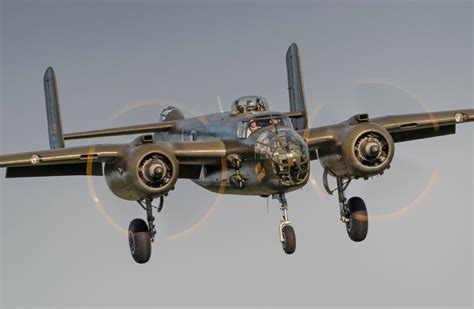
The B-25A entered service with limited defensive armament but already incorporated survivability upgrades like cockpit armor. Combat experience rapidly demanded heavier protection, leading to the B-25B, which introduced powered gun turrets on both the dorsal and ventral fuselage. These turrets featured remote sighting systems—advanced technology for the era—and significantly improved defensive coverage.
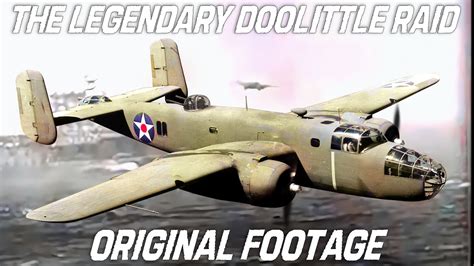
It was the B-25B that would achieve immortality in one of the war’s most daring operations: the Doolittle Raid.
Mass production truly accelerated with the B-25C and B-25D variants. Manufacturing expanded to multiple plants, including Inglewood, California, and Kansas City. Together, these two versions accounted for more than 3,800 aircraft, forming the backbone of early Mitchell combat deployment.
Factories refined production methods constantly—simplifying wiring, standardizing parts, and adjusting armor layouts—turning the Mitchell into a machine that could be built quickly without sacrificing combat durability.
The Rise of the Gunship: B-25G and B-25H
Combat has a way of rewriting engineering blueprints.
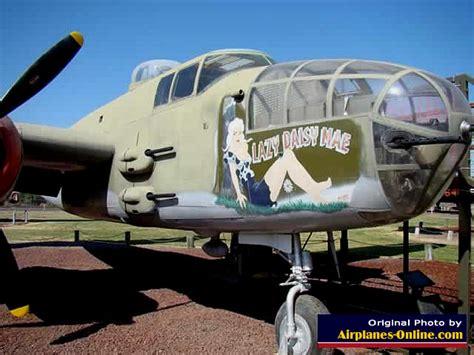
As Allied forces pushed into Europe and the Pacific, commanders discovered that medium bombers could be devastating at low altitude. Strafing runs—high-speed attacks against ships, convoys, and airfields—proved brutally effective. The B-25, with its stable flight characteristics and roomy nose section, became an ideal candidate for transformation into a flying gun platform.
The B-25G embodied this shift. Its most striking feature was a 75-millimeter cannon mounted in the nose—an artillery piece more commonly associated with tanks. Supplemented by forward-firing .50-caliber machine guns, the aircraft could rip through shipping and fortified ground targets. Over 400 units were built.
Engineers pushed the concept further with the B-25H. This version retained a lighter cannon but dramatically expanded machine-gun armament. Additional forward guns, combined with waist and tail positions, turned the aircraft into a storm of converging firepower. To save weight, designers even removed the co-pilot seat in some configurations.
More than 1,000 B-25H gunships were produced, and they became feared low-level attackers across the Pacific.
The Most Numerous Variant: B-25J Production Dominance
If the G and H variants represented specialization, the B-25J represented synthesis.
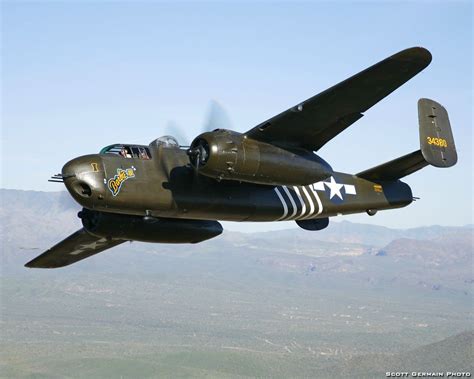
With 4,318 aircraft built, it was the most produced Mitchell variant by a wide margin. The J model blended high-altitude bombing capability with the option for heavy strafing armament. Some retained the classic glass bombardier nose, while others were modified into solid-nose gunships.
North American Aviation established modification centers where brand-new aircraft could be tailored for specific missions before delivery. B-25Js emerged configured for:
- Reconnaissance
- Maritime patrol
- Arctic operations
- Desert warfare
- Low-level gunship strikes
This modular philosophy allowed the same base aircraft to serve radically different roles without redesigning the airframe from scratch—a production efficiency that helped sustain high output late into the war.
The Doolittle Raid: When the B-25 Made History
On April 18, 1942, sixteen B-25B bombers launched from the deck of the aircraft carrier USS Hornet in an operation that sounded like fiction but unfolded as history.
The Doolittle Raid marked the first time land-based medium bombers struck the Japanese home islands. The psychological shock far outweighed the physical damage, proving Japan was vulnerable and boosting Allied morale after months of setbacks.
The B-25 was selected for practical reasons. It combined short takeoff performance, solid payload capacity, and forgiving low-speed handling. Its tricycle landing gear—a nose wheel rather than a tail-dragger layout—improved pilot visibility during carrier takeoff rolls.
Crews trained intensely to launch from the carrier’s 467-foot deck. Pilots timed their acceleration with the ship’s bow rising on ocean swells, using wind and lift to claw into the air at speeds near 70 mph—astonishing for a bomber of its size.
Engineering a One-Way Mission
The raid demanded extreme aircraft modifications.
Standard B-25 fuel capacity was insufficient for the 2,400-mile mission from carrier launch to Chinese landing zones. Engineers and crews improvised additional fuel storage throughout the fuselage:
- Rubber tanks in the bomb bay
- Fuel bags in crawlways
- Auxiliary containers in turret compartments
- Hand-poured reserve cans mid-flight
Defensive systems were stripped to save weight. Tail guns were removed, and some aircraft installed painted broomsticks to simulate armament and deter fighters. The highly secret Norden bombsight was replaced with a simpler improvised device to prevent capture.
The raiders flew at wave-top altitude to avoid radar detection, navigating across hostile territory in aircraft never designed for carrier warfare or ultra-long-range penetration.
The mission succeeded tactically and resonated strategically, altering both American morale and Japanese defensive planning.
Global Operators: The Mitchell Across Allied Air Forces
Although built in the United States, the B-25 became a multinational workhorse.
The U.S. Army Air Forces operated the majority, deploying Mitchells in Europe, North Africa, the Mediterranean, and the Pacific. The aircraft’s adaptability made it equally effective against bridges in Italy, airfields in Burma, or shipping in the Bismarck Sea.
Other operators expanded its global footprint:
- U.S. Navy and Marine Corps flew the PBJ-1 maritime patrol variant
- The Royal Air Force operated Mitchell squadrons in Europe
- The Soviet Union received aircraft via Lend-Lease
- The Royal Australian Air Force used them in the Pacific
- Chinese Nationalist forces deployed them against Japan
- Free Dutch and Free French units integrated them into Allied operations
This widespread adoption underscored the bomber’s reliability and logistical practicality.
Industrial Scale: Factories That Built the Mitchell
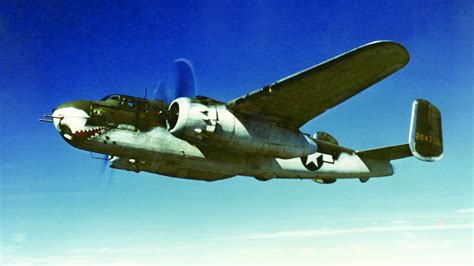
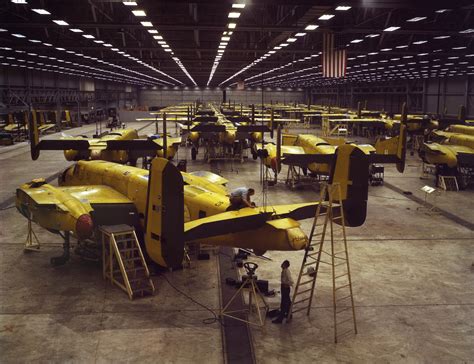
The production of 9,816 bombers required industrial choreography on a national scale.
North American Aviation transformed from a modest manufacturer into a wartime giant. Its facilities—including Inglewood and Kansas City—operated 24 hours a day, often six or seven days per week.
The Kansas City plant, built at Fairfax Airport, embodied wartime secrecy and urgency. Designed with minimal outward light exposure to avoid aerial detection, the factory initially planned to produce B-29 Superfortresses. When that contract shifted, the facility pivoted to B-25 production, dramatically increasing Mitchell output.
By 1943, the plant was producing aircraft at nearly four times its earlier rate.
Across all programs, North American manufactured more than 40,000 aircraft, accounting for roughly 14% of total U.S. wartime aircraft production—a staggering industrial contribution.
Lessons Learned and Evolution in Doctrine
The Doolittle Raid and subsequent combat deployments reshaped how the B-25 was used.
Originally conceived for medium-altitude level bombing, the aircraft proved far more lethal at low altitude. Strafing shipping lanes, destroying supply convoys, and attacking airstrips became signature missions.
North American responded by institutionalizing flexibility through Modification Centers, where aircraft could be refitted immediately after assembly. This reduced downtime and allowed combat units to request theater-specific upgrades.
The Mitchell’s evolution from bomber to gunship illustrated a broader wartime engineering truth: aircraft that adapt survive.
Production Compared to Other North American Aircraft
Despite its impressive production run, the B-25 was not North American Aviation’s most numerous aircraft.
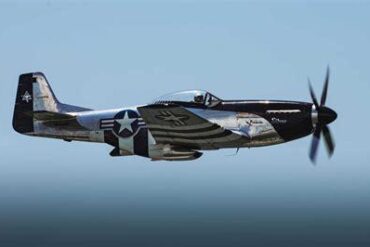
The company produced vast numbers of the T-6 Texan trainer, a crucial pilot training platform, and the legendary P-51 Mustang fighter. The Dallas plant alone manufactured nearly 19,000 aircraft, including approximately 17,000 T-6s and over 15,000 P-51s.
This context highlights the Mitchell’s place within a larger ecosystem of wartime aviation manufacturing—essential, prolific, but part of an even greater industrial constellation.
End of Production and Postwar Transition
With Japan’s surrender in August 1945, wartime aircraft demand collapsed almost overnight.
B-25 contracts were canceled on August 18, 1945. Orders that once projected 8,000 additional aircraft shrank to just 24 within months. The Kansas City facility completed a final batch of 72 Mitchells by October 31, 1945, closing the bomber’s production chapter.
Factories that had built instruments of war transitioned back to civilian industry. The Kansas City plant, for instance, was transferred to General Motors for automobile manufacturing—an industrial sword reforged into a plowshare.
Legacy of the B-25 Mitchell
Counting production totals tells only part of the story.
The B-25 Mitchell earned a reputation as one of the most adaptable, durable, and mission-flexible bombers of World War II. It served in bombing, strafing, reconnaissance, maritime patrol, and special operations roles. It launched from carriers, operated from jungle strips, and endured extreme climates from Arctic cold to Pacific humidity.
Its 9,816-aircraft production run reflects more than manufacturing scale—it represents engineering elasticity under wartime pressure.
Few aircraft could shift so fluidly between doctrines: from precision bombing at altitude to cannon-armed ship hunting at wave height. Fewer still could do so while being flown by such a wide coalition of Allied nations.
The Mitchell’s story lives at the intersection of industry, innovation, and audacity—where assembly lines met carrier decks, and where a medium bomber became an outsized symbol of Allied reach.