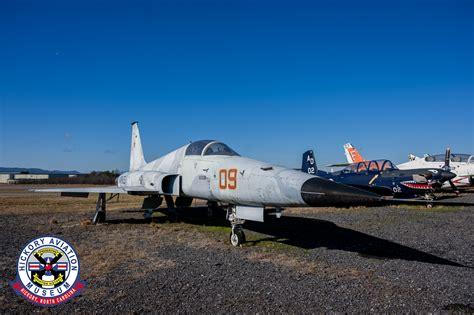
The question sounds simple: How many Northrop F-5 Tiger II fighters were built? The answer, like many Cold War stories, is layered with export politics, licensed production lines, and an aircraft family that quietly became one of the most successful Western fighter programs of its era.
In total, approximately 2,600 F-5 fighters were produced across two generations. If you include the closely related T-38 Talon trainer, which shares the same design roots, that number rises to roughly 3,800 aircraft. For a light fighter that the United States itself never fully embraced as a frontline jet, those figures are extraordinary.
To understand how those numbers came to be, and why the F-5 still flies more than six decades after its first flight, we need to trace the aircraft’s evolution—from the early Freedom Fighters to the refined Tiger II—and explore the strategic decisions that shaped its production.
The Origins of the Northrop F-5 Program
The F-5 began life as the Northrop N-156, a lightweight, twin-engine supersonic design intended to be simple, affordable, and exportable. At a time when fighters like the F-4 Phantom II were growing heavier, more complex, and more expensive, Northrop pursued a different philosophy: compact size, mechanical reliability, and low operating costs.
The aircraft’s first flight took place on July 31, 1963, marking the start of what would become one of the longest-serving fighter families in modern aviation. Unlike many ambitious Cold War programs that ballooned in cost and shrank in production, the F-5 delivered something rare in military aviation—performance as promised, on schedule, and within budget.
That reputation would become central to its global success.
First Generation: F-5A and F-5B Freedom Fighters
The first operational generation consisted primarily of the F-5A single-seat fighter and the F-5B two-seat combat-capable trainer, collectively known as the Freedom Fighter series.
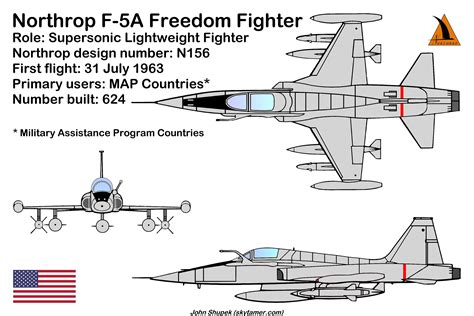
These early variants were optimized largely for the air-to-ground mission. They lacked a sophisticated fire-control radar and were limited in air-to-air capability. In the early 1960s, this was a calculated compromise. Many allied air forces needed an affordable supersonic aircraft more than they needed a high-end interceptor.
Production figures for the first generation were substantial:
- 624 F-5A single-seat fighters (including prototypes)
- 200 F-5B two-seat trainers
- 86 RF-5A reconnaissance variants
- Additional minor subvariants
In total, 1,204 first-generation F-5A/B/C/D aircraft were built before Northrop transitioned to the second generation in 1972.
The aircraft earned the nickname “Tiger” during the Vietnam War when a dozen F-5As were deployed under the program name “Skoshi Tiger.” While their combat role was limited, the name stuck—and it would define the second generation.
The Evolution to the F-5E Tiger II
By the late 1960s, air combat requirements were changing. The spread of improved MiG-21 variants and radar-guided missiles demanded better sensors and stronger air superiority performance. Northrop responded with a significantly upgraded version: the F-5E Tiger II.
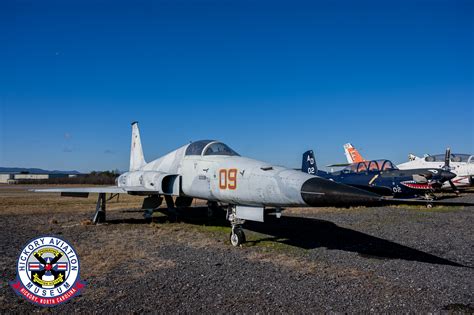
Introduced in 1972, the F-5E featured:
- A redesigned, larger fuselage
- More powerful engines
- Improved aerodynamics
- An advanced AN/APQ-159 radar, replacing the older AN/APQ-153
The new radar doubled detection range, improved off-boresight tracking angles, and significantly enhanced reliability. While it did not match the capability of heavy fighters like the F-15, it transformed the F-5 into a credible air superiority platform within its weight class.
Production of the F-5E was extensive and global.
Second Generation Production Numbers: F-5E and F-5F
Between 1972 and 1989, the second-generation Tiger II family was produced in large numbers both in the United States and under international license.
Northrop built:
- 792 F-5E single-seat fighters
But this was only part of the story. Licensed production added significantly to the total:
- Taiwan built 308 F-5Es
- South Korea built 68 F-5Es
- Switzerland built 91 F-5Es
Altogether, more than 1,200 F-5E aircraft were produced worldwide.
The two-seat version, the F-5F Tiger II, also saw strong production:
- 146 built by Northrop
- 20 built by South Korea
- 66 built by Taiwan
This brings the total F-5F production to roughly 230–250 aircraft, depending on accounting of subvariants.
In total, approximately 1,399 F-5E/F Tiger II aircraft were produced.
When combined with the first-generation Freedom Fighters, overall F-5 fighter production reaches approximately 2,600 aircraft.
The F-20 Tigershark: The Jet That Never Was
No discussion of F-5 production is complete without mentioning the F-20 Tigershark, originally designated the F-5G. It was a radical evolution of the Tiger II concept.
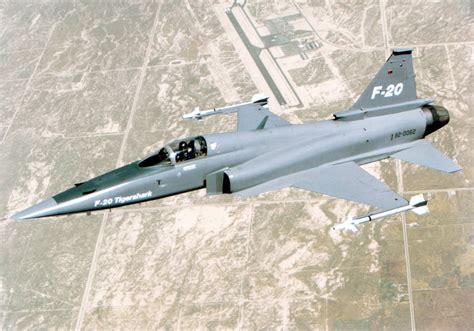
The F-20 featured:
- A powerful new engine
- The General Electric AN/APG-67 radar
- Modernized avionics
- True beyond-visual-range combat capability
Technically, it was a major leap forward. Strategically, it was ill-timed. When U.S. export restrictions eased, many potential buyers gained access to the more capable F-16 Fighting Falcon. Given the option, most selected the F-16.
Only three F-20 prototypes were built. Not a single production aircraft was sold.
The Tigershark stands as one of aviation history’s great “what if” stories—a reminder that performance alone does not guarantee production success.
The T-38 Talon: The Trainer Cousin
While the F-5 family served primarily export customers, its design DNA also produced one of the most successful jet trainers in history: the T-38 Talon.
Derived from the same N-156 lineage, the T-38 was purpose-built as a supersonic trainer for the United States Air Force.
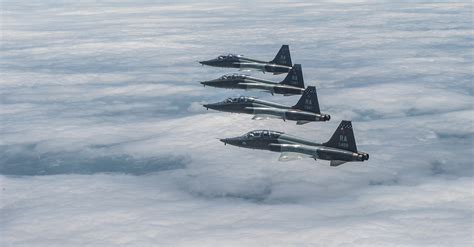
A total of 1,187 T-38 Talons were produced, nearly all as two-seat trainers. Unlike the F-5, none were license-built overseas. The T-38 became the backbone of advanced jet training in the United States and remains in service more than six decades after introduction.
If we combine F-5 fighters (≈2,600) and T-38 trainers (1,187), the broader Northrop “5” family totals roughly 3,800 aircraft.
That is a remarkable production run for a lightweight design that was never the U.S. Air Force’s primary fighter.
How Many F-5s Remain in Service Today?
Production numbers tell only part of the story. Longevity defines success in military aviation.
Estimates suggest that around 400 to 500 F-5 fighters remain in service worldwide today, excluding T-38 trainers. Including T-38s, active aircraft in the broader family may exceed 1,200.
The aircraft remains operational in countries such as:
- South Korea (largest current F-5 operator)
- Botswana
- Kenya
- Tunisia
- Several other nations using the jet for training or limited air defense
In South Korea alone, roughly 90+ F-5s are believed to remain active, providing air policing and interim combat capability while the KF-21 Boramae enters service.
The durability of the F-5 contrasts sharply with aircraft like the MiG-21, which, despite far larger production numbers (over 11,000 built), now survives in only small and often uncertain operational numbers.
Why the F-5 Production Story Matters
The raw figure—approximately 2,600 F-5 fighters built—is impressive on its own. But the real significance lies in how those numbers were achieved.
The F-5 was:
- Delivered on schedule
- Delivered at or below contract price
- Built with engineered growth potential
- Designed for low operating costs
That last point is crucial. Many advanced fighters become too expensive to sustain, leading to early retirements. The F-5’s simplicity allowed smaller air forces to maintain credible supersonic capability without unsustainable budgets.
Its structure was robust. Its engines were relatively easy to overhaul. Its avionics could be upgraded incrementally. In Chile, for example, F-5s were modernized with the EL/M-2032 radar, allowing use of advanced missile systems and extending relevance decades beyond original specifications.
The result is an aircraft that outlasted rivals not by brute performance, but by intelligent design.
Final Production Totals at a Glance
To answer the central question clearly:
- First-generation F-5A/B/C/D: 1,204 built
- Second-generation F-5E/F Tiger II: 1,399 built
- Total F-5 fighters: Approximately 2,600
- F-20 Tigershark prototypes: 3
- T-38 Talon trainers: 1,187
- Grand total (F-5 family + T-38): Approximately 3,800
These numbers place the F-5 among the most successful Western fighter aircraft of the Cold War era.
A Lightweight Fighter with Heavy Influence
The F-5 was never the flashiest aircraft of its generation. It did not dominate headlines like the F-14 or F-15. It did not embody fifth-generation stealth mystique. Instead, it quietly delivered exactly what dozens of nations needed: a reliable, affordable, supersonic fighter that could be maintained without industrial superpower budgets.
More than sixty years after its first flight, hundreds remain in service. That longevity is not accidental. It is the product of disciplined engineering and strategic export positioning.
So when asking how many Northrop F-5 Tiger II fighters were built, the answer—about 2,600 fighters, or nearly 3,800 including the T-38 family—is not just a statistic. It is a testament to one of the most enduring tactical aircraft designs ever introduced.
In an era where fighter programs are often defined by spiraling costs and shrinking production runs, the F-5 stands as a reminder that sometimes, lighter and simpler can mean longer-lasting—and ultimately more influential.