Montreal’s aviation landscape has rarely been shaped by calm, incremental change. Instead, it has been defined by ambition, miscalculation, and the long shadow of infrastructure decisions that outlived their usefulness. The latest development at Montreal Metropolitan Airport (YHU) represents a rare attempt to break that cycle. Rather than chasing symbolic scale or international prestige, Porter Airlines and its partners are building something deliberately restrained, commercially disciplined, and tightly aligned with real passenger behavior. The goal is not to replace Montréal–Trudeau International Airport, but to relieve it in a way that finally makes a two-airport system viable in a city still haunted by one of aviation’s most expensive failures.
For half a century, Montreal’s aviation planners have lived with the consequences of Mirabel Airport. What was once imagined as a futuristic replacement for Dorval turned into a sprawling monument to forecasting errors, distance miscalculations, and misplaced expectations about how travelers choose airports. The lesson was simple, but painfully expensive: infrastructure only works when passengers actually want to use it. YHU is being shaped around that principle from the ground up.
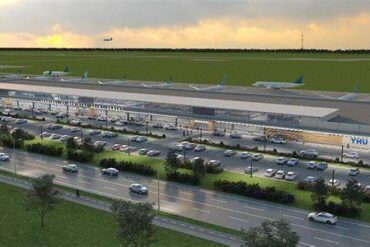
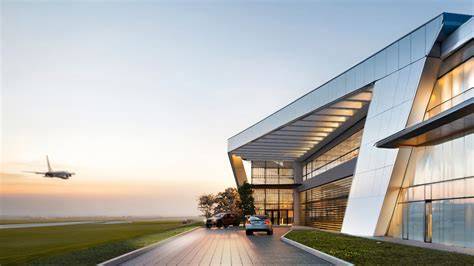
On June 15, 2026, Montreal Metropolitan Airport officially opens its new $450 million commercial terminal at the former Saint-Hubert Airport site. Unlike Mirabel, which was designed as a bold leap into the future, YHU is being built as a pragmatic extension of present-day demand. It is not trying to redefine global aviation. It is trying to make domestic flying less painful.
The Ghost of Mirabel Still Shapes Every Decision
Mirabel Airport remains one of the most instructive failures in North American aviation history. Built roughly 55 kilometers from downtown Montreal, it was conceived during an era when planners believed passenger growth would justify a massive greenfield airport far from the city core. The vision was not modest. Mirabel was intended to eventually absorb international traffic, replace existing facilities, and serve as a continental gateway of unprecedented scale.
What the planners underestimated was not demand, but behavior. Travelers do not simply follow capacity; they follow convenience. The long distance from the city center, combined with inadequate transport connections, made Mirabel feel disconnected from the daily rhythm of Montreal life. Airlines struggled with fragmented operations as domestic and international flights were split between two airports, increasing costs and reducing efficiency. Over time, the system collapsed under its own complexity.
By the early 2000s, passenger services had effectively returned to the closer Dorval site, now known as Montréal–Trudeau International Airport. Mirabel’s vast terminals were repurposed for cargo and industrial uses, becoming a physical reminder that infrastructure success depends less on ambition than on usability.
That legacy is not theoretical for YHU. It is operational guidance.
Why YHU Is Designed Around Distance, Not Dreams
The defining difference between Mirabel and YHU is geography. Saint-Hubert Airport sits approximately 15 kilometers from downtown Montreal on the South Shore, a distance that transforms the psychology of travel. Instead of planning for a half-hour drive to a remote mega-terminal, passengers can realistically integrate airport travel into daily urban movement patterns.
This proximity shapes everything about the new terminal. The 226,000-square-foot facility is intentionally compact by global hub standards, yet highly optimized for throughput. It includes nine boarding bridges, streamlined security lanes, and a passenger flow design that minimizes unnecessary walking. Capacity is set to reach up to four million passengers annually, but the emphasis is on predictability and speed rather than expansion for its own sake.
The design philosophy rejects the traditional airport logic of “bigger equals better.” Instead, it treats time as the core product. The terminal is engineered so that friction points are reduced at every stage, from curbside drop-off to gate access. The intent is not to impress travelers with scale, but to remove reasons for frustration.
Porter Airlines and the Domestic-First Strategy
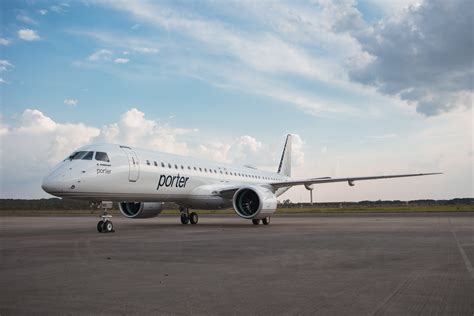
Porter Airlines plays a central role in making YHU viable. Once known primarily for regional turboprop service, the airline has undergone a significant transformation into a competitive domestic network carrier. At YHU’s launch, Porter plans 138 weekly flights across 12 Canadian destinations, creating a tightly focused network designed to establish immediate utility.
The fleet mix is central to this strategy. The Embraer E195-E2 jets provide the range and capacity needed for cross-country routes, while the Bombardier Dash 8-400 aircraft maintain efficient service on shorter regional segments. This dual-fleet approach allows Porter to calibrate supply with demand in a way that avoids the inefficiencies that often plague new airport launches.
Critically, Porter is not attempting to turn YHU into an international gateway at inception. That decision marks a sharp departure from the Mirabel model, which was built with global expansion as an early expectation rather than a gradual outcome. By focusing exclusively on domestic traffic, YHU reduces operational complexity and avoids the customs and immigration bottlenecks that can overwhelm new facilities.
The result is a more controlled growth environment where passenger experience can stabilize before expansion pressures emerge.
A Private Capital Model Built for Accountability
One of the most structurally important differences between YHU and earlier airport megaprojects lies in its financing model. The total investment of approximately C$450 million is significant, but it is modest compared with traditional large-scale airport expansions that can spiral into multi-billion-dollar commitments.
Funding is anchored by YHU Infrastructure Partners, a joint venture between Porter Aviation Holdings and Macquarie Asset Management, one of the world’s largest infrastructure investors. This structure introduces a level of commercial accountability that public-only projects often lack. Investors are not rewarded for building capacity alone; they are rewarded for generating sustained passenger volume.
Supplementing this structure is a C$90 million loan from the Canada Infrastructure Bank, aligning public interest objectives with private sector discipline. The financial design ensures that every operational decision is tied to demand reality rather than speculative forecasting.
This matters because it changes incentives. Instead of expanding for prestige or political visibility, the airport must continuously justify itself through usage. If passengers do not come, revenue does not materialize. That feedback loop is exactly what was missing in Mirabel’s original development logic.
The Airport That Sells Time Instead of Space
YHU’s most distinctive proposition is not architectural. It is experiential. The airport is being positioned as a time-saving alternative rather than a structural replacement for larger facilities. In practical terms, that means reducing the psychological and physical distance between arrival and departure.
The terminal layout emphasizes directness. Short walking paths replace long corridors. Security processing is designed to reduce queue volatility. Wayfinding is simplified to limit decision fatigue. The goal is that passengers can arrive significantly closer to departure time than they would at traditional large hubs without increasing risk of missing flights.
This approach aligns with modern travel behavior, where time efficiency often outweighs loyalty to specific airports. In domestic markets especially, passengers frequently choose based on convenience rather than network connectivity. YHU is explicitly designed to exploit that preference.
The absence of international processing is also a strategic advantage. Without customs and immigration flows, the airport avoids one of the most common congestion points in global aviation. That allows operational focus to remain on rapid movement rather than regulatory complexity.
Can Montreal Sustain Two Airports Without Fragmentation
The long-term viability of YHU depends on whether Montreal can support a functional multi-airport system without repeating past fragmentation. Montréal–Trudeau International Airport remains the dominant hub, handling international traffic and the majority of long-haul connectivity. YHU is not positioned to challenge that role.
Instead, it is attempting to carve out a complementary niche focused on domestic and regional travel. In theory, this mirrors systems in cities like London or New York, where different airports specialize in different traffic types. The success of such systems depends on clarity of role separation. When airports compete directly for the same passengers, inefficiencies emerge. When they specialize, networks stabilize.
YHU’s challenge is not infrastructure readiness. It is behavioral adoption. Travelers must perceive sufficient value in switching airports to justify changing established habits. Porter’s strategy suggests that convenience, rather than pricing or novelty, will be the primary driver of that shift.
If successful, Montreal will finally achieve what Mirabel was originally intended to deliver, but through an entirely different logic: not consolidation, but functional distribution of demand.
If it fails, the region will once again confront a familiar truth about aviation infrastructure. Building capacity is straightforward. Aligning it with human behavior is not.