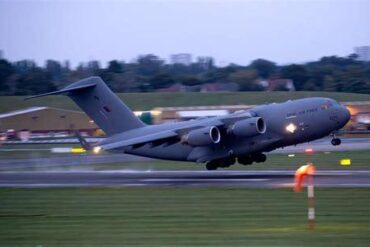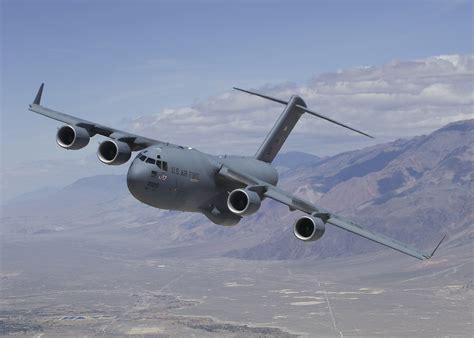
The Boeing C-17 Globemaster III looks like it should obey the usual laws of big jets: fast, high, and allergic to dirt runways. Instead, it behaves like an aerodynamic heretic. This 585,000-pound airlifter can creep through the sky at speeds that make other aircraft of its size sweat bullets, then drop into short, rough strips with a precision that feels more helicopter than heavy jet. The result is a machine that rewrote how modern militaries think about moving massive cargo directly into the teeth of chaos, without the luxury of long concrete runways or safe rear-area hubs.
That low-and-slow talent is not a party trick. In contested airspace, altitude and speed are visibility. The faster and higher a jet flies, the more predictable and detectable it becomes to radar, infrared sensors, and visual observers. The C-17’s extremely low and slow flying capability lets it contour the terrain, hide in valleys, and approach landing zones on steep, aggressive profiles that shorten exposure time to ground threats. It is survival engineering turned into metal and software, where lift, thrust, and control logic collaborate to keep a giant airborne when physics would rather see it fall out of the sky.
Strategic airlift used to mean distance and payload at the cost of flexibility. Tactical airlift meant flexibility at the cost of payload. The C-17’s design ambition was to refuse that tradeoff. It had to cruise intercontinentally like a long-haul airliner, then arrive behaving like a bush plane on steroids. That contradiction forced engineers to squeeze performance out of every square inch of wing, every pound of thrust, and every line of flight-control code. The aircraft’s low-speed magic is not one clever trick. It is a layered system of aerodynamic decisions, propulsion geometry, and digital control that turns stall margins into working space.
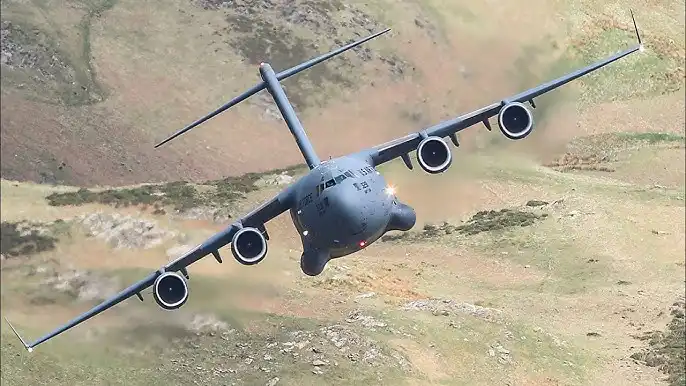
Built for Direct Delivery into Hostile Terrain
The C-17 Globemaster III was shaped by a logistical problem, not a stylistic one. In the late Cold War era, planners faced an ugly gap between the gigantic C-5 Galaxy, which demanded long, pristine runways, and the rugged C-130 Hercules, which could land almost anywhere but could not carry the heaviest vehicles and outsized equipment. The solution was not a compromise aircraft. It was a hybrid philosophy: strategic reach married to tactical intimacy. The aircraft had to leave a continental base, cross oceans, then descend into airstrips that looked more like scraped earth than infrastructure.
That requirement pushed the airframe toward unusual proportions. The wing is broad and carefully shaped to stay productive at low speeds, while the fuselage is tall and boxy to swallow tanks, helicopters, and palletized relief supplies. The landing gear was engineered for brutality, spreading weight across multiple wheels to avoid pulverizing dirt, gravel, or ice. The result is an aircraft that treats a 3,500-foot strip as a working runway rather than a dare. This is not merely about landing short. It is about arriving with authority, unloading fast, turning around on narrow surfaces, and leaving before the situation deteriorates.
Low-speed flight matters long before the wheels touch. Approach profiles into austere zones are steep, often flown with minimal margins for error. The C-17’s geometry and control systems allow pilots to fly high angles of attack without losing authority over pitch and roll. That stability at the edge of the flight envelope is the foundation of its assault-landing reputation. The aircraft is comfortable in the uncomfortable parts of the sky, where airflow is messy and margins are thin.
NASA-Inspired Wing Physics That Refuse to Stall
At the heart of the C-17’s slow-flight prowess sits a wing that learned its manners from research aircraft. The supercritical wing design, matured through NASA aerodynamic studies, reshapes how air behaves at both high and low speeds. Traditional wings generate shockwaves on their upper surfaces as they approach transonic speeds, wasting energy as drag. The supercritical profile flattens the upper surface and thickens the trailing edge, delaying shock formation and preserving efficiency during cruise. That keeps the C-17 economical and stable at around 450 knots despite its blunt fuselage.
The quiet brilliance is what happens when the aircraft slows down. Lift is a conversation between wing shape and airflow energy. At low speeds, airflow becomes lazy, and wings risk stalling as smooth flow separates into turbulence. The C-17 fights that separation with aggressive high-lift devices: leading-edge slats that guide air over the wing at steep angles, and large, double-slotted flaps that dramatically increase wing area and curvature. These surfaces do not merely tweak lift. They transform the wing into a different machine for slow flight, one that can remain productive when forward speed drops far below what other heavy jets tolerate.
This is where the physics gets mischievous. Lift normally comes from speed. The C-17 manufactures lift by reshaping how air clings to its wings. That allows the aircraft to fly approach speeds in the 150-knot range during routine operations and even slower in tactical profiles, with stability that feels unfair for something weighing more than half a million pounds. The wing refuses to give up when airflow gets sluggish, and that refusal is the foundation of short-field performance.
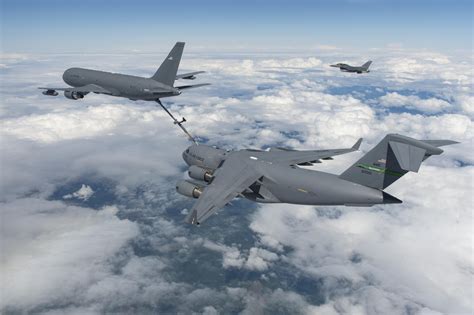
Powered Lift: When Engines Become Part of the Wing
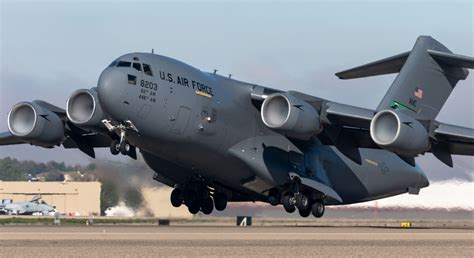
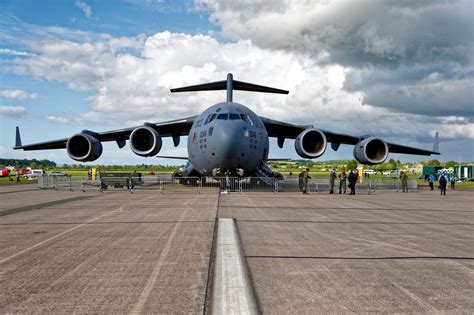
The C-17’s most elegant cheat code is how it uses its engines to help the wings do their job. The four turbofans are mounted so that their exhaust flows directly over and through the extended flaps during approach and landing. This externally blown flap arrangement turns engine thrust into an aerodynamic tool. The high-energy exhaust re-energizes the airflow over the wing, delaying separation and dramatically boosting lift at low speeds. In practical terms, the aircraft carries its own wind over the wing, even when forward motion alone would be insufficient.
This is powered lift in action. The engines are no longer just pushing the aircraft forward. They are actively shaping the airflow that keeps it airborne. That synergy allows the C-17 to remain controllable at speeds that would push other jets into a stall. It also tightens the relationship between throttle and lift, giving pilots a direct way to fine-tune descent rates and approach angles without relying solely on pitch changes. The aircraft becomes more helicopter-like in its responsiveness during the final moments of an assault approach.
The geometry of the tail matters here too. The tall T-tail keeps the horizontal stabilizer out of the turbulent wake of the wing and engines during high-lift configurations. Clean airflow over the tail preserves pitch authority when the aircraft is flying slow and steep, exactly when control margins are thinnest. The whole airframe is choreographed to keep airflow attached and controllable when the sky is trying to pull the rug out from under it.
The Art of Falling Fast Without Going Fast
Slow flight is only half the trick. The other half is getting down quickly without building dangerous speed. The C-17 is famous for its steep tactical descents, dropping at rates that would make airline passengers reconsider their life choices. The aircraft can shed altitude at more than 12,000 feet per minute while holding a relatively low airspeed. This is how it stays high and safe for most of an approach, then dives into a landing zone with minimal exposure time.
The secret weapon here is the in-flight use of thrust reversers. On most jets, reversers are a ground-only affair. On the C-17, they can be deployed in the air as aerodynamic brakes. The engine cowlings redirect thrust forward and upward, opposing the aircraft’s motion and dumping energy without demanding a nose-high attitude that could risk a stall. This lets pilots fly steep glideslopes at stable speeds in the 115 to 135-knot range, even while descending aggressively toward short, rough strips.
This technique reshapes approach geometry. Instead of long, shallow descents that advertise the aircraft’s presence, the C-17 can remain high until the last practical moment, then commit to a rapid, controlled plunge. The landing itself is flown with conviction. The aircraft is planted onto the runway rather than floated gently, trusting its robust landing gear to absorb the energy. The combination of powered lift on the way down and aerodynamic braking on the way in makes the whole maneuver feel like controlled gravity.
Digital Nerves: Fly-By-Wire That Guards the Edge
A human pilot alone cannot juggle the physics of steep descents, powered lift, and high angles of attack without help. The C-17’s quadruple-redundant fly-by-wire system acts as a digital nervous system, filtering pilot inputs through layers of logic that protect the aircraft from overstressing itself. This does not make the aircraft docile. It makes it precise. The control laws allow aggressive bank angles and rapid roll rates while quietly preventing stalls and structural abuse.
The cockpit design reinforces that precision. The center-mounted control stick blends the tactile feel of a fighter with the familiarity of a transport yoke, giving pilots fine-grained authority during demanding approaches. Dual head-up displays keep critical flight data in the pilot’s line of sight, reducing the need to look down at instruments when flying low and close to terrain. The aircraft becomes an extension of the crew’s intent rather than a wrestling match with aerodynamics.
This digital scaffolding is what allows the C-17 to exploit its low-speed envelope safely. The computers continuously balance pitch, thrust, and control-surface deflection to keep the aircraft within safe limits while still granting the agility needed to mask behind terrain and thread narrow approach corridors. The result is a heavy jet that can bank hard, descend steeply, and fly slow without flirting with disaster.
Landing Where Runways Pretend to Exist
Short-field performance is meaningless if the aircraft shatters itself on arrival. The C-17’s landing gear is engineered like expedition equipment. Fourteen wheels distribute weight across a wide footprint, lowering ground pressure so the aircraft can operate on dirt, gravel, and even sea ice. The suspension is tuned to absorb brutal touchdown energies, allowing pilots to commit to steep approaches without fearing that the landing will end the mission.
Ground handling is part of the low-speed story. The C-17 can back itself up using thrust reversers, a capability that turns tiny strips into workable parking lots. The exhaust is directed upward to avoid blasting debris into the engines, reducing foreign object damage in austere environments. Tight turning capability allows the aircraft to reverse direction on narrow surfaces using a three-point turn. This autonomy matters when there is no ground crew, no tug, and no margin for dithering.
The practical effect is profound. A remote strip becomes a logistics node. Cargo moves directly from intercontinental flight to front-line delivery without being broken down and reloaded onto smaller aircraft. That compression of the supply chain is what turns low-speed flight from an aerodynamic curiosity into a strategic advantage.
Why Low and Slow Redefined Heavy Airlift Strategy
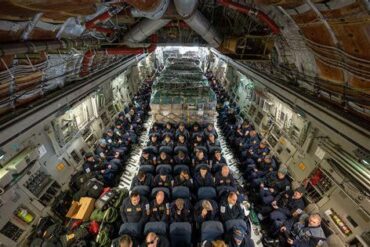
The C-17’s slow-flight capability reshaped doctrine as much as design. Heavy lift no longer had to mean distant airfields and long ground convoys. Tanks, helicopters, medical units, and relief supplies could be delivered straight to the point of need. The aircraft’s modular interior lets it pivot from armored vehicles to flying intensive care units with ruthless efficiency, supporting mass evacuations and humanitarian missions where infrastructure is broken or nonexistent.
This flexibility changes timelines. Aid arrives before chaos hardens. Forces arrive before adversaries can entrench. The aircraft’s ability to operate without ground support equipment shrinks the footprint of an operation, reducing exposure and logistical drag. Low and slow is not about romance. It is about compressing the distance between decision and effect.
Incremental upgrades to avionics and defensive systems continue to sharpen this edge, but the core achievement remains aerodynamic. The C-17 demonstrated that heavy jets do not have to be prisoners of long runways and gentle approaches. By mastering the slow end of the envelope, it expanded what strategic airlift can mean in a world where runways are rare and threats are common.
The sky usually rewards speed and altitude. The C-17 Globemaster III earns its keep by thriving where the sky is thick, slow, and unforgiving. That is the quiet rebellion at the heart of its design: a giant that learned to move like something much smaller, and in doing so, changed how the world moves its weight.