Calculating weight and balance is a vital preflight task that ensures the aircraft operates within its designed limits, safeguarding both performance and safety. Mastery of this procedure becomes instinctive with repetition, transforming from basic math into an essential aspect of responsible aviation decision-making. The foundation lies in the simple formula Weight × Arm = Moment, and while modern tools like ForeFlight streamline the process, a deep understanding remains indispensable for pilots at all levels.
Why Accurate Weight and Balance Calculation Matters
Understanding why we calculate weight and balance is crucial. Regulatory requirements, such as those found in 14 CFR Part 91.9, implicitly demand accurate weight and balance assessments by mandating adherence to Aircraft Flight Manual (AFM) performance data for takeoff and landing distances. Flying outside of approved weight and balance parameters can degrade aircraft performance, jeopardize stability, and create potentially catastrophic flight conditions.
An overloaded aircraft experiences extended takeoff and landing rolls, higher stall speeds, reduced climb rates, and excessive stress on structural components. Similarly, improper balance can affect controllability, stability, and even lead to unrecoverable flight conditions like spins.
Essential Terms in Weight and Balance
To effectively calculate weight and balance, we must be fluent in the terminology:
- Standard Empty Weight: Weight of the airframe, engines, all fixed equipment, and unusable fuel and full operating fluids.
- Basic Empty Weight: Standard empty weight plus optional and special equipment.
- Licensed Empty Weight: Similar to basic empty weight but may exclude full operating fluids.
- Maximum Ramp Weight: Maximum weight for ground operations.
- Maximum Takeoff Weight (MTOW): Highest weight for safe takeoff.
- Maximum Landing Weight: Highest weight allowed for landing.
- Maximum Zero Fuel Weight: Maximum permissible weight excluding usable fuel.
- Payload: Weight of passengers, baggage, and cargo.
- Useful Load: Difference between takeoff weight and basic empty weight.
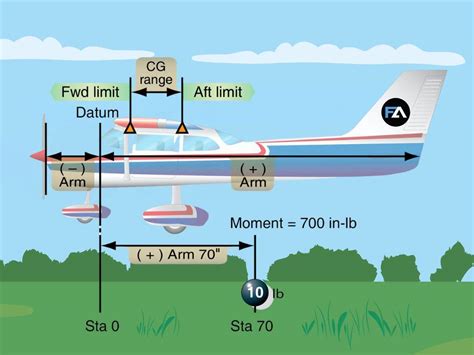
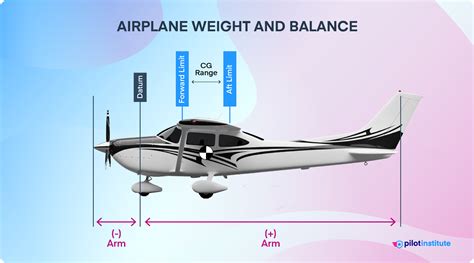
- Datum: An imaginary vertical plane from which all horizontal distances are measured.
- Arm: Horizontal distance from the datum to the center of gravity of an item.
- Station: A location along the aircraft fuselage defined by its distance from the datum.
- Center of Gravity (CG): The point where an aircraft would balance if suspended.
- Moment: A measure of the rotational force, calculated as Weight × Arm.
- Moment Index: Moment divided by a constant to simplify calculations.
Understanding Weight: The First Critical Element
Following Chapter 2 of the Pilot’s Operating Handbook (POH) or AFM, the importance of adhering to specified weight limitations cannot be overstated. Among these, Maximum Takeoff Weight (MTOW) is paramount. Exceeding MTOW leads to:
- Longer takeoff rolls due to the need for greater lift.
- Higher landing speeds, increasing the distance required for a safe landing.
- Reduced climb performance, making obstacle clearance riskier.
- Structural stress beyond design limits, potentially causing material failure.
Maintaining weight within allowable parameters preserves the aircraft’s intended handling characteristics and structural integrity.
Understanding Balance: The Second Critical Element
Balance focuses on the aircraft’s center of gravity (CG). A correctly located CG ensures the aircraft maintains controllability and stability throughout the flight envelope.
A forward CG results in:
- Nose-down tendency.
- Higher stall speed.
- Difficulty in flaring and rotating during takeoff.
An aft CG leads to:
- Nose-up tendency.
- Reduced longitudinal stability.
- Increased risk of stalls and spins that are difficult to recover from.
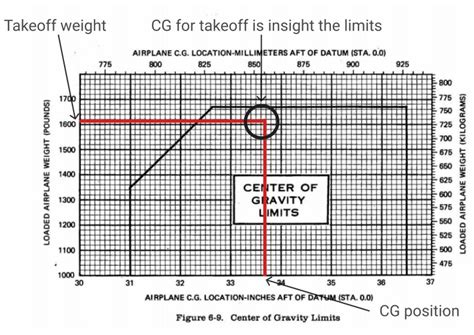
We must meticulously determine the loaded CG and compare it against the manufacturer’s forward and aft limits. Any deviation could critically impair safe flight performance.
Three Methods for Calculating Weight and Balance
We have three primary methodologies for determining weight and balance:
1. Calculation Method: Directly calculate each component’s moment (Weight × Arm) and find the total.
2. Graph Method: Plot known weights on AFM/POH graphs showing station moments against CG limits.
3. Table Method: Use AFM/POH tables that offer pre-calculated moment values for specific weights and stations.
While modern software applications simplify the process, the ability to manually calculate weight and balance remains a fundamental skill, especially in environments where technology may be unavailable.
Step-by-Step: Manual Calculation Method
The manual calculation method involves systematic data collection and arithmetic. Here’s the detailed process:
First, create a table with three columns: Weight, Arm, and Moment. Enter the following line items:
- Empty weight
- Pilot + Copilot
- Rear passengers
- Fuel—main tanks
- Fuel—auxiliary tanks
- Baggage 1
- Baggage 2
1. Empty Weight: Obtain the official empty weight from the aircraft’s POH/AFM record. Example: 2,100 lbs × 78.3 inches = 164,430 in-lb.
2. Passenger and Cargo Weights: Weigh passengers and baggage accurately. Remember to include personal items like jackets or carry-ons. For Avgas, use 6 lbs per gallon as a standard conversion.
3. Arm Values: Find arm values in Chapter 6 of the POH/AFM. Example arm distances:
- Pilot + Copilot: 85.0 in
- Rear passengers: 121.0 in
- Fuel Main Tanks: 75.0 in
- Baggage Area 1: 150.0 in
4. Moment Calculations: Multiply each weight by its corresponding arm:
- Pilot + Copilot: 340 lbs × 85.0 in = 28,900 in-lb
- Rear Passengers: 350 lbs × 121.0 in = 42,350 in-lb
- Fuel: 450 lbs × 75.0 in = 33,750 in-lb
- Baggage 1: 80 lbs × 150.0 in = 12,000 in-lb
5. Summing Totals: Add all individual weights and moments:
- Total Weight = 2,100 + 340 + 350 + 450 + 80 = 3,320 lbs
- Total Moment = 164,430 + 28,900 + 42,350 + 33,750 + 12,000 = 281,430 in-lb
6. Calculating CG: Divide total moment by total weight:
CG = 281,430 in-lb / 3,320 lbs = 84.8 inches aft of datum
Ensure the CG falls within the manufacturer’s specified forward and aft CG limits for safe operation.
Making Adjustments If Out of Limits
If our calculations reveal that the aircraft is overweight or the CG lies outside the permitted range, adjustments must be made before flight. Solutions include:
- Reducing fuel load for short flights.
- Redistributing baggage or seating.
- Offloading non-essential cargo.
A disciplined preflight check includes considering these adjustments proactively, especially on long trips where variations in fuel consumption and passenger movement might influence the CG over time.
Practical Tips for Weight and Balance Management
- Always verify passenger weights personally if possible rather than relying solely on stated figures.
- Account for fuel burn, especially if CG shifts significantly as fuel is used.
- Document weight and balance calculations as part of preflight planning for legal and safety reasons.
- Practice calculations manually during training flights to build competence.
- Consult Chapter 10 of the FAA’s Pilot’s Handbook of Aeronautical Knowledge for in-depth examples and case studies.
By consistently applying these best practices, we reinforce the habit of meticulous flight preparation and uphold the highest standards of aviation safety.
In conclusion, calculating weight and balance is more than regulatory compliance; it is a critical discipline that ensures aircraft performance, flight safety, and the well-being of all aboard. By mastering manual calculation methods and applying them rigorously, we not only satisfy legal obligations but also affirm our commitment to professional airmanship.