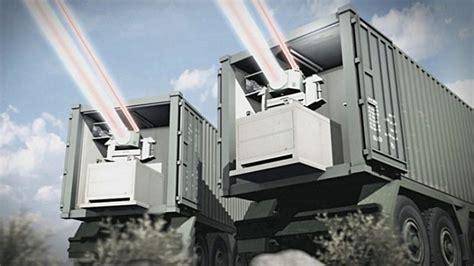
Israel’s Iron Beam system, known in Hebrew as Ma’gen Or (“Shield of Light”), represents one of the most advanced evolutions in modern air defense technology. As the world’s first operational directed-energy air defense weapon, this high-energy laser system is poised to redefine the economics and efficiency of intercepting short-range threats, with deployment scheduled for October 2025. Developed by Rafael Advanced Defense Systems, in partnership with Lockheed Martin for the U.S. market, Iron Beam offers a glimpse into a future where missile defense costs are slashed by orders of magnitude, while simultaneously providing enhanced operational capabilities.
Launched into public view at the Singapore Airshow in 2014, Iron Beam has undergone a rapid, strategically significant development cycle. From its roots in earlier Israeli and American experiments with chemical lasers, to full-scale demonstrations downing live threats, this system is a crucial pillar of Israel’s multi-layered missile defense doctrine, supporting and augmenting Iron Dome, David’s Sling, and Arrow systems.
A Game-Changer in Energy-Based Intercepts
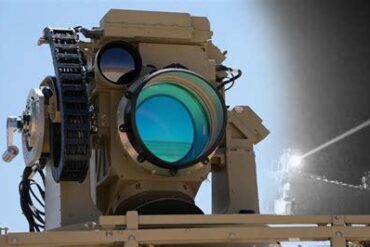
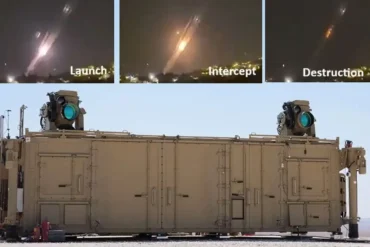
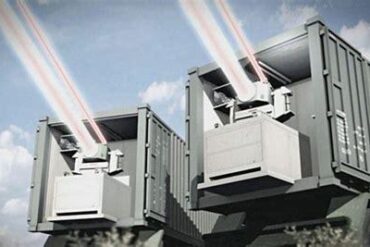
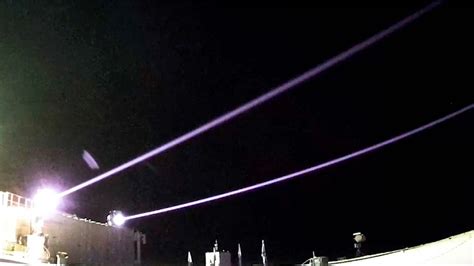
At its core, Iron Beam leverages solid-state fiber laser technology to achieve near-instantaneous neutralization of incoming projectiles. The system utilizes a dual high-energy laser module, capable of firing beams with ≥100 kW of power, concentrated to the size of a coin at up to 10 kilometers. The precise engagement process starts with a tracking radar and command-and-control (C2) unit locating and locking onto a target. Then, multiple converging laser beams focus on a precise impact point, heating it until the structural integrity of the target fails—typically within four seconds of contact.
Compared to traditional interceptor missiles, this process is silent, debris-free, and most notably, cheap. Each engagement costs as little as US$ 2–5 in direct energy, with full operational overheads pushing it to around US$ 2,000 per shot. Contrast this with interceptor missiles like those used in Iron Dome, which run from US$ 100,000 to US$ 150,000 per missile, and the fiscal appeal of Iron Beam becomes obvious.
Iron Beam’s Tactical Advantages in the Field
The system’s primary advantage lies in its virtually unlimited magazine. Since it fires beams of light instead of physical projectiles, Iron Beam can theoretically engage hundreds of targets continuously as long as it has power and clear line-of-sight. This attribute is crucial when defending against swarming UAVs, mortar barrages, and short-range rocket attacks—a common threat profile for Israel’s northern and southern borders.
Operational efficiency is another benefit. With fewer moving parts, lower manpower requirements, and no interceptor debris falling to earth, the Iron Beam system lowers both operational risk and logistical overhead. It excels particularly in urban defense scenarios, where falling debris from kinetic interceptors can pose a hazard to civilian infrastructure.
Limits and Environmental Constraints
While revolutionary, Iron Beam is not without limitations. The system is highly sensitive to atmospheric conditions. Fog, clouds, heavy rain, and dust storms can scatter or absorb the laser energy, reducing effectiveness. Additionally, the system requires a dwell time—that is, a fixed period during which the laser must remain on target to deliver destructive energy. This makes intercepting high-velocity missiles or rotating projectiles more challenging.
Another challenge arises from countermeasures. Adversaries may develop heat-resistant coatings, rotating bodies, or sacrificial layers to delay the destructive effect of the laser. Therefore, while Iron Beam is ideal for slower, unarmored aerial targets like drones or mortar shells, it will likely need to operate in tandem with kinetic systems for complete aerial threat coverage.
Technical Specifications and System Integration
By 2023, Iron Beam had reached a power output of 100 kW+, with R&D underway to combine two solid-state lasers for a unified output approaching 300 kW. This enhancement would enable multi-target simultaneous engagement and extend the range beyond 10 kilometers. The full system comprises:
- Radar Array – Detects and tracks incoming threats
- C2 System – Coordinates targeting and beam operation
- Dual HEL Modules – Emit focused, high-energy beams
- Power Management Unit – Ensures continuous, stable laser output
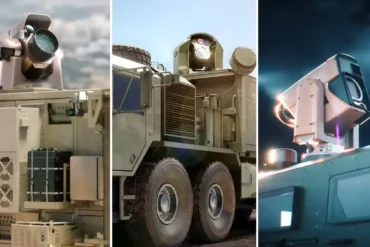
Originally designed as a mobile unit, later integration with the Iron Dome infrastructure allowed for shared power and cooling resources. This not only reduced weight but also enabled centralized control across multiple defense layers.
Development History: From THEL to Iron Beam
The idea of using lasers to destroy incoming projectiles isn’t new. The Tactical High Energy Laser (THEL), a joint U.S.-Israel project from 1996 to 2005, successfully destroyed rockets and shells during tests. However, its bulky size, high cost, and chemical laser design rendered it impractical for deployment.
Iron Beam emerged from over 14 years of continuous solid-state laser research led by Rafael. After its announcement in 2014, it underwent rigorous development and live-fire trials, culminating in April 2022’s success at the White Sands Missile Range. Here, Iron Beam intercepted rockets, drones, anti-tank missiles, and mortars, proving its battlefield viability under realistic scenarios.

Variants: Naval and Lite Iron Beam Systems
Recognizing the need for flexibility across platforms, Rafael has developed two major variants:
- Naval Iron Beam: Announced in May 2023, this version features a 100 kW laser for integration on corvettes and naval vessels. With operational ranges of several kilometers, it is expected to become functional within 4–5 years, offering robust close-in defense for ships.
- Lite Beam: Displayed in October 2024, this 10 kW variant is designed for light armored vehicles and is compatible with the Samson 30 mm Remote Weapon Station. It provides point defense against UAVs and small drones with a range of 2 kilometers, offering mobile forces a lightweight energy-based interceptor.
These variants ensure that Iron Beam can be deployed not just in fixed bases or border positions, but also in naval theaters and on-the-move ground operations.
Strategic and Geopolitical Implications
Iron Beam’s deployment has significant ramifications for both regional and global security frameworks. For Israel, it enhances homeland defense and reduces reliance on costly missile stockpiles. It could become a strategic export product, especially to countries facing asymmetric threats from rocket and drone attacks.
Moreover, the collaboration with Lockheed Martin paves the way for U.S. adoption or adaptation of Iron Beam technologies. With American forces often engaged in forward deployments, the ability to carry a lightweight, replenishable defense system becomes an attractive proposition.
Future Outlook: October 2025 and Beyond
With deployment set for October 2025, Iron Beam represents a turning point in laser weapon operationalization. While still complemented by traditional missile systems, it opens new defensive paradigms centered on renewable, speed-of-light weaponry. As research pushes laser outputs higher and dwell times shorter, we can expect future generations of Iron Beam to potentially counter hypersonic threats, satellite-disrupting drones, and even provide space-based defense architecture components.
As defense needs evolve, the integration of AI for targeting, automated C2 networks, and real-time atmospheric compensation systems could take Iron Beam’s capabilities far beyond its current configuration. What began as a science fiction dream is now poised to become the new standard of aerial threat deterrence.