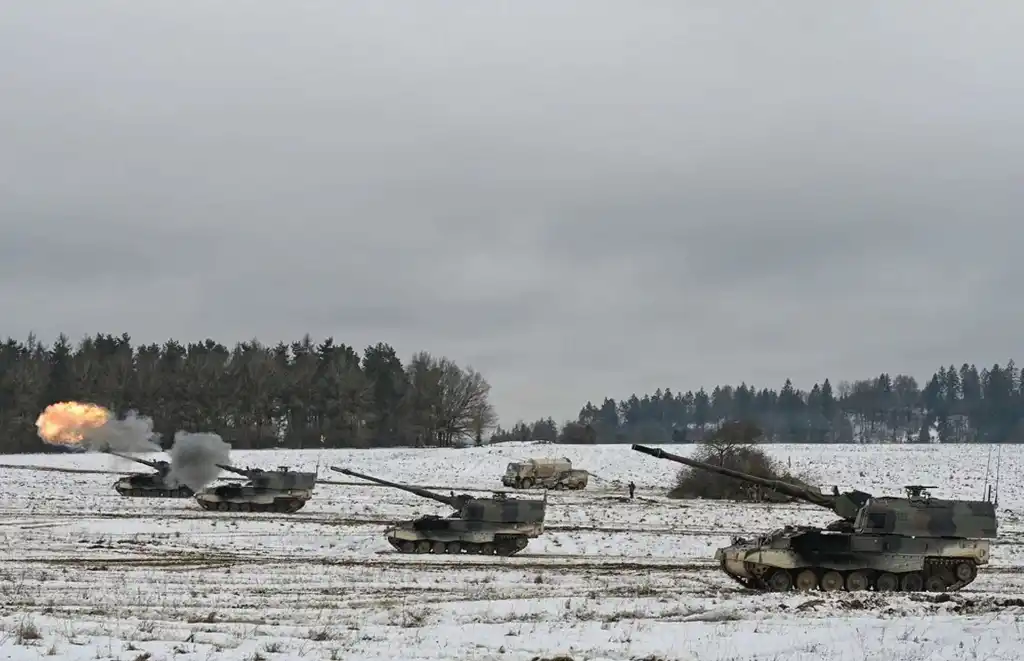
Italy has deployed its PzH 2000 155mm self-propelled howitzers to Germany for live-fire operations during Dynamic Front 26, a major NATO-linked multinational artillery exercise designed to strengthen cross-border fire coordination across Europe. On February 8, 2026, Italian Army artillery crews conducted live missions at the Grafenwoehr Training Area, underscoring NATO’s growing focus on synchronized, high-tempo fires capable of operating seamlessly across national boundaries in a contested environment.
The exercise is not simply about demonstrating firepower. Dynamic Front 26 is structured to test the full spectrum of modern artillery employment, from rapid force assembly and movement through constrained logistics corridors to digital fire mission processing and live execution under time pressure. The objective is to ensure that artillery units from multiple nations can plan, coordinate, and deliver effective fires under a unified operational framework. In a European contingency, where maneuver formations may operate across shifting borders and fragmented battle spaces, such interoperability is no longer optional—it is central to deterrence.
Italian participation highlights the operational maturity of the Panzerhaubitze 2000 (PzH 2000), one of NATO’s most capable tracked self-propelled artillery systems. Designed for speed, survivability, and sustained high-volume fire, the system represents a benchmark for alliance tube artillery.
PzH 2000: Engineered for Tempo and Survivability
The PzH 2000 is built around a 155 mm/L52 cannon compliant with the Joint Ballistics Memorandum of Understanding (JBMOU), ensuring compatibility with the full family of NATO-standard 155 mm ammunition and modular propelling charges. This compliance allows multinational units to share ammunition types and operate within aligned ballistic parameters—an essential requirement for coalition warfare.
What distinguishes the platform is its automation and digital fire-control architecture. The turret integrates an advanced loading system that enables a burst rate of three rounds in approximately ten seconds and a sustained rate of up to ten rounds per minute. That rapid output compresses the timeline between mission receipt and rounds on target, enabling artillery batteries to respond quickly to evolving battlefield demands. In modern high-intensity warfare, seconds often determine whether a target is struck or escapes.
Tempo, however, is not only about delivering fire—it is about surviving long enough to continue delivering it. Contemporary battlefields are saturated with counter-battery radars, loitering munitions, and precision-guided artillery systems capable of striking firing positions within minutes. The PzH 2000 was designed with this threat environment in mind. Its ability to conduct a rapid emplacement, execute a fire mission, and displace within roughly ninety seconds embodies the shoot-and-scoot doctrine adapted for a sensor-rich battlefield. Armored protection and onboard CBRN safeguards further enhance survivability, while tracked mobility enables the system to maneuver alongside heavy armored formations rather than remaining confined to rear-area positions.
Dynamic Front 26: Multinational Fires at Scale
Dynamic Front 26 spans multiple live-fire and command-post locations, including Germany, Romania, Poland, and Spain, with an additional training footprint extending into Türkiye. More than twenty Allied and partner nations are participating, operating a mix of cannon and rocket artillery systems. The geographic dispersion of the exercise reflects a core NATO assumption: any major European conflict would unfold across a broad front, requiring multinational coordination from the outset.
The drill emphasizes synchronized planning and execution of long-range fires across national boundaries. Rather than conducting parallel national exercises, participating units operate within an integrated command architecture designed to simulate real-world operational friction. Higher headquarters must manage competing priorities across the wider battlespace while ensuring that artillery effects are massed where they matter most.
This approach directly supports NATO’s Eastern Flank Deterrence Line concept, which aims to disrupt aggression early, degrade adversary formations, and deny the rapid consolidation of territorial gains. By rehearsing cross-border artillery missions, NATO demonstrates that its firepower is not fragmented along national lines but integrated into a cohesive theater-wide capability.
Digital Integration and Cross-Border Fire Control
A critical enabler of this integration is the Artillery Systems Cooperation Activities (ASCA) framework, a digital interoperability mechanism that allows different national fire-control systems to exchange missions seamlessly. In operational terms, ASCA enables a fire direction center in one country to generate and approve a mission that can be executed by guns located hundreds of kilometers away under another nation’s command.
During Dynamic Front 26, such digital linkages are stress-tested under realistic operational conditions. Data transmission, target validation, ballistic calculations, and clearance procedures must function reliably despite differences in national equipment and doctrine. This technical interoperability transforms multinational artillery from a symbolic coalition into a genuinely networked fires architecture capable of delivering distributed effects.
For Italy, integration through ASCA ensures that its PzH 2000 units can contribute directly to multinational targeting cycles. Rather than operating as a standalone national contingent, Italian batteries become nodes within a broader NATO fires network.
Extended Reach: Italy’s Vulcano Precision Ammunition
Italy’s artillery capability is further enhanced by the Vulcano 155 precision-guided ammunition family, developed by Leonardo. Designed for 155/52-caliber guns such as the PzH 2000, Vulcano rounds offer extended range combined with high accuracy using inertial and satellite guidance, with optional semi-active laser homing.
This pairing transforms conventional tube artillery into a deep-shaping instrument. Targets previously reserved for dedicated missile systems—such as command posts, logistics nodes, or high-value armored concentrations—can be engaged at extended distances with meter-level precision. Within a multinational framework like Dynamic Front 26, such precision expands the operational menu available to commanders while reducing collateral risk.
The combination of rapid firing capability and precision munitions provides a layered effect: high-volume suppressive fires when needed, and selective, high-value engagements when precision is paramount. For NATO planners, this versatility increases deterrent credibility by complicating adversary calculations.
Shared Platforms and Alliance Cohesion
The PzH 2000’s presence across multiple NATO members—including Germany, the Netherlands, Greece, Croatia, Lithuania, and Hungary—creates a shared ecosystem of doctrine, maintenance knowledge, and ammunition standards. Platform commonality simplifies multinational planning by aligning ballistic performance and range envelopes. When units from different nations operate similar systems, friction is reduced in both training and potential combat operations.
The system’s combat employment in Ukraine has further reinforced its relevance. Real-world operational feedback informs training scenarios and highlights the continued importance of armored, mobile artillery capable of surviving in contested environments. Exercises such as Dynamic Front 26 incorporate lessons learned from recent conflicts, ensuring that doctrinal assumptions are continuously tested against evolving battlefield realities.
Toward Arcane Front: The Next Phase of Multinational Fires
Dynamic Front 26 marks the final iteration under its current structure before merging with the Arcane Thunder series to form Arcane Front, a consolidated exercise framework emphasizing deeper integration between sensors, shooters, and decision-making processes across domains. This evolution reflects NATO’s recognition that modern fires are not isolated artillery events but part of a broader network linking intelligence, surveillance, reconnaissance, and command elements.
The Italian PzH 2000 deployments at Grafenwoehr thus serve as more than visual confirmation of alliance readiness. They represent a practical demonstration of NATO’s intent to refine distributed, cross-border fires capable of operating at speed and scale. By rehearsing rapid mission processing, synchronized targeting, and multinational coordination, the Alliance signals that any attempt to achieve a swift military advantage in Europe would encounter an integrated and responsive artillery network.
In the forests of Bavaria, amid the thunder of 155 mm gunfire, the message is both technical and strategic. Modern deterrence is built not only on possessing advanced systems but on proving they can function cohesively across nations, under pressure, and at tempo. Through Dynamic Front 26, Italy and its NATO partners are demonstrating precisely that capacity.