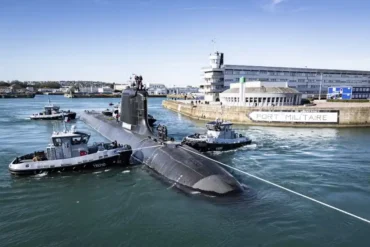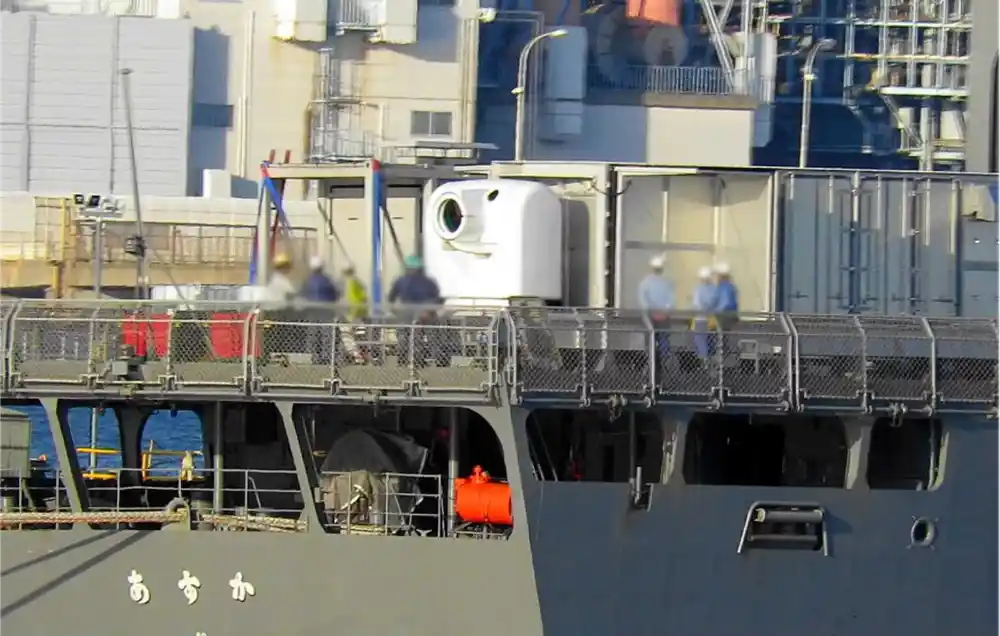
Japan has taken a groundbreaking leap in naval defense with the installation of a 100kW-class laser weapon system aboard the Japanese Maritime Self-Defense Force (JMSDF) experimental ship JS Asuka. This unprecedented integration represents a significant milestone in Japan’s evolving directed-energy weapons (DEW) program, signaling a paradigm shift in how modern navies approach threats from drones, missiles, and other aerial projectiles.
JS Asuka: The Testbed for Naval Breakthroughs
Commissioned in 1995, JS Asuka has long served as a floating laboratory, designed not for combat but for real-world testing of future-oriented technologies. Over the decades, it has hosted advanced systems including electromagnetic railguns and prototype combat management systems, acting as a strategic enabler of Japan’s high-tech maritime ambitions. The latest addition—ATLA’s 100kW-class laser weapon—is perhaps the most revolutionary yet.
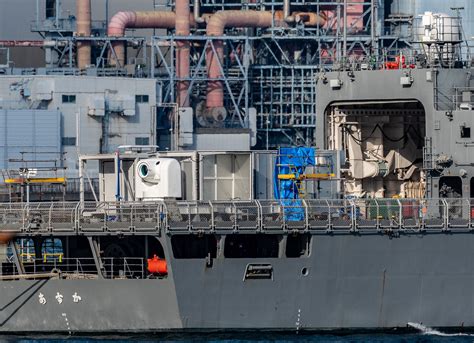
Developed by the Acquisition, Technology & Logistics Agency (ATLA), the laser system has now reached its final integration phase at the Japan Marine United (JMU) shipyard in Isogo. Once complete, it will undergo full-scale sea trials in 2026, leveraging Asuka’s modular design and experimental charter.
From Research to Reality: The Road to 100kW
The journey to this laser milestone began in 2018 when ATLA initiated focused research into high-energy DEWs. Years of rigorous testing and engineering culminated in a 100kW demonstrator in February 2023, a system that passed multiple ground-based trials by meeting key energy, targeting, and operational benchmarks. The successful lab results laid the groundwork for this current sea-based integration phase, with February 27, 2026, set as the target date for live maritime testing.

Strategic Relevance: Why Lasers Matter in Modern Naval Warfare
The importance of this deployment extends far beyond Japan’s borders. High-energy lasers are uniquely positioned to counter next-generation threats, particularly swarming drones, loitering munitions, and hypersonic projectiles, which are often cheaper and more abundant than conventional cruise missiles. Unlike missile interceptors that cost upwards of $1 million per launch, a laser’s cost-per-shot is negligible—often just the cost of energy consumed, making it a sustainable defense solution.
Additionally, lasers provide instantaneous engagement at the speed of light, with minimal signature. They operate silently, with no exhaust plume, no recoil, and a zero-collateral profile—ideal for deployment in crowded maritime zones, disputed waters, or politically sensitive engagements.
Architecture and Capabilities of the Japanese System
According to defense analysts familiar with the system, Japan’s 100kW-class laser includes:
- Modular Electric Power Systems capable of scalable integration across various ship classes.
- Advanced Beam Control for high-precision targeting of fast-moving threats.
- Robust Cooling Mechanisms designed to handle sustained operation in maritime climates.
This architecture is being developed with future scalability in mind. Once validated, the system is expected to be deployed aboard frontline platforms such as the Mogami-class frigates and Aegis destroyers, forming an integral part of a multi-layered defense web that blends kinetic interceptors, CIWS (Close-In Weapon Systems), and DEWs.
Global Context: Japan Joins a Laser Arms Race
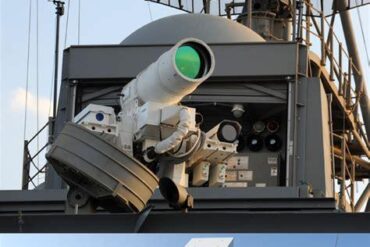
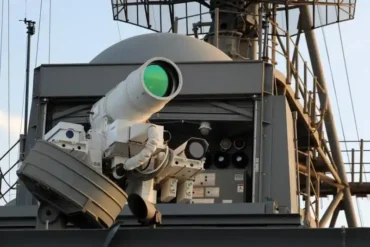
Japan’s deployment comes amid a global acceleration in naval DEW programs. The United States Navy pioneered this field with its 30kW LaWS (Laser Weapon System) aboard the USS Ponce in 2014. Since then, the U.S. has fielded even more potent systems like the 60kW HELIOS on Arleigh Burke-class destroyers and the ODIN (Optical Dazzling Interdictor, Navy) designed for drone suppression.
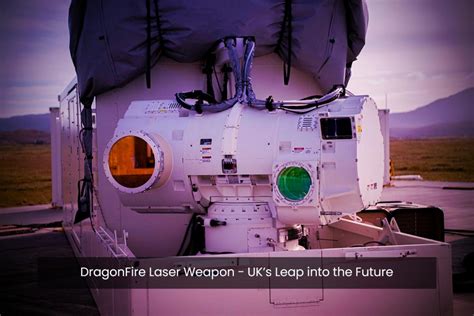
Meanwhile, the United Kingdom has invested heavily in its DragonFire program—a collaborative project with MBDA, Leonardo, and QinetiQ. Boasting a 50kW output, DragonFire underwent successful trials in 2023–2024, with maritime trials planned for 2025 and deployment expected aboard Type 23 and Type 26 frigates.
The convergence of these programs across NATO-aligned nations demonstrates a strategic consensus: directed-energy weapons are no longer experimental novelties—they are fast becoming operational necessities.
The Indo-Pacific Angle: Strategic Imperatives Behind the Laser Push
Japan’s laser development must also be viewed within the broader geopolitical dynamics of the Indo-Pacific. With increasing maritime tensions in the East China Sea, especially around the Senkaku/Diaoyu Islands, and frequent aerial incursions by Chinese drones and aircraft, the JMSDF faces growing pressure to enhance resilience and autonomous defense capabilities.
By reducing dependence on missile stockpiles—which may be limited or delayed during conflict—Japan positions itself to meet multi-vector threats with unmatched agility. Directed-energy systems also help address saturation attacks, a tactic in which multiple low-cost drones or missiles attempt to overwhelm ship defenses.
Implications for Defense Industry and International Collaboration
The integration of laser systems also presents a new frontier for Japan’s defense industry, potentially unlocking dual-use innovations in optics, thermal management, and targeting AI. Already, there is growing speculation about future joint development initiatives with allied nations—particularly the U.S., UK, and possibly Australia under the AUKUS pact.
Such collaborations may focus on interoperability, shared targeting algorithms, and the development of multi-national combat systems capable of operating in sync across regional fleets. In this sense, Japan’s laser initiative is not just a national investment but a regional force multiplier.
Future-Proofing Japan’s Naval Arsenal
With shipboard power systems rapidly improving, Japan’s future warships are likely to incorporate hybrid electric drives and advanced energy storage to accommodate next-gen DEWs. Already, conceptual designs for future JMSDF destroyers show dedicated energy bays and power management subsystems tuned for high-energy payloads.
The use of modular systems also ensures that as laser technology matures—potentially reaching 300kW or higher outputs—Japan can seamlessly retrofit these systems aboard both new and existing vessels, maintaining a flexible and formidable fleet posture.
Conclusion: A New Maritime Doctrine Takes Shape
The forthcoming sea trials of Japan’s 100kW-class laser aboard JS Asuka will mark more than a technological showcase—they will define a new doctrine in naval warfare. One where energy replaces explosives, and precision, speed, and sustainability converge into a lethal, reliable shield against 21st-century threats.
If successful, the trials will cement Japan’s position not only as a regional power but as a global leader in naval innovation, shaping how tomorrow’s wars will be fought—and won—at sea.