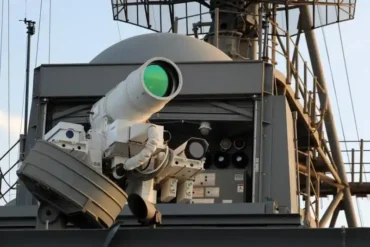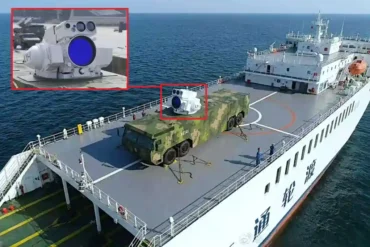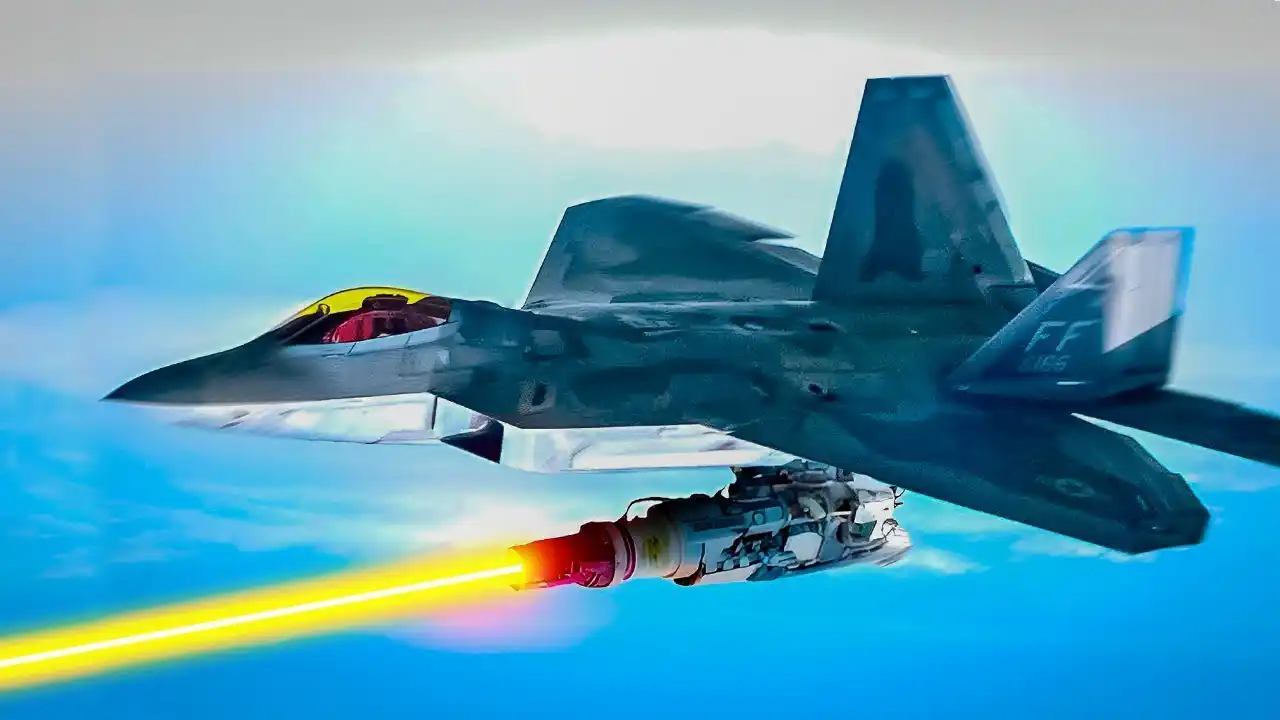
The F-22 Raptor, a dominant force in modern aerial warfare, is on the verge of undergoing a groundbreaking transformation. With the addition of a directed-energy weapon known as the Self-Protect High-Energy Laser Demonstrator (SHiELD), this stealth fighter is poised to elevate its capabilities from elite to nearly untouchable. But the question that lingers in defense circles is both simple and staggering: Can the F-22’s laser weapon actually burn enemy jets in mid-air?
The F-22 Raptor: A Lethal Air Dominance Platform
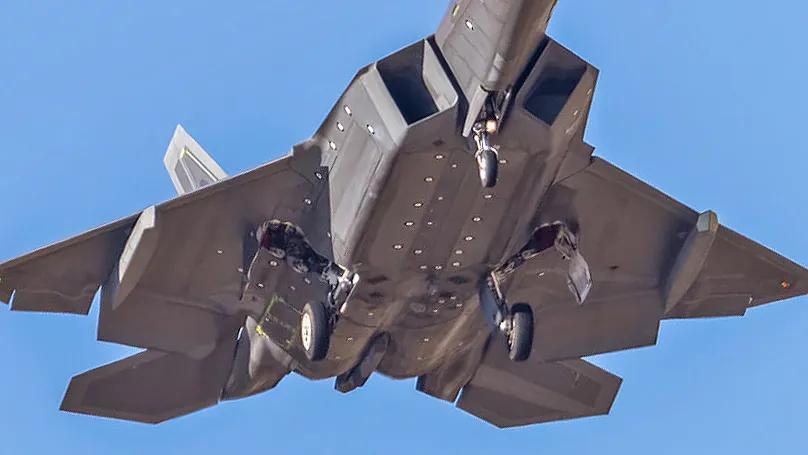
Since its introduction into service in 2005, the F-22 Raptor has defined what it means to be a fifth-generation stealth fighter. Developed by Lockheed Martin, this aircraft was designed primarily for air superiority, but it also boasts air-to-ground attack, electronic warfare, and signal intelligence capabilities. It is celebrated for its supercruise ability, radar-evading profile, and unmatched agility.
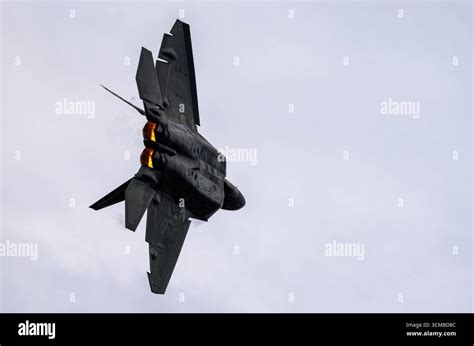
With a top speed exceeding Mach 2 and a combat radius of 800 miles (1,300 km), the F-22 already reigns supreme in contested skies. Yet even this apex predator faces an evolving array of threats—particularly from hypersonic missiles and autonomous drone swarms. That’s where lasers come into play.
Enter SHiELD: The Self-Protect High-Energy Laser Demonstrator
The SHiELD program, overseen by the U.S. Air Force Research Laboratory (AFRL), represents a leap forward in airborne directed-energy technology. Designed in collaboration with defense contractors such as Lockheed Martin, Boeing, and Northrop Grumman, this compact laser system is intended to be mounted onto fighter aircraft like the F-22. Unlike kinetic weapons that rely on ammunition and explosive force, SHiELD utilizes concentrated beams of light to disrupt, degrade, or outright destroy incoming threats.
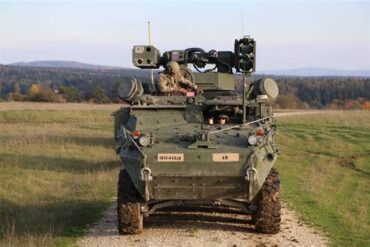
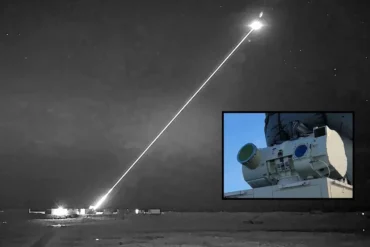
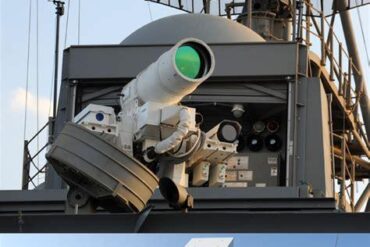
The laser weapon works by rapidly heating a small area on the target, whether it’s a missile’s guidance system or the skin of an enemy drone, causing structural failure. The technology is compact, electrically powered, and capable of engaging multiple targets at the speed of light, making it an ideal self-defense tool in increasingly complex air battles.
How the Laser Weapon Operates Mid-Air
The integration of a high-energy laser on the F-22 is not merely a feat of miniaturization—it’s an orchestration of thermal management, beam control, power generation, and targeting precision. At its core, the SHiELD system consists of three primary components:
- Laser Pod (LANCE) – The pod that generates and emits the laser.
- Beam Control System (BCS) – Focuses and directs the laser at moving targets.
- Thermal and Power Systems – Maintain the laser’s functionality during high-speed maneuvers.
To successfully strike a moving object in mid-air, such as an enemy missile or a UAV, the laser must be precisely stabilized and cooled, while maintaining line-of-sight. Adaptive optics and gyroscopic stabilization allow for pinpoint accuracy. According to AFRL engineers, SHiELD is designed to lock on and neutralize threats within seconds, all without alerting the target, thanks to its silent, invisible beam.
Tactical Value Against Enemy Jets
While SHiELD was initially conceptualized to defend against surface-to-air missiles (SAMs) and air-to-air threats, the idea of burning through an enemy aircraft’s fuselage or avionics mid-flight is no longer confined to science fiction. In controlled test environments, similar laser systems have been shown to disable optical sensors, burn through outer skins, and overload electronic systems of drones and mock missiles.
However, engaging a manned enemy jet in a dynamic dogfight is a more complex scenario. Realistically, the laser’s use against other fighters would likely center on targeting vital sensors, radar domes, or missile racks, rather than outright disintegration. Still, even momentarily blinding or disabling an adversary at 20,000 feet could provide the F-22 with the critical edge needed to finish the kill using conventional weapons.
Engineering Hurdles and Operational Limits
While the prospects are thrilling, the physics of directed-energy warfare impose some significant limitations. One of the primary challenges is power generation. A laser powerful enough to destroy hardened airborne targets consumes enormous energy—more than the F-22’s onboard systems currently generate. Future solutions may involve auxiliary power units or energy storage systems such as supercapacitors.
Another challenge is thermal regulation. Lasers produce heat as a byproduct, and dissipating that heat without compromising stealth is a monumental task. Engineers are experimenting with advanced liquid cooling loops and heat-dissipating composites, but these remain in prototype stages.
Lastly, atmospheric conditions such as rain, dust, or fog can refract or scatter laser beams, reducing effectiveness. While high-altitude engagements mitigate some of these concerns, they still present unpredictable combat variables.
Strategic Implications for Modern Air Warfare
Should SHiELD become operational on the F-22, it would dramatically shift the balance of air power. Traditional missile-based defense relies on reaction time, ammunition stores, and trajectory prediction. In contrast, a laser-equipped fighter engages at light speed, with unlimited shots as long as power is available. This introduces a new doctrine: “Energy Supremacy.”
For adversaries such as China’s J-20 Mighty Dragon or Russia’s Su-57 Felon, the presence of laser weaponry means any approach could result in immediate targeting—not just by radar-guided missiles, but by a beam-based defensive grid. It forces enemy pilots and AI systems to account for an entirely different threat profile.
Funding, Cost, and Political Momentum
The estimated cost of each F-22 Raptor, fully upgraded, hovers around $350 million. The integration of SHiELD is part of a broader Department of Defense push into directed-energy weaponry, with billions of dollars earmarked across multiple platforms, including ground vehicles, naval ships, and other aircraft such as the F-35 Lightning II.
Political support remains strong, particularly in the context of great-power competition and the need for technological superiority. The U.S. Congress has largely supported funding allocations, especially as hypersonic missile threats from adversarial states increase. Analysts believe that if the F-22 proves successful with laser systems, future sixth-generation fighters will be built with these weapons as standard.
Expert Opinions and Industry Forecasts
Military analysts agree that SHiELD has the potential to become a game-changer in aerial combat, especially in layered defense missions. Dr. Mark Gunzinger, a former Air Force colonel and strategic expert, noted that “the ability to shoot down multiple threats at the speed of light—without reloading—is not evolutionary; it’s revolutionary.”
Defense technology insiders also predict that within the next five years, low-power lasers for sensor blinding will be standard in frontline aircraft, while high-energy beam weapons will continue maturing toward operational readiness. The F-22, as the testbed for this tech, is thus central to the future of multi-domain dominance.
The Real Question: Can It Burn a Jet Mid-Air?
The answer lies somewhere between “not yet” and “almost.” Today’s SHiELD configuration is optimized for missile and drone neutralization, not for disintegrating enemy jets. However, targeted disablement of sensitive components is well within reach. This means an F-22 could theoretically render an enemy jet combat-ineffective without firing a bullet or missile—a surgical strike of light, not explosives.

This marks the beginning of an era where stealth meets silent lethality, and the world’s most advanced fighter jet becomes a flying energy weapon platform. Whether it will someday slice through the wings of enemy aircraft remains to be seen, but it’s increasingly clear: in the future of air combat, the battlefield will be illuminated not by flares, but by lasers.