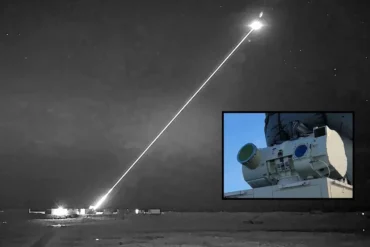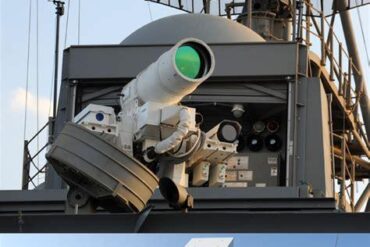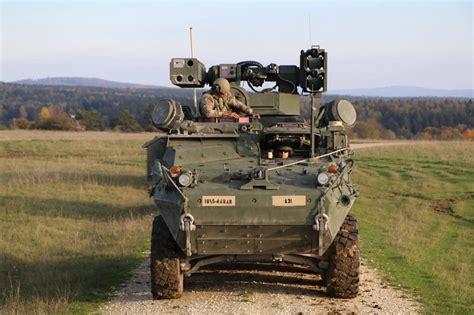
The U.S. Army has taken a historic leap forward in air defense with the first operational deployment of its Directed Energy Maneuver Short-Range Air Defense (DE M-SHORAD) system, marking a pivotal moment in modern military technology. During a groundbreaking live-fire exercise at Fort Sill, Oklahoma, soldiers of the 4th Battalion, 60th Air Defense Artillery Regiment, in collaboration with the Army’s Rapid Capabilities and Critical Technologies Office (RCCTO), successfully tested this cutting-edge laser weapon against a swarm of aerial threats.
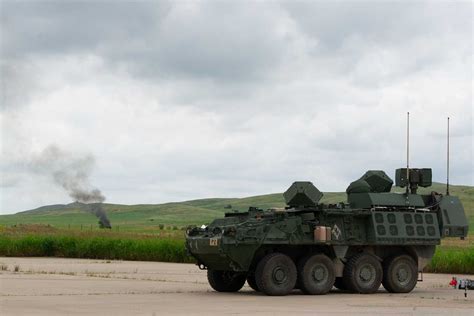
The live demonstration, held in June 2025, showcased how directed energy weapons are now transitioning from concept to battlefield reality. Mounted on a rugged Stryker A1 8×8 armored vehicle, the DE M-SHORAD system targeted and neutralized Group 1-3 unmanned aerial systems (UAS), reflecting the growing dominance of drones and the pressing need for advanced countermeasures. This event emphasized the Army’s layered defense strategy, blending traditional kinetic weapons with state-of-the-art laser systems for maximum protection.
DE M-SHORAD: A Technological Breakthrough in Mobile Air Defense
At the heart of this revolutionary system is a 50-kilowatt class high-energy laser, integrated seamlessly onto the Stryker platform under the Multi-Mission High Energy Laser (MMHEL) program. Developed by Raytheon Technologies, the DE M-SHORAD includes a precision beam director, sophisticated electro-optical/infrared tracking systems, and a Ku720 multi-mission radar, offering unparalleled detection and engagement capabilities. The integration and power management, overseen by Kord Technologies, ensures the vehicle’s high-energy systems function reliably in harsh operational environments.
The Stryker A1’s Double-V Hull (DVH) design enhances crew survivability against mines and improvised explosive devices, while its Caterpillar C9 engine, delivering 450 horsepower, powers both vehicle mobility and the laser system. Energy for the directed energy weapon is supplied by lithium nickel cobalt aluminum oxide (Li-NCA) batteries, recharged via onboard diesel generators, allowing sustained, mobile laser operations.
Transforming Air Defense with Laser Precision
The DE M-SHORAD represents a seismic shift in how the U.S. Army confronts airborne threats. Unlike conventional munitions that face logistical constraints and replenishment issues, laser weapons provide virtually unlimited ammunition, restricted only by available power. With the ability to neutralize drones, rotary and fixed-wing aircraft, rockets, artillery, and mortars, this system delivers a scalable, low-cost-per-shot defense against both asymmetric and near-peer adversaries.
During the Fort Sill exercise, soldiers engaged in complex, real-time scenarios simulating drone swarms and mixed aerial threats. This tested not only the laser system’s hardware but also the soldiers’ ability to adapt tactics, techniques, and procedures (TTPs) for high-energy engagements. Operators faced decisions involving rapid target deconfliction, the integration of kinetic and directed energy responses, and coordination across multiple defensive layers.
The Guardian’s Role in Future Battlefield Superiority
The DE M-SHORAD, nicknamed the “Guardian,” is rapidly establishing itself as a cornerstone of the Army’s evolving air defense doctrine. Its development aligns with the upcoming Enduring High Energy Laser (E-HEL) program, expected to become the Army’s first official directed energy program of record by Fiscal Year 2026 (FY26). This transition signals the Army’s commitment to embedding laser weapons within brigade combat teams, divisions, and frontline maneuver elements.
The integration of such systems reflects the growing threat posed by massed drone attacks, often used by adversaries to overwhelm traditional defenses. Laser weapons, with their speed-of-light precision and minimal collateral damage, offer a decisive edge. By reducing reliance on finite munitions stockpiles, they enable continuous defense coverage while lowering operational costs.

Directed Energy and the Future of Warfare
The U.S. Army’s investment in DE M-SHORAD underscores a broader trend in military innovation, where directed energy is increasingly seen as essential for future conflict environments. With adversaries deploying swarming drones, low-cost aerial platforms, and saturation tactics, laser weapons provide the capability to maintain air superiority under mounting pressure.
Unlike conventional kinetic interceptors, laser systems engage threats with extreme accuracy, rapid response, and minimal logistical burden. Their utility is particularly evident against small UAS threats, which can evade radar or saturate defenses through sheer numbers. The DE M-SHORAD’s multi-sensor suite enhances its ability to detect, track, and destroy such targets across a variety of operational conditions.
Furthermore, the system contributes to a resilient, multi-layered air defense network where lasers complement, rather than replace, existing kinetic systems. This redundancy is vital to ensuring continuous protection even in contested or degraded environments where adversaries attempt to disable conventional air defenses.
DE M-SHORAD: A Strategic Game-Changer
The Fort Sill exercise marks more than just a technical milestone; it signifies a doctrinal evolution. With the Guardian system operationally tested, the Army is laying the groundwork for large-scale deployment of directed energy capabilities. This initiative reflects a calculated response to shifting global threats, from state actors with advanced drone fleets to irregular forces employing off-the-shelf UAS for asymmetric advantage.
By leveraging directed energy, the U.S. Army gains:
- Lower engagement costs per target, critical for countering mass drone attacks.
- High precision with reduced collateral damage, vital in urban or sensitive areas.
- Persistent defense capabilities, unconstrained by finite munitions.
- Enhanced mobility, ensuring frontline forces remain protected on the move.
The Guardian’s deployment demonstrates how technology, mobility, and layered defense are converging to meet evolving battlefield demands. With the DE M-SHORAD now proven in operational exercises, its presence is set to expand across U.S. Army units, reinforcing defensive perimeters and securing maneuver elements in high-threat zones.
Conclusion: Ushering in the Age of Laser Warfare
The successful operational use of the DE M-SHORAD laser air defense vehicle represents a watershed moment for the U.S. Army and the broader defense community. No longer confined to laboratories or prototypes, directed energy weapons are now an active component of combat-ready formations.
As the threat landscape evolves, with drones and low-cost aerial systems proliferating, the Army’s integration of laser technology offers a decisive, scalable, and sustainable solution. The Guardian system’s deployment at Fort Sill is not merely an exercise—it is a glimpse into the future of warfare, where precision energy outpaces volume firepower, and technological superiority secures battlefield dominance.
In this era of rapidly advancing threats, the DE M-SHORAD stands as a testament to the Army’s commitment to innovation, adaptability, and ensuring U.S. forces maintain the edge in air defense for years to come.