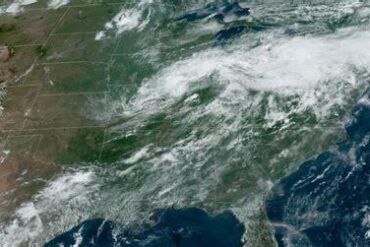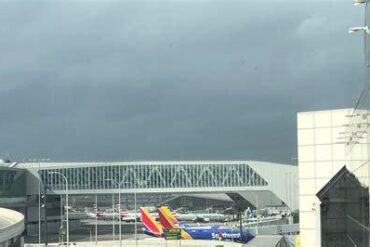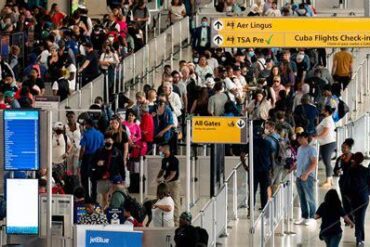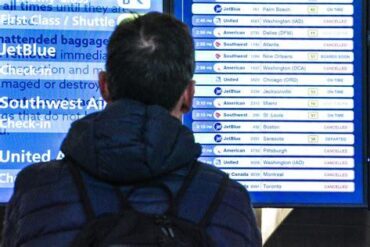
Heavy thunderstorms sweeping across the US Northeast have caused one of the most disruptive travel periods of the summer, with JetBlue Airways emerging as one of the airlines hit hardest by the severe weather. The carrier canceled approximately one in every 20 scheduled flights during the peak of the disruption while delays spread rapidly across its network. With many of JetBlue’s largest operations concentrated in New York and Boston, persistent storms created a cascading operational challenge that affected passengers nationwide.
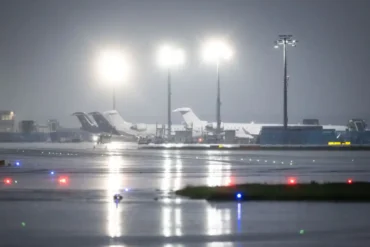
The disruption stretched far beyond isolated airport delays. Intense rainfall, lightning, and rapidly developing storm cells forced the Federal Aviation Administration (FAA) to introduce multiple traffic management initiatives, including ground stops and ground delays at several of the country’s busiest airports. These restrictions were designed to safely manage aircraft movements through increasingly congested airspace while preventing airborne holding patterns and unnecessary diversions. As departures slowed, aircraft and flight crews quickly fell out of position, creating ripple effects across hundreds of routes.
JetBlue’s operational footprint made it particularly vulnerable during this weather event. The airline relies heavily on John F. Kennedy International Airport (JFK), Boston Logan International Airport (BOS), and flights serving Newark Liberty International Airport (EWR), all of which experienced significant weather-related interruptions. By Thursday, roughly 5% of JetBlue’s flights had been canceled, while another 38% were delayed, marking one of the carrier’s most difficult operational days in recent memory.
JetBlue Faces Its Most Severe Weather Disruption Of The Week
Across the United States, nearly 1,000 flights were canceled on Thursday as thunderstorms repeatedly swept through major aviation corridors. Conditions were especially challenging around New York City, where JFK and Newark each recorded well over one hundred cancellations. Heavy rainfall also prompted flash flood warnings in several communities surrounding the metropolitan area, complicating airport access for thousands of travelers already dealing with delayed departures.
The operational consequences extended well beyond the Northeast. Every canceled flight left aircraft, cabin crews, and pilots displaced from their scheduled rotations. Once that chain is interrupted, airlines often require an entire day—or longer—to restore aircraft positioning and crew availability. As a result, delays propagated across networks reaching the Midwest, the South, Florida, and even destinations on the West Coast.
FAA Ground Stops Played A Critical Role In Managing Congestion
Rather than allowing excessive numbers of aircraft to depart into already saturated airspace, the FAA implemented ground stop advisories at numerous airports. These measures temporarily prevent departures bound for affected airports until traffic flow returns to manageable levels. While frustrating for passengers waiting at departure gates, ground stops reduce airborne congestion, minimize holding patterns, and improve overall system safety during rapidly changing weather.
Among the airports affected were Boston Logan (BOS), Baltimore/Washington (BWI), Ronald Reagan Washington National (DCA), Denver International (DEN), Newark (EWR), Washington Dulles (IAD), John F. Kennedy (JFK), LaGuardia (LGA), and Philadelphia International (PHL). The widespread geographic coverage demonstrated how a concentrated weather system in one region can influence air traffic across the national network.
Multiple Airlines Experienced Delays, But JetBlue Recorded The Highest Cancellation Rate
Although nearly every major US airline experienced operational disruption, JetBlue reported the highest percentage of cancellations among large carriers. Frontier Airlines canceled approximately 2% of scheduled flights while delaying around 29%. Southwest Airlines, Delta Air Lines, United Airlines, and Allegiant Air each canceled roughly 1% of operations but still recorded delay rates approaching or exceeding thirty percent. American Airlines and SkyWest Airlines avoided widespread cancellations yet still experienced substantial schedule disruptions as weather-related restrictions spread across the network.
The statistics illustrate how airline network design influences operational resilience. Carriers with significant concentrations of flights through weather-affected hubs often experience more severe disruption than airlines with broader geographic distribution. For JetBlue, whose largest bases are directly within the impacted region, the storms created a particularly difficult operating environment.
Recovery Efforts Continue As Storm Threat Persists
The disruption did not end once thunderstorms moved away from individual airports. By Friday, nearly 200 additional flights had already been canceled across the United States, with many concentrated around the New York metropolitan area as unsettled weather continued. Airlines have introduced flexible rebooking policies, allowing eligible travelers to modify itineraries without the usual change penalties while operations gradually recover.
Passengers are being encouraged to monitor flight status closely before leaving for the airport, as additional thunderstorms could prompt further FAA traffic management initiatives. Even after skies begin to clear, airlines must reposition aircraft, reconnect flight crews, and restore normal scheduling before networks fully stabilize.
The latest disruption highlights how vulnerable modern airline operations remain to severe summer convection. While advanced forecasting, sophisticated air traffic management, and flexible scheduling help reduce risk, prolonged thunderstorms across major hub airports can still create nationwide consequences within hours. For JetBlue, whose network is deeply anchored in the Northeast, this week’s storms demonstrated just how quickly adverse weather can transform localized turbulence into a system-wide operational challenge affecting tens of thousands of travelers.