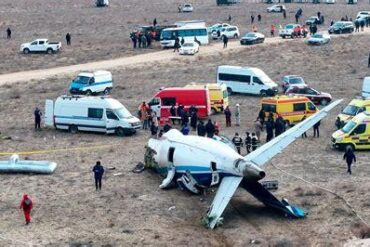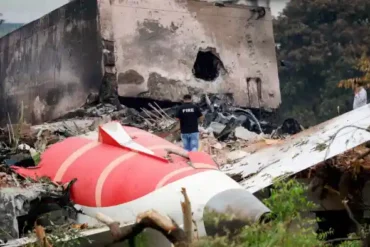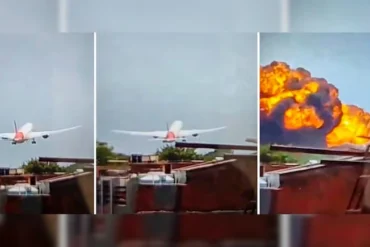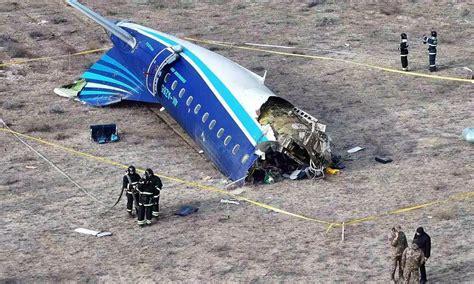
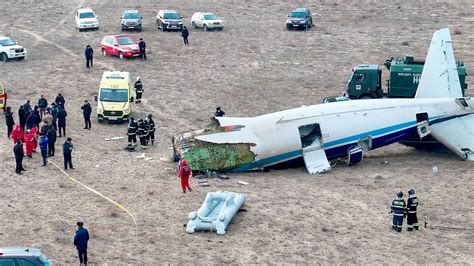
On December 25, 2024, Azerbaijan Airlines Flight 8243 met a tragic end in western Kazakhstan, claiming 38 lives out of 67 onboard. One year later, a newly released interim report by Kazakhstan’s Ministry of Transport confirms that the Embraer E190 was fatally damaged by metal fragments prior to crashing — fragments that are believed to have originated from a Russian missile interception gone awry.
Flight 8243’s Fateful Journey Through Danger
Flight 8243 departed Baku, Azerbaijan, with a planned route to Grozny, Russia. However, weather conditions thwarted its landing attempt in Grozny, forcing the pilots to reroute. During this diversion, passengers reported hearing a loud bang — a moment now attributed to the detonation of a Russian anti-air missile targeting Ukrainian drones in the region. Unwittingly, the Azerbaijan Airlines E190 crossed paths with metal shrapnel generated from the nearby blast.
According to the interim report, the hydraulic system was critically damaged during this encounter, compromising control systems essential for stable flight. The crew redirected toward Aktau Airport in Kazakhstan, but the aircraft’s fate was already sealed. The jet crashed during its emergency landing attempt, despite the flight crew’s efforts to regain control.
Forensic Evidence Points to External Metal Fragments
The Ministry’s findings are precise and chilling. A traceological examination of the aircraft’s hydraulic system pipe No. 2 showed distinct signs of metal tearing, a form of damage consistent with external contact from iron-based alloys — primarily steel. Importantly, no trace of explosives was found, which strongly supports the theory of proximity damage from shrapnel rather than a direct strike.
“The mechanism of damage is metal tearing as a result of contact with fragments (foreign objects) made of iron-based metal alloys (steel base),” the report stated.
Though the report stops short of officially attributing responsibility, President Vladimir Putin recently admitted that Russian missile fragments were the likely cause. This tacit acknowledgment strengthens prevailing theories that the aircraft was collateral damage from an anti-drone operation.
Black Box Analysis Reveals Final Moments
Investigators have concluded their analysis of the aircraft’s Flight Data Recorder (FDR) and Cockpit Voice Recorder (CVR). These black boxes were instrumental in reconstructing the sequence of events, offering insights into aircraft system behavior and crew decision-making during the crisis.
- The FDR highlighted system anomalies following the in-air detonation, including degradation of control responsiveness.
- The CVR captured the escalating urgency among pilots as systems failed and backup mechanisms became overwhelmed.
Investigators also attempted to recover data from the aircraft’s Honeywell Central Maintenance Computer, which could have offered a detailed fault log. However, severe thermal damage prevented extraction. Collaborative efforts continue with Honeywell and US authorities to retrieve what remains of the data.
Specialized Working Groups Dissect the Disaster
To further dissect the disaster, the investigative team split into two task forces:
- One group is dedicated to reconstructing the hydraulic failure, including simulations and stress analysis of the damaged components.
- The second group is examining flight safety risks in conflict zones, with a focus on civil aviation vulnerabilities around warzones and air defense operations.
These working groups operate under heightened urgency, knowing that the final report — while still months away — will influence international aviation protocols for years to come.

Flying Through Conflict Zones: An Increasing Global Risk
The downing of Flight 8243 has reopened painful debates about the risks of flying over or near conflict zones. Although military targets are usually distinct from civil aviation corridors, errors in identification, timing, and proximity can — and have — led to catastrophe.
This is not an isolated case:
- Malaysia Airlines Flight MH17 was destroyed in 2014 by a Buk surface-to-air missile fired by pro-Russian separatists over eastern Ukraine, killing 298 people.
- Ukraine International Airlines Flight 752 was accidentally shot down in Tehran in 2020 by Iran’s Islamic Revolutionary Guard Corps, during post-strike confusion against US forces.
In both cases, miscalculation and the fog of war turned routine flights into death traps.
The issue remains topical. With increasing US military activity around Venezuela, there have already been multiple near misses — including a JetBlue aircraft narrowly avoiding a US Air Force refueling tanker. Similar risks exist in East Asia, the South China Sea, and the Middle East, especially where transponders are disabled or air traffic control lacks full military coordination.
Russia’s Implicit Admission and International Reactions
President Putin’s recent comments, in which he acknowledged that Russian missile fragments “likely” caused the crash, were met with mixed reactions. While some viewed the admission as a step toward transparency, others criticized the lack of formal accountability. No international body has yet issued formal condemnation or launched sanctions specifically tied to the incident.
Diplomatic observers believe this subdued response is partially due to the ambiguity around intent. The strike was not deliberate, and the E190 was not identified as a target. Nevertheless, international aviation law mandates protection of civilian aircraft, even in proximity to military operations.
Calls for Stronger Airspace Coordination and Civilian Protection
The tragedy of Flight 8243 underscores the need for tighter civil-military coordination in airspace management. Experts are now calling for:
- Real-time alerts to divert commercial flights from active military engagements.
- Enhanced satellite tracking to monitor missile activity along known civilian corridors.
- Global NOTAM reforms, ensuring that military alerts reach civil aviation authorities faster and more clearly.

Some voices in the aviation industry are also pushing for expanded no-fly zones over combat zones, even when conflicts are low-intensity. Airlines have traditionally made these decisions based on risk assessments, but as this case shows, timing and proximity can override even the most careful planning.
Ongoing Investigation and Anticipated Final Report
Though this report is only interim, it provides the clearest picture yet of what befell Flight 8243. Investigators continue working closely with international aviation bodies, forensic experts, and military analysts. The final report is expected in mid to late 2026, pending the outcomes of:
- Full material analysis of recovered parts.
- Completion of hydraulic system simulation.
- Clarification of Russian military operations in the area at the time of the incident.
Families of the victims continue to demand justice, transparency, and formal recognition of the event’s military connection. For them, the technical details offer some closure — but the broader questions of responsibility remain unresolved.
Legacy of Flight 8243: A Civilian Casualty of Military Action
In the end, Flight 8243 becomes part of a tragic lineage — commercial aircraft brought down not by mechanical fault or human error, but by the brutal, unpredictable consequences of war. The loss reverberates far beyond Azerbaijan and Kazakhstan, posing critical questions to the entire global aviation system.
Until international norms evolve to shield civilians from the shadows of conflict, the skies will remain — in certain regions — as deadly as the battlefields below.