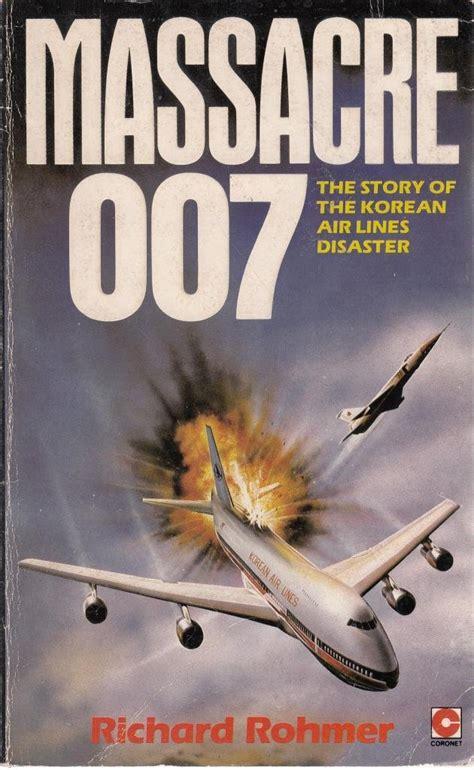
On September 1, 1983, a Boeing 747-230B, registered as HL7442, vanished from the skies over the Sea of Japan after being struck by Soviet air-to-air missiles. Korean Air Lines Flight 007 (KE007), en route from New York City to Seoul via Anchorage, deviated from its planned flight path and fatally entered restricted Soviet airspace during a time of intense Cold War tensions. What followed was a catastrophic sequence of misunderstandings, political denials, and tragic loss.
The shootdown of Flight 007 remains one of the most haunting incidents in commercial aviation history. It not only took 269 lives, including that of U.S. Congressman Larry McDonald, but also escalated global hostilities, revealed critical gaps in aviation protocols, and led to seismic changes in how air traffic is monitored worldwide.

Autopilot Error and Navigational Drift
The tragedy of Flight KE007 began not with aggression, but with a technological oversight. After refueling at Anchorage International Airport, the aircraft’s crew failed to switch the autopilot from HEADING SELECT mode to INS (Inertial Navigation System) mode—a critical transition necessary for long-range, autonomous navigation.
As a result, the Boeing 747 unknowingly began drifting north of its assigned path shortly after takeoff. Instead of following the designated R-20 air corridor, it veered off-course by over 500 kilometers, a trajectory that would carry it deep into Soviet airspace over Kamchatka, a territory housing high-value strategic missile installations.
This navigational error remained undetected for hours, in part due to the flight’s trans-oceanic location and a lack of immediate real-time tracking. Onboard, the flight crew apparently remained unaware of the deviation, assuming they were on course based on visual cues and other instruments that failed to provide direct warnings of the autopilot setting.
Soviet Interception and Missile Strike
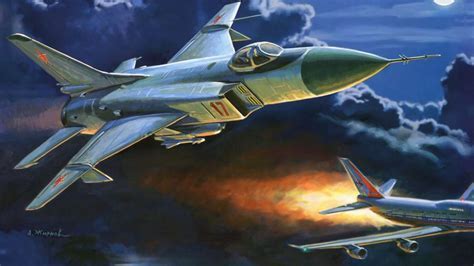
At a time when the Soviet Union was conducting a ballistic missile test near Petropavlovsk, the intrusion of an unidentified aircraft into restricted airspace set off a cascade of defensive actions. The Soviets scrambled multiple Su-15TM ‘Flagon’ interceptors from Dolinsk-Sokol Air Base, following a well-rehearsed protocol of identification and engagement.
Contact was established visually with the intruding aircraft near Sakhalin Island, yet the interceptors received no response to their radio hails. In a harrowing development, the Soviet pilots fired warning shots, but these were invisible to the Boeing 747 crew, who continued their presumed normal flight, unaware of the peril looming behind them.
At 18:26 UTC, with no communication and acting under high alert conditions, Major Gennadi Osipovich of the Soviet Air Defense Forces launched two K-8 (R-98) air-to-air missiles. One detonated near the tail, causing severe hydraulic failure and cabin decompression. The damage was catastrophic: the plane entered an uncontrolled climb to 38,250 feet, then began a steep descent.
Desperate Minutes Over Moneron Island
Despite the massive structural damage, the crew of KE007 managed to regain limited control at around 16,424 feet, stabilizing the aircraft briefly. Over the next five minutes, the aircraft struggled in the air, attempting to maintain altitude.
However, as it flew over Moneron Island, a remote Soviet territory in the Sea of Japan, the aircraft began an uncontrolled spiral descent. Moments later, it broke apart midair, crashing into the ocean. All 269 passengers and crew onboard perished instantly.
Among the dead was Congressman Larry McDonald, a conservative U.S. politician known for his anti-Communist stance, whose presence on the flight became a geopolitical flashpoint.
Soviet Secrecy and Political Fallout
The Soviet Union’s initial response was both denial and deflection. They claimed no knowledge of the incident while accusing the United States of using the flight as cover for MASINT (Measurement and Signature Intelligence) operations. It wasn’t until September 6, 1983, under mounting international pressure, that the Soviets admitted to shooting down a civilian aircraft.
Even then, the explanation given was laden with accusations. The Soviets argued that the aircraft was on a spy mission, citing its extended flight path and failure to respond to intercept warnings as proof. This assertion was never substantiated and has been widely debunked by international investigations.
The black boxes—flight data and cockpit voice recorders—were secretly recovered by Soviet divers in October 1983, but their contents were withheld from international investigators until the dissolution of the Soviet Union in 1992. When released, the tapes revealed no evidence of espionage, only a flight crew unaware of the impending doom.
ICAO Analysis and Aviation Reforms
The International Civil Aviation Organization (ICAO) launched a formal investigation into the shootdown. Their final report identified the root cause as a procedural failure by the flight crew, specifically the incorrect autopilot setting that allowed the aircraft to stray off-course undetected. However, the ICAO strongly condemned the Soviet Union’s failure to identify and warn the civilian aircraft properly, and their lack of transparency after the event.
The incident triggered sweeping changes in global aviation safety and monitoring:
- The U.S. expanded its Alaska radar coverage to prevent future incidents.
- Civilian access to Global Positioning System (GPS) was accelerated, transforming global navigation for both aviation and maritime operations.
- Improved cross-national coordination protocols were developed for tracking aircraft near international borders.
Cold War Context and Strategic Miscalculations
Understanding the tragic decisions made on that day requires viewing them through the lens of 1983’s Cold War hostility. The Soviets had witnessed multiple reconnaissance flights skirting their airspace, and tensions were peaking with the announcement of U.S. Pershing II missile deployments in Europe. The appearance of a non-communicative aircraft over Kamchatka’s intercontinental ballistic missile silos triggered worst-case assumptions.
The United States, while deeply critical of the shootdown, had limited means to de-escalate beyond public condemnation. President Ronald Reagan called the act a “massacre” and used the opportunity to highlight the moral divide between the two superpowers.
However, in intelligence circles, the flight’s proximity to sensitive military zones and its timing with U.S. reconnaissance missions raised enduring questions about coincidence versus coordination—questions that remain partly unanswered.
Search Efforts and Salvage Operations
Due to Cold War hostilities, search and recovery operations were hampered by mistrust and lack of coordination. The U.S., South Korea, Japan, and the Soviet Union all mounted efforts, but operated independently, often in overlapping sectors, leading to duplicative work and limited success.
From September to November 1983, deep-sea salvage missions attempted to retrieve wreckage, personal effects, and remains. However, Moneron Island and its surrounding waters remained under Soviet control, restricting access to the most critical zones. Soviet naval units recovered key debris—including parts of the black boxes—without disclosure to international teams.
To this day, the wreckage of KE007 lies scattered across the seabed, with only a portion ever retrieved or publicly documented.
Legacy and Lessons in Aviation History
The downing of Korean Air Lines Flight 007 was more than a tragedy; it was a turning point in international aviation and geopolitics. The event exposed the fragility of assumptions in air traffic control, the catastrophic consequences of technical oversight, and the dangers of militarized borders during periods of suspicion.
More importantly, it led to the global democratization of GPS, which now forms the backbone of modern navigation systems across civilian and commercial sectors. Aviation protocols were rewritten to prevent a similar disaster from recurring.
In 1993, a year after the cockpit tapes were finally released, international aviation bodies convened to establish more rigorous standards for navigation awareness, route deviation alarms, and real-time communication protocols for flights near national airspace boundaries.
Final Thoughts: An Unforgotten Tragedy
While the Cold War has since ended, the lessons of Flight 007 endure. Monuments stand in South Korea, Japan, and the United States, bearing the names of those lost. Annual remembrances and continuing aviation reforms honor their memory, ensuring their deaths were not in vain.
The sky that bore witness to this act of mistaken aggression now guides millions of aircraft daily, safer and more accurately than ever—thanks in part to the painful legacy of Korean Air Lines Flight 007.