March Air Reserve Base in Riverside County, California, has stood at the center of American airpower since 1918. That founding date places it just 15 years after the Wright brothers’ first powered flight — a moment when aviation itself was an experiment measured in seconds and feet, not in global reach and strategic deterrence. Today, aircraft stationed at March ARB stretch longer than the Wright brothers’ entire first flight. The base’s evolution mirrors the evolution of flight itself, and now a $133 million upgrade is preparing it for the next era.
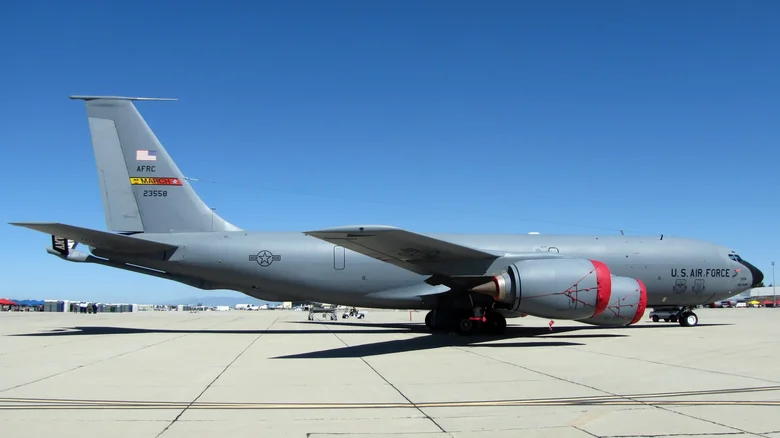
For decades, March ARB has been synonymous with air mobility and aerial refueling, hosting generations of tanker aircraft that quietly sustain U.S. global operations. The Boeing KC-135 Stratotanker and the KC-10 Extender have long defined its skyline. Now, the installation is preparing for the next chapter: full integration of the KC-46A Pegasus, Boeing’s newest aerial refueling platform. This modernization is not cosmetic. It is structural, operational, and strategic.
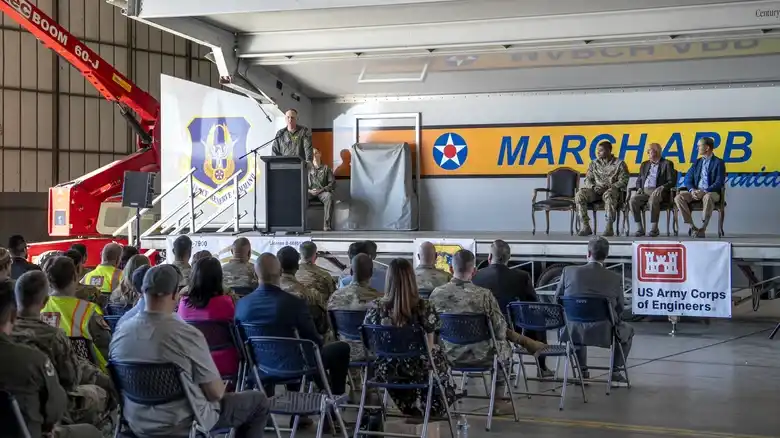
Construction officially began on December 16, 2025, led by Harper Construction Company Inc., under oversight from the U.S. Army Corps of Engineers (USACE). At a groundbreaking ceremony, officials emphasized that the project ensures March ARB’s role as a cornerstone of American airpower will continue well into the future. The message was clear: this is infrastructure built not just for today’s aircraft, but for decades of sustained operational demand.
A Purpose-Built Hangar for the KC-46 Pegasus
At the heart of the upgrade is a massive, two-bay maintenance and fueling hangar designed specifically for the KC-46A Pegasus. To understand its scale, consider the aircraft it must house. The KC-46A has a 156-foot wingspan and measures 165.5 feet in length. The new hangar will accommodate two of these tankers simultaneously — a logistical necessity for a base that operates in high-readiness cycles.
The structure is engineered with reinforced concrete foundations and a steel frame and roof system, ensuring durability under the stress of heavy aircraft operations. Insulated metal wall systems and advanced utility integration provide environmental control and energy efficiency. Large tanker aircraft require extensive power supply, fueling systems, and hydraulic support capabilities, all of which are integrated into the design from the ground up.
Safety is embedded into the architecture. The hangar includes modern fire suppression systems, fall-protection measures for elevated maintenance work, and dedicated storage zones for hazardous materials. These features are not luxuries; they are essential safeguards when servicing aircraft that carry thousands of gallons of fuel and sophisticated mission systems. Personnel support areas — including operational workspaces and staging zones — ensure that daily maintenance cycles can proceed efficiently without compromising safety or speed.
Upgrading Building 1244 for Training and Logistics
The modernization effort extends beyond the hangar. Building 1244 is undergoing substantial renovation to support fuselage training and cargo pallet storage operations. The KC-46 is not merely a tanker; it also has cargo and aeromedical evacuation capabilities. That dual-purpose functionality requires enhanced training infrastructure.
The building upgrades include new classrooms, a briefing room, and expanded office space to accommodate instruction and mission planning. HVAC systems are being modernized to meet updated performance and environmental standards, while fire suppression systems are also being improved to align with current safety codes. These enhancements reflect a broader shift toward integrating operational readiness with training efficiency.
Cargo pallet storage capacity is equally critical. Air mobility operations depend on rapid configuration changes — switching between refueling missions and cargo support roles. By upgrading storage and training facilities in parallel, March ARB ensures the KC-46 fleet can operate at maximum flexibility.
Airfield and Site Infrastructure Enhancements
The project includes significant site preparation work, demolition of outdated structures, and installation of KC-46 mooring points on the airfield. Mooring systems are designed to secure aircraft during high winds or adverse weather conditions, a necessary adaptation as newer tankers integrate into existing ramp space.
Airfield striping updates are also underway, aligning runway and taxiway markings with KC-46 operational requirements. While these changes may appear minor, airfield markings are critical for safety and precision in high-tempo environments. Environmental remediation measures are included where required, reflecting federal construction standards and environmental compliance obligations.
The construction timeline is projected at approximately three years. Officials have described this as only one phase in a broader modernization initiative, with additional improvements expected in future funding cycles. The hangar and training facilities form the foundation; future phases may expand maintenance capacity and support infrastructure as the KC-46 fleet presence grows.
Understanding the $133M vs. $250M Price Question
Public discussion around the project has sometimes cited figures as high as $250 million, leading to confusion. Officially, the awarded construction contract stands at $134 million, reflecting the value of the work authorized in this phase.
The higher figure originates from early solicitation documents, which often present estimated value ranges during the planning stage. Federal military construction projects commonly span multiple phases and budget cycles. During solicitation, notional upper-range values are included to account for potential scope variations or future expansions. Once contracts are awarded, the official value reflects the funded scope at that time.
This distinction is procedural rather than controversial. The Department of Defense frequently structures large projects incrementally, funding core infrastructure first and layering additional enhancements later. The current $134 million contract represents the defined and approved scope of work — centered on preparing March ARB to support the KC-46A Pegasus effectively.
A Century of Service, Reinforced for the Future
March Air Reserve Base has served through world wars, Cold War tensions, and modern expeditionary operations. Its identity is inseparable from the evolution of air mobility. The introduction of the KC-46 Pegasus signals another technological leap, combining refueling capability with modern avionics, defensive systems, and cargo versatility.
Infrastructure determines operational capacity. Without purpose-built hangars, training facilities, and airfield modifications, advanced aircraft cannot achieve their intended readiness levels. This upgrade ensures that March ARB remains not merely historic, but operationally indispensable.
From reinforced concrete foundations to advanced fire suppression systems, the modernization effort reflects a base preparing to sustain global airpower for decades to come. Whether measured at $133 million or viewed within broader long-term planning frameworks, the investment underscores one central fact: March Air Reserve Base is not a relic of aviation history. It is an active engine of American air mobility — now rebuilt to support the next generation of strategic reach.