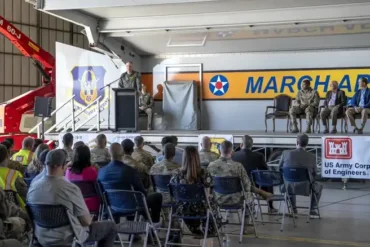
March Air Reserve Base sits quietly on the inland edge of Southern California, far from the glamour of coastal aviation hubs and Silicon Valley tech campuses. Yet in the coming decades, this base will sit at the center of American power projection, quietly enabling fighter jets, bombers, cargo aircraft, and allied fleets to stay airborne across the globe. The United States Air Force is committing roughly $250 million to modernize March ARB, and this is not cosmetic infrastructure spending. It is a structural bet on how future wars, deterrence missions, and humanitarian operations will be fought and sustained.
The upgrade is anchored around the arrival of the Boeing KC-46A Pegasus, the Air Force’s next-generation aerial refueling and multi-role transport platform. March ARB is not merely receiving new aircraft; it is being transformed into a technologically modernized logistics node designed to operate in contested, data-rich battle environments. The scale of construction underway—new hangars, reinforced taxiways, simulators, antennas, training facilities, and support infrastructure—reveals how deeply the military is reshaping its backbone to support 21st-century operations.
This is a story about concrete and steel, yes. But it is also about geopolitics, technological evolution, and the slow, methodical modernization of a fleet that underwrites global American presence.
March Air Reserve Base’s Strategic Role in the US Air Force’s Global Architecture
March Air Reserve Base occupies a geographic sweet spot. Positioned in Southern California, it offers proximity to Pacific deployment corridors, major industrial suppliers, and a vast reserve personnel pool. The base already hosts a mix of reservists, National Guard units, and active-duty personnel, creating a hybrid operational ecosystem that allows rapid scaling during crises.
From the Air Force’s perspective, March ARB is not just another base on a map. It is a logistics anchor point that can project power across the Pacific, support domestic disaster response, and integrate seamlessly with active-duty command structures. When the Pentagon invests hundreds of millions into a single installation, it is effectively signaling that the base will remain operational and relevant for half a century or more.
Why the KC-46A Pegasus Is Forcing a Massive Infrastructure Overhaul
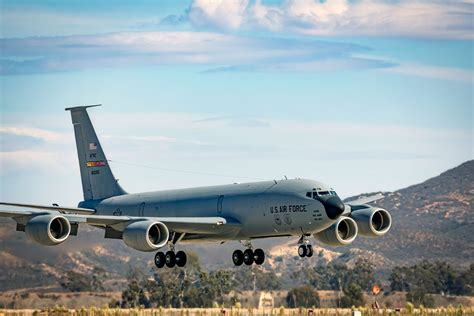
The immediate catalyst for the $250 million upgrade is the arrival of the KC-46A Pegasus, a tanker aircraft built on the Boeing 767 platform. Compared to the venerable KC-135 Stratotanker, the Pegasus is physically larger in every dimension—taller, wider, longer, and significantly heavier when fully loaded with fuel and cargo.
Legacy hangars designed for the slimmer, lighter KC-135 simply cannot accommodate the Pegasus. Doors are too low, structural spans are too narrow, and floor load tolerances are insufficient. The solution is not incremental renovation but wholesale reconstruction: taller hangars, reinforced foundations, and re-engineered ramp geometry to handle the aircraft’s weight and wingspan.
This is not just about parking an aircraft indoors. Modern tankers require climate-controlled environments, secure digital networks, and specialized maintenance facilities to protect sensitive avionics, classified systems, and composite materials. The new hangars will integrate environmental controls and security infrastructure that reflect the Pegasus’s role as a networked combat platform rather than a simple fuel truck.
A $133 Million Maintenance Hangar and the Physics of Modern Tankers
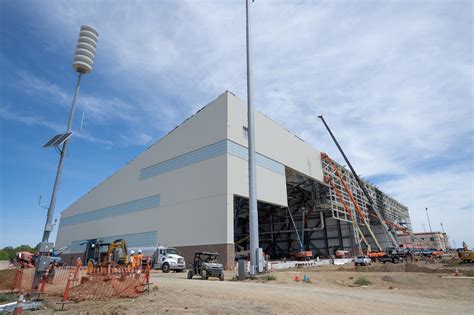
The centerpiece of March ARB’s transformation is a massive two-bay maintenance hangar costing more than $133 million. This structure is being built at a higher ground elevation, which sounds trivial until you consider the cascading engineering consequences. The surrounding tarmac must be demolished and rebuilt at a precise incline to align with the hangar floor, ensuring safe towing and parking operations for multi-hundred-ton aircraft.
The Pegasus’s weight requires thicker concrete slabs across taxiways and ramps to prevent subsurface cracking and long-term structural degradation. Reinforced pavements are not glamorous, but they are essential. A cracked ramp is not a nuisance—it can ground aircraft and compromise mission readiness.
Air Traffic Control, Antennas, and the Invisible Infrastructure Layer
One of the more esoteric upgrades underway is the replacement of air traffic control antennas. The new hangars are so tall that they physically block legacy antenna line-of-sight paths. To maintain reliable radar, communications, and navigation signals, March ARB installed two taller antennas in early 2026.
This highlights a hidden truth about modern air bases: physical structures and electromagnetic systems are deeply interdependent. Build a taller hangar, and you may inadvertently disrupt radar coverage. Modernizing a base means redesigning both the visible architecture and the invisible digital and radio-frequency scaffolding that keeps aircraft safe and connected.
Simulators, Classrooms, and the Human Infrastructure Surge
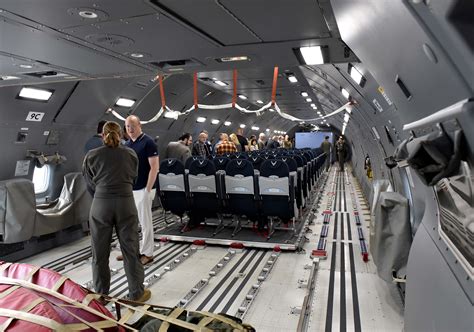
Hardware is only half the equation. March ARB is also preparing for a surge in personnel, with roughly 144 additional staff expected to support the KC-46 mission. New flight simulators, classrooms, and training facilities are part of the $240+ million military construction budget allocated to the base.
The Pegasus’s digital refueling systems, cargo configurations, and aeromedical evacuation capabilities require specialized training pipelines. Unlike the KC-135’s analog-era systems, the KC-46 is a flying network node with software-driven interfaces and advanced sensors. Training crews locally reduces operational friction and ensures faster mission readiness once aircraft arrive.
Why March ARB Was Selected for the KC-46 Mission
Basing decisions in the Air Force are rarely sentimental. March ARB was chosen after evaluating strategic location, existing infrastructure, community support, and cost efficiency. The base already possessed significant ramp space, runways, and hangars that could be adapted, reducing the total cost of transition compared to building a greenfield tanker hub elsewhere.
March ARB also stood out as the only candidate with a fully integrated mix of reservists, guardsmen, and active-duty personnel on site. This hybrid model allows flexible manpower scaling, making the base particularly attractive for a platform that will be heavily tasked across multiple mission sets.
Political support played a role too. Bipartisan advocacy from local stakeholders and congressional representatives provided confidence that March ARB would remain politically and financially supported for decades, a key factor when infrastructure investments span half-century timelines.
March ARB’s Deep Roots in Aerial Refueling History
March Air Reserve Base is not new to tankers. It became a tanker base in the late 1950s as the KC-135 entered service, supporting Strategic Air Command bombers during the Cold War. The 452nd Air Refueling Wing, later redesignated the 452nd Air Mobility Wing, received its first KC-135 in 1976 and went on to operate some of the most heavily tasked reserve tankers in the force.
The KC-135’s service at March spanned nearly seven decades, with upgrades including re-engining into the more efficient KC-135R variant. These aircraft supported global operations, humanitarian missions, and contingency deployments, becoming a logistical backbone for American air power.
The base itself underwent BRAC-driven closure as an active-duty installation in the early 1990s, but it persisted as a reserve hub. The final KC-135 flyover in May 2020 symbolized the end of an era and the beginning of the Pegasus transition.
The Pegasus Advantage: More Than Just a Flying Fuel Truck
The KC-46A Pegasus represents a philosophical shift in tanker design. The KC-135 was essentially a flying gas station with limited data and mission integration capabilities. The Pegasus, by contrast, is designed to operate in contested environments and act as a data relay node.
It features infrared countermeasures, electronic warfare capabilities, and resilient structures intended to survive in missile-threat environments. Its sensors and communication systems allow it to share real-time battlefield data with other aircraft, transforming it into a networked asset rather than a passive support platform.
Operationally, the KC-46 can refuel multiple aircraft simultaneously using both boom and hose-and-drogue systems, dramatically increasing mission throughput. It carries three times more cargo pallets, twice as many passengers, and significantly more aeromedical evacuation capacity than its predecessor.
Digital Refueling and the End of the Prone Boom Operator
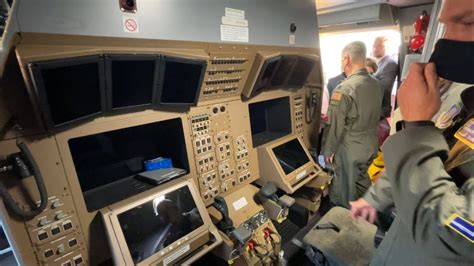
One of the most striking technological shifts is how refueling is performed. On the KC-135, boom operators lay prone at the rear of the aircraft, visually guiding the refueling boom through a window. On the KC-46, the operator sits in the front, using a digital 3D panoramic system fed by cameras and sensors.
This Remote Vision System transforms refueling into a data-driven operation, reducing physical strain and enabling advanced visualization. It also underscores why March ARB needs new simulators and training infrastructure—operating a digital refueling station is closer to flying a drone cockpit than using a mechanical boom system.
A Tanker That Can Refuel Itself
Another crucial difference is that the KC-46 can be refueled in flight as a standard capability. Many KC-135 aircraft cannot receive fuel, limiting their endurance and on-station time. The Pegasus’s receiver capability allows it to remain deployed longer, extending the operational reach of strike and transport packages.
This capability changes tanker tactics. A Pegasus can stay on station to support extended operations without returning to base, effectively multiplying the endurance of fighter and bomber formations. That endurance is one of the quiet but decisive factors in modern warfare.
The Pegasus Program’s Turbulent Early Years
The KC-46 program did not arrive fully formed. It endured years of scrutiny over “Category 1” deficiencies, including a refueling boom that was too rigid for lighter aircraft and early-generation remote vision systems that lacked clarity.
Engineering fixes such as the Boom Telescopic Actuator Redesign and the RVS 2.0 sensor overhaul have transformed the aircraft’s operational reliability. By 2025, the Pegasus had logged over 150,000 flight hours, completed a 45-hour non-stop mission across three continents, and achieved worldwide combat deployment certification.
The Air Force’s decision to bypass a “bridge tanker” competition and instead procure up to 75 additional KC-46As signals institutional confidence that the platform is now delivering on its promise.
Infrastructure as a Strategic Weapon
The $250 million upgrade at March ARB illustrates a broader truth: infrastructure is a strategic weapon. Aircraft are only as effective as the bases that support them. Hangars, runways, simulators, fuel systems, and data networks form the skeleton that allows fleets to operate at scale.
By investing in March ARB, the Air Force is not merely modernizing a base; it is hardening a logistics node against future operational demands. Reinforced tarmacs, taller hangars, advanced antennas, and digital training facilities collectively enable a generation of aircraft designed for data-centric warfare.
In a conflict scenario, the ability to rapidly generate sorties, maintain aircraft, and sustain tanker operations can determine the tempo of air campaigns. March ARB’s modernization ensures that this tempo will not be constrained by legacy infrastructure limitations.
Power Projection for the Next Half-Century
The Air Force expects March ARB to serve as a key strategic hub for the Pegasus fleet for at least the next 50 years. That timeline is staggering in an era of rapid technological change, but it reflects the reality that military infrastructure evolves slowly and deliberately.
Tankers are the unsung enablers of air power. Without them, fighters cannot reach distant theaters, bombers cannot loiter, and cargo aircraft cannot operate at intercontinental scale. By anchoring a modern tanker hub in Southern California, the Air Force is reinforcing its ability to project power across the Pacific, respond to crises, and support allies.
This $250 million investment is a down payment on future deterrence.
The Economic and Community Impact Around March ARB
Large military construction projects ripple through local economies. Contractors, engineers, suppliers, and service providers benefit from multi-year construction timelines. The arrival of additional personnel and families increases demand for housing, schools, and services, integrating the base more deeply into the regional economy.
Community support was a decisive factor in selecting March ARB for the KC-46 mission. That support now translates into tangible economic activity and long-term stability. Bases that demonstrate strong civilian-military integration are more resilient to future BRAC cycles and budgetary fluctuations.
The Broader Tanker Transition Across the US Air Force
March ARB’s upgrade is one chapter in a nationwide tanker transition. The KC-135 fleet, with some airframes approaching 70 years of service, is being phased out in favor of the KC-46 and potentially future platforms like blended-wing-body concepts and next-generation air dominance support aircraft.
This transition is not simply about replacing old planes. It is about redefining the tanker as a multi-role platform that integrates logistics, data, and survivability. Bases like March ARB are being redesigned to support that new role, blending traditional maintenance infrastructure with digital training and secure networks.
The result is a tanker force that is not just bigger and newer, but fundamentally more integrated into modern combat doctrine.
Concrete, Code, and the Future of Air Power
The spectacle of demolishing concrete and erecting massive hangars can feel mundane compared to stealth fighters and hypersonic weapons. Yet this is where military power quietly accumulates. Infrastructure is the substrate upon which advanced aircraft, trained crews, and networked operations rest.
March Air Reserve Base’s $250 million upgrade is not a headline-grabbing weapons program. It is something more durable: a foundational investment in endurance, flexibility, and strategic reach. When the KC-46A Pegasus begins arriving in 2028, it will roll onto a base engineered for the future rather than patched from the past.
In the long arc of military modernization, this is how empires sustain themselves—not just with cutting-edge aircraft, but with the concrete, steel, and silicon that keep them flying.