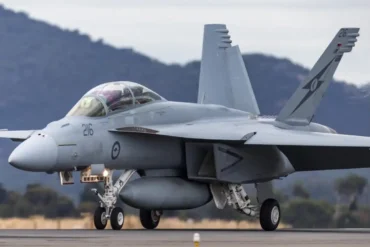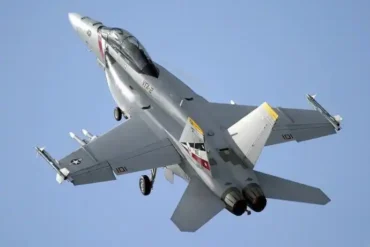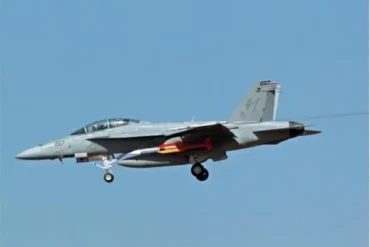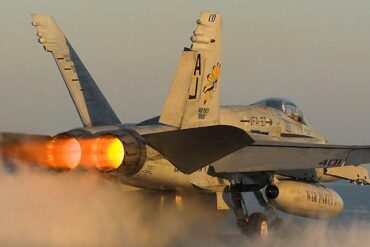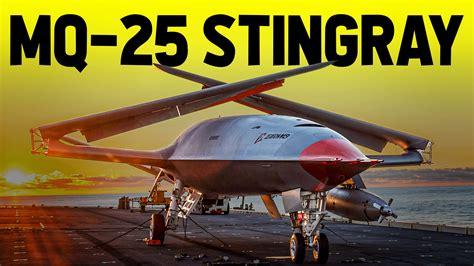
The F/A-18E/F Super Hornet was designed to carry weapons, defend carrier strike groups, and deliver combat power across thousands of miles of ocean. Yet for nearly two decades, a significant portion of these advanced fighters have spent their valuable flight hours performing a mission they were never meant to specialize in: acting as airborne fuel trucks.
The arrival of the Boeing MQ-25 Stingray is designed to change that reality. As the U.S. Navy’s first operational carrier-based unmanned aircraft, the Stingray represents more than a new tanker. It is the beginning of a fundamental transformation in how aircraft carriers generate combat power.
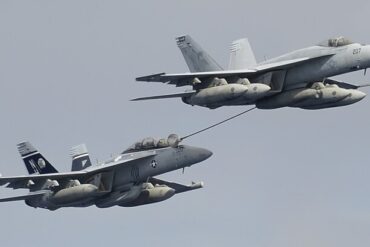
For years, the Navy accepted an inefficient compromise. Without a dedicated carrier tanker aircraft, the Super Hornet became the solution by default. Fighter aircraft equipped with D-704 aerial refueling stores have been forced to trade missiles and combat capability for fuel hoses, reducing the number of jets available for strike missions.
The MQ-25 aims to reverse that equation. By taking over the carrier’s aerial refueling responsibility, the autonomous tanker will return Super Hornets to their primary role: delivering weapons, protecting the fleet, and extending American naval aviation reach in increasingly contested environments.

The F/A-18 Super Hornet’s Unwanted Role as a Tanker
The concept of using fighters as “buddy tankers” was never considered an ideal solution. It was a workaround created after the Navy retired its dedicated carrier tanker aircraft without an immediate replacement.
When aircraft such as the Lockheed S-3B Viking and Grumman KA-6D Intruder left service, the carrier air wing lost specialized aircraft capable of transferring fuel to other fighters. The Super Hornet was the only modern aircraft already operating from carriers that had enough fuel capacity, performance, and compatibility to temporarily fill the gap.
The result was an unusual situation. One of the world’s most capable multirole fighters was routinely assigned a mission that contributed little direct combat power.
During carrier operations, approximately 20% to 33% of Super Hornets can be dedicated to tanker duties. In a typical carrier air wing containing around 44 strike fighters, that means roughly nine to fifteen aircraft may spend their sorties carrying refueling equipment instead of weapons.
For a fighter that costs approximately $67 million, this represents a significant opportunity cost. Every Super Hornet flying as a tanker is one less aircraft available for offensive operations, fleet defense, electronic warfare support, or additional strike capacity.
The issue becomes even more important as naval warfare evolves. Modern anti-access systems, particularly China’s DF-26 anti-ship ballistic missile, have pushed U.S. carriers farther away from potential combat zones. Distance creates a fuel problem, and fuel determines whether carrier aviation can reach the battlefield.
The Navy does not simply need more aircraft. It needs greater efficiency from every aircraft already aboard the carrier.
Why the MQ-25 Stingray Changes Carrier Aviation
The MQ-25 Stingray was created around one specific mission: providing organic aerial refueling capability for carrier air wings without consuming valuable fighter capacity.
Unlike the Super Hornet, the MQ-25 is not a combat aircraft performing a secondary role. It is a purpose-built unmanned tanker designed from the beginning to carry fuel, operate from carriers, and extend the range of crewed aircraft.
The aircraft can deliver approximately 15,000 pounds (6,804 kilograms) of fuel at distances of up to 500 nautical miles (926 kilometers) from the carrier. This allows fighters to receive fuel far from the ship and dramatically increases the operational radius of the entire carrier air wing.
A Super Hornet operating without tanker support has a combat radius of roughly 450 to 500 nautical miles. With MQ-25 support, that reach can extend beyond 1,000 nautical miles, allowing carrier aircraft to operate from safer distances while still reaching important targets.
The strategic impact is significant. The carrier strike group no longer has to choose between moving closer to threats or accepting reduced strike effectiveness. The MQ-25 gives commanders additional operational flexibility.
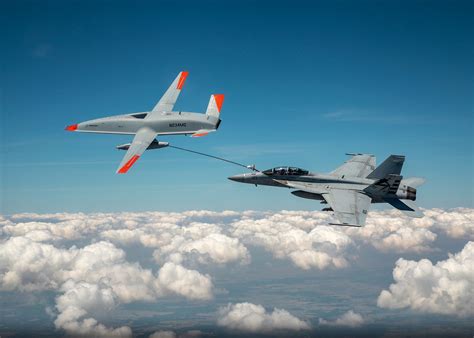
The Navy describes the purpose of the aircraft clearly: the Stingray allows ordnance to replace refueling stores on Super Hornet pylons. In practical terms, the aircraft carrier gains additional combat power without adding another manned fighter squadron.
The number of aircraft on the deck remains the same, but the number available for combat increases.
The Challenge of Making an Autonomous Carrier Aircraft
Creating an unmanned aircraft is difficult. Creating an unmanned aircraft capable of launching from and landing on a moving aircraft carrier is an entirely different challenge.
Carrier aviation is one of the most demanding environments in the world. Aircraft must operate on a crowded deck exposed to saltwater, extreme weather, limited visibility, and constantly changing conditions.
A carrier launch involves accelerating an aircraft from zero to approximately 150 miles per hour (241 kilometers per hour) in only a few seconds through a catapult system. During this process, the aircraft experiences intense forces that test the airframe, flight controls, and onboard computers.
For a piloted aircraft, a human pilot can make last-second decisions based on experience and visual judgment. For an autonomous aircraft, those decisions must be handled through sensors, software, and carefully designed control systems.
The MQ-25 program must prove that autonomous systems can perform every step of carrier operations, including taxiing, launch, flight control, refueling procedures, and arrested recovery.
This is why the program’s timeline has moved beyond its original goals. The challenge is not simply building an aircraft that flies. It is building a robotic aircraft that can safely integrate into the world’s most complex aviation environment.
Boeing MQ-25 Production Aircraft Begins Flight Testing
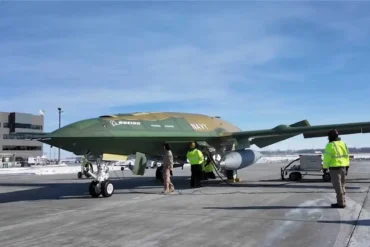
The MQ-25 program reached a major milestone when a production-representative aircraft completed its first flight. The aircraft demonstrated autonomous taxi operations, takeoff, planned flight activities, and landing while controlled through the Unmanned Carrier Aviation Mission Control System (UMCS).
The aircraft was operated through a ground-based control station rather than from a cockpit. Boeing and Navy personnel successfully managed the aircraft during testing, proving that the basic command architecture required for autonomous carrier aviation is becoming reality.
However, flight testing is only one part of the process. The aircraft must still complete carrier suitability evaluations, including the catapult launches and arrested landings that determine whether it can operate from active Navy carriers.
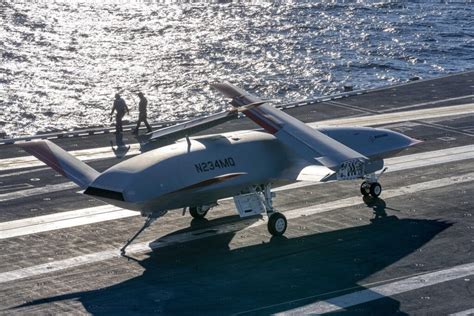
The size of the MQ-25 adds another challenge. Despite being unmanned, it is not a small drone.
Rear Admiral Stephen Tedford previously emphasized that many observers underestimate the aircraft’s dimensions. The Stingray is approximately as long as an F/A-18 and has a wingspan comparable to the E-2D Advanced Hawkeye.
That means carrier crews must handle an aircraft with the physical presence of a traditional naval aircraft while also adapting to a new operating concept.
Why MQ-25 Operational Capability Has Taken Longer Than Expected
The Navy originally planned for the MQ-25 to achieve initial operational capability in 2024. That target has since moved significantly, with current planning placing IOC around the second quarter of fiscal year 2029.
The delay reflects the complexity of introducing an entirely new category of aircraft into carrier operations.
The first operational capability requires more than aircraft delivery. The Navy must establish trained personnel, maintenance systems, mission procedures, and carrier integration methods.
The initial IOC definition calls for three MQ-25A aircraft with the necessary equipment and personnel operating from an MQ-25-capable aircraft carrier.
The Navy’s cautious approach reflects the importance of getting autonomous carrier aviation right. A failure on land is serious. A failure on a carrier at sea can threaten aircraft, crews, and an entire strike group.
Production will gradually increase. Current plans call for several aircraft per year initially, eventually increasing toward higher annual production rates. The Navy plans to acquire approximately 76 MQ-25 aircraft, including test aircraft.
However, the real impact will depend on numbers. A handful of Stingrays can prove the concept, but a carrier air wing requires approximately 20 to 24 aircraft to achieve the full tanker transformation.
How MQ-25 Will Reshape Future Carrier Strike Operations
Once enough MQ-25 aircraft enter service, carrier operations will change significantly.
Today, air wing commanders must calculate strike packages after assigning tanker duties to Super Hornets. Some combat aircraft are effectively removed from the equation before the mission begins.
With dedicated unmanned tankers, planners can start with the full fighter inventory.
This creates additional flexibility in every mission category. More aircraft can carry weapons. More fighters can provide air defense. More platforms can support complex operations over longer distances.
The impact is especially important in the Indo-Pacific region, where distances are enormous and adversaries increasingly rely on long-range weapons to threaten naval forces.
The MQ-25 does not make aircraft carriers invisible or invulnerable. Instead, it changes the distance at which they can operate effectively.
By extending fighter range, the Stingray allows carriers to maintain greater separation from hostile missile systems while still projecting air power.
MQ-25 Is Only the Beginning of Naval Autonomous Aviation
The importance of the MQ-25 extends beyond tanker operations.
The aircraft is effectively a technology foundation for future carrier-based unmanned systems. Before the Navy can operate armed autonomous aircraft from carriers, it must first solve the difficult problems of autonomous launch, recovery, communication, and flight deck integration.
The Stingray provides that experience.
Future versions of carrier drones could perform intelligence, surveillance, electronic warfare, and potentially strike missions. Although the current MQ-25 configuration is not an armed aircraft, its large payload capacity has already created discussions about possible future roles.
The same aircraft capable of carrying 15,000 pounds of fuel could theoretically carry other payloads in future concepts.
Whether the Navy develops armed variants remains uncertain, but the technological pathway is becoming clearer.
The MQ-25 is not just replacing a tanker mission. It is establishing the operational foundation for a new generation of carrier aviation.
The Return of the Super Hornet as a True Fighter
For the F/A-18 Super Hornet, the arrival of the MQ-25 represents a return to its original purpose.
The aircraft was built to deliver weapons, protect naval forces, and dominate contested airspace. It was never intended to spend a large percentage of its service life transporting fuel.
The Stingray removes that burden.
When enough MQ-25 aircraft enter service, the Super Hornet will once again become what it was designed to be: a combat aircraft carrying weapons instead of fuel pods.
The transformation will not happen overnight. Carrier aviation changes slowly because the consequences of failure are enormous. But the direction is clear.
The autonomous tanker is arriving, and when it becomes fully operational, one of the Navy’s most capable fighters will finally stop doing the mission it has always hated most.