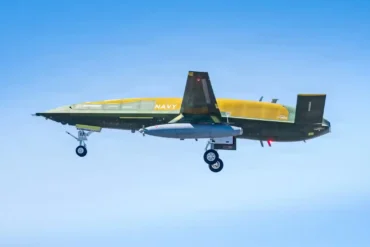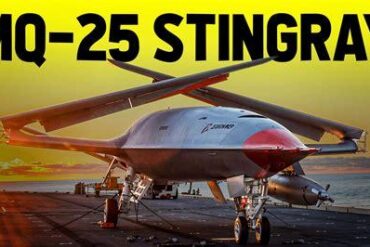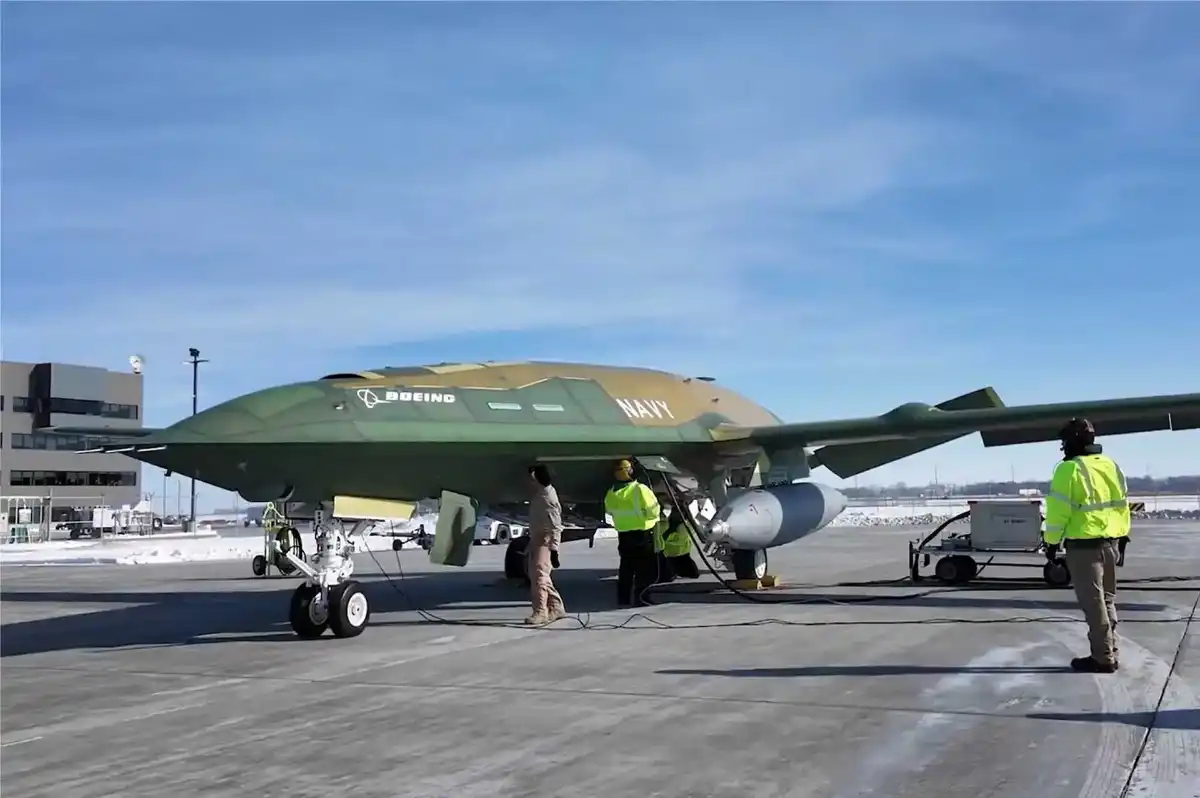
The U.S. Navy has crossed a quiet but consequential threshold in naval aviation, completing the first autonomous taxi test of an operational MQ-25A Stingray on January 30, 2026. Announced by Boeing, the event signals that unmanned aircraft are no longer confined to test ranges and controlled demonstrations. They are beginning to learn the choreography of real-world carrier operations, where precision, predictability, and trust are non-negotiable.
Unlike earlier unmanned demonstrators that proved concepts in isolation, this aircraft was configured to operational fleet standards. That distinction matters. The MQ-25A involved in the test was not a laboratory prototype but a platform intended for frontline service, designed to integrate seamlessly with the daily rhythm of U.S. Navy aviation. The autonomous taxi sequence unfolded ashore, yet its implications are unmistakably maritime, pointing directly toward the complex and hazardous environment of an aircraft carrier flight deck.
During the test, the Stingray responded to commands issued by Air Vehicle Pilots, initiating movement from a stationary position, following predefined taxi routes, executing controlled turns, and performing stop-and-hold maneuvers that mirror carrier deck handling procedures. Each action validated a tightly integrated autonomy architecture that fuses navigation inputs, control algorithms, and layered safety constraints. On a carrier deck, where aircraft are separated by meters rather than margins, predictable behavior is not a convenience; it is survival.
The U.S. Navy’s focus on autonomous taxiing may appear modest compared to catapult launches or arrested landings, but seasoned naval aviators understand why it matters. Carrier decks are among the most demanding operational environments in military aviation. Aircraft must maneuver amid jet blast, shifting deck motion, limited visibility, and the constant proximity of personnel and equipment. For an unmanned aircraft, ground movement is the first test of whether humans can trust autonomy in close quarters. The successful taxi test demonstrates that the MQ-25A can move deliberately and safely under command, laying the groundwork for more complex deck operations to follow.
This milestone is rooted in a strategic reassessment that began more than a decade ago. By the mid-2010s, the U.S. Navy recognized that the effective combat radius of carrier-based fighters had been steadily shrinking as potential adversaries fielded longer-range sensors and weapons. Rather than immediately pursuing a new manned aircraft, the Navy identified organic aerial refueling as the most urgent gap. Fighters were burning flight hours as improvised tankers, eroding readiness and combat availability across carrier air wings.
In August 2018, Boeing was awarded the Engineering and Manufacturing Development contract for the MQ-25 program, defeating proposals from General Atomics and Lockheed Martin. Valued at approximately USD 805 million, the contract covered four development aircraft, ground control systems, and supporting infrastructure. Subsequent production decisions transformed the MQ-25 from a promising concept into the U.S. Navy’s first operational carrier-based unmanned aircraft, a designation that carries both technical and cultural weight.
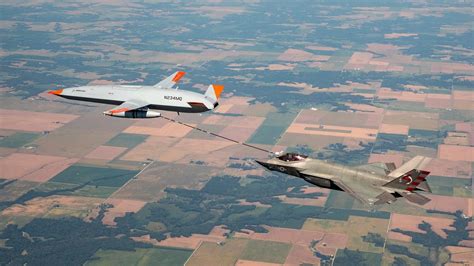
At its core, the MQ-25A Stingray is designed as a force multiplier, not a replacement for manned fighters. Powered by the Rolls-Royce AE 3007N turbofan, the aircraft emphasizes endurance and fuel efficiency over raw performance. In operational terms, it is expected to offload more than 6,800 kilograms (15,000 pounds) of fuel at tactically relevant distances, extending the reach of platforms such as the F-35C Lightning II and F/A-18E/F Super Hornet. Each successful refueling sortie returns manned fighters to their primary roles, restoring strike capacity and air defense flexibility to the carrier air wing.
Yet the Navy’s ambitions for the MQ-25A extend well beyond tanking. Within naval aviation planning circles, the Stingray is widely regarded as the gateway platform for a broader unmanned ecosystem at sea. Its communications architecture, autonomy stack, and deck integration procedures are deliberately structured to support mission growth. Once carrier operations are normalized, the aircraft could take on secondary roles including persistent intelligence, surveillance, and reconnaissance, airborne communications relay to extend command-and-control networks, and battlespace sensing to support long-range targeting in distributed maritime operations.
The autonomous taxi test directly supports that long-term vision. Before an unmanned aircraft can be trusted with catapult launches or arrested recoveries, it must demonstrate disciplined behavior during ground handling. Navy officials have repeatedly emphasized that deck operations represent one of the highest-risk phases of carrier aviation. By validating autonomous taxiing early, the program reduces risk while generating critical data to refine human-machine interaction models, deck crew procedures, and safety certification standards.
Viewed globally, the MQ-25A underscores a distinctly American approach to unmanned naval aviation. European efforts, most notably the Dassault-led nEUROn, prioritized stealth shaping and autonomous strike concepts as technology demonstrators rather than operational assets. While nEUROn delivered valuable insights into low-observable design and autonomy, it was never intended to integrate into the daily tempo of carrier flight operations or to assume enabling roles within an air wing.
Russia’s unmanned aviation initiatives, including the S-70 Okhotnik-B, follow a similar pattern. These platforms emphasize payload, penetration, and loyal wingman concepts in support of manned fighters such as the Su-57. They are land-based systems optimized for strike missions, with no demonstrated focus on carrier compatibility or autonomous deck handling. Russian naval aviation, constrained by limited carrier infrastructure, has shown little progress toward operational unmanned carrier aviation.
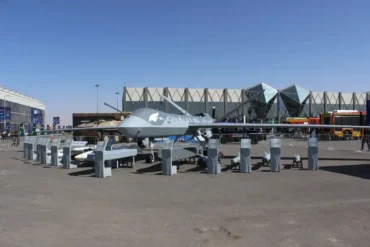
China represents a more direct point of comparison. Beijing has tested jet-powered unmanned aircraft such as the GJ-11 Sharp Sword, and analysts widely assess that China views carrier-capable unmanned systems as future force multipliers. However, no Chinese platform has yet been confirmed as an operational carrier-based tanker integrated into routine fleet service. In contrast, the MQ-25A is being introduced not as an experimental adjunct but as a core enabler of carrier air power.
For the U.S. Navy, the implications of this transition are operational, strategic, and institutional. Operationally, the MQ-25A increases strike range, sortie generation, and carrier survivability by allowing carriers to operate farther from hostile shores. Strategically, it supports the Navy’s shift toward distributed maritime operations, enabling long-range airpower without expanding the manned fleet. Institutionally, it compels changes in training pipelines, maintenance practices, and deck crew procedures as unmanned aircraft become routine participants rather than curiosities.
The autonomous taxi test also highlights a subtler transformation: the recalibration of trust between humans and machines. Carrier aviation has always been built on disciplined procedures and shared expectations. Deck crews rely on pilots to behave predictably under pressure. By demonstrating that an unmanned aircraft can meet those expectations on the ground, the MQ-25A begins to earn its place among manned counterparts, not through spectacle but through reliability.
As the program advances toward catapult launch trials and arrested landings, each milestone will represent more than technical progress. It will mark another step in reshaping how the U.S. Navy generates airpower in an era defined by long-range threats and great-power competition. The first autonomous taxi test of the operational MQ-25A Stingray may seem understated, but history often turns on such moments, when a new capability quietly proves it can be trusted to move forward under its own power.