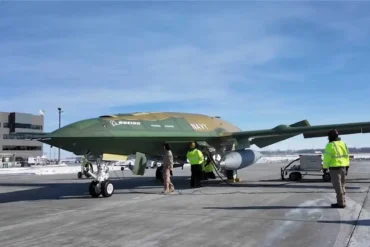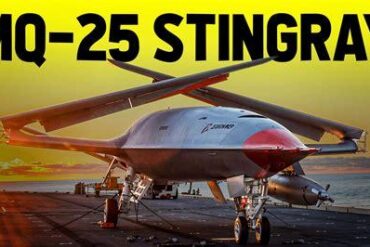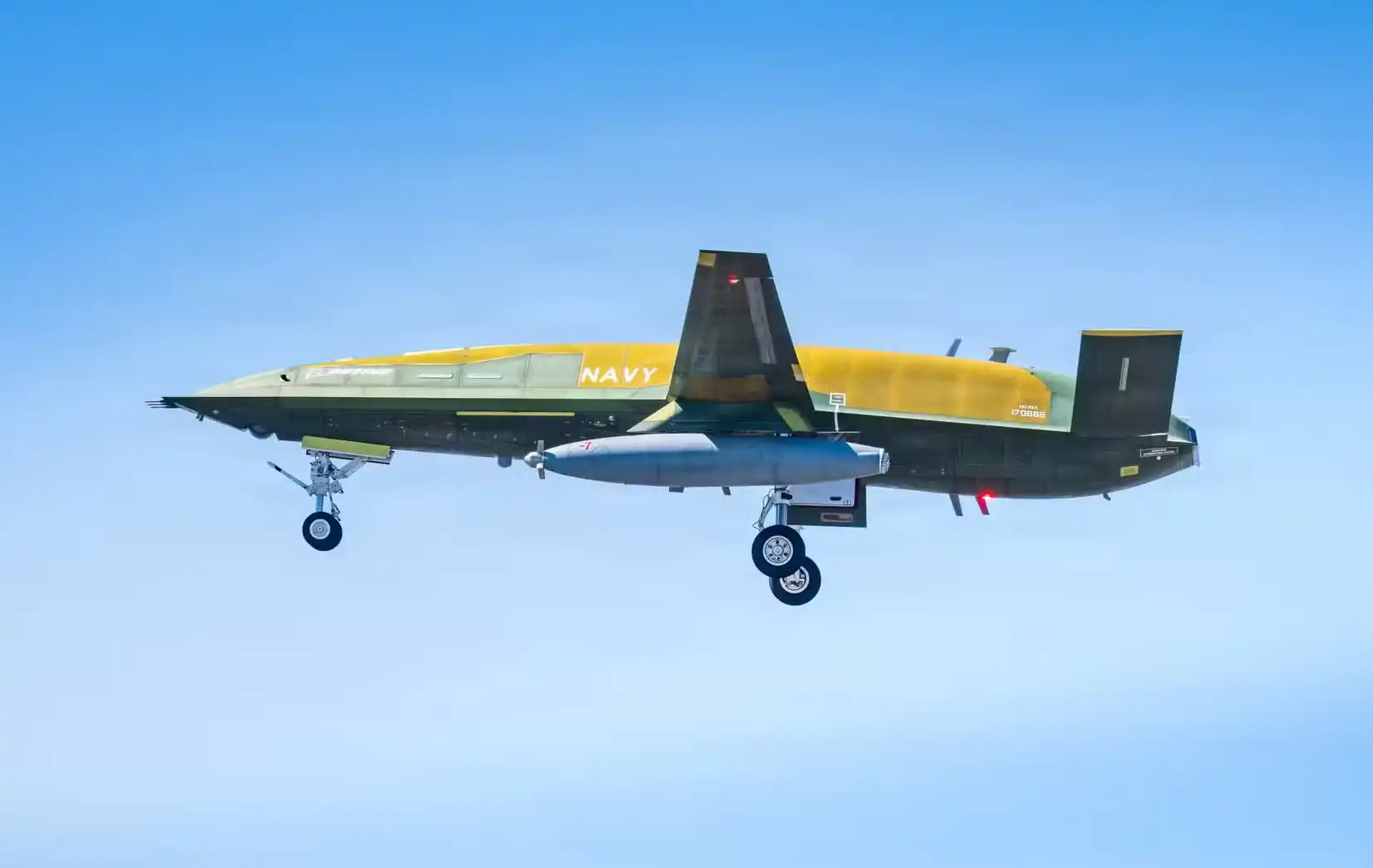
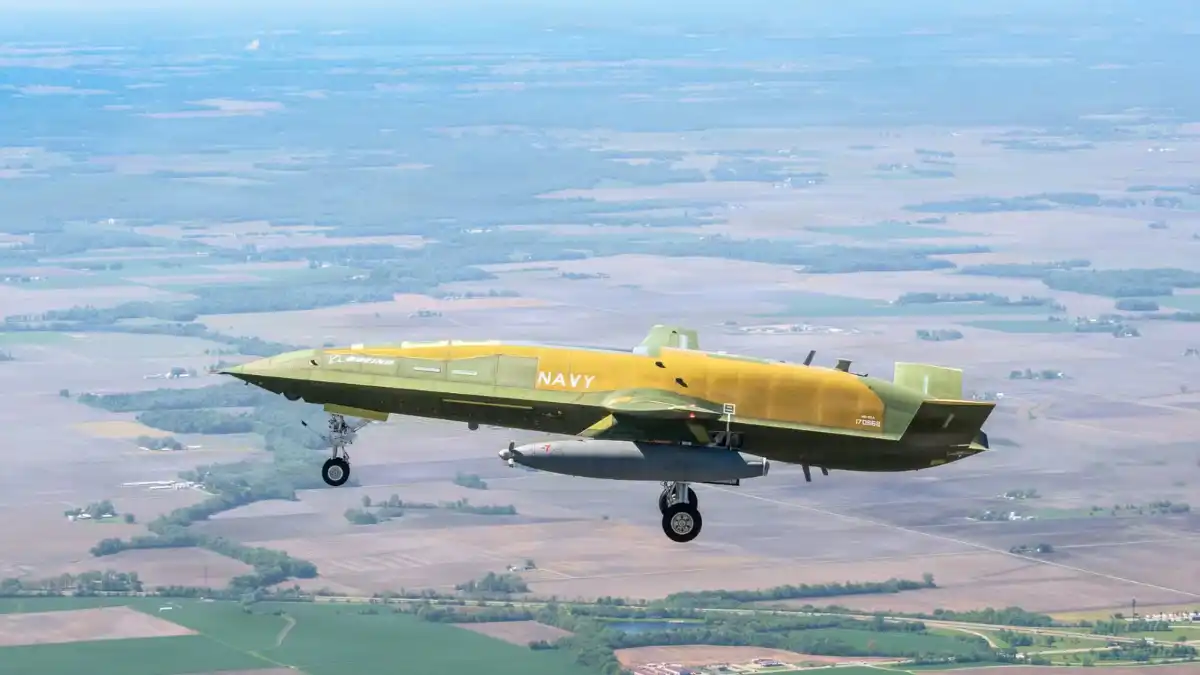
The United States Navy has taken a decisive step into the future of naval air power after the first production-representative Boeing MQ-25A Stingray successfully completed its maiden flight on April 25. The two-hour mission signaled more than a routine test event. It marked the arrival of the Navy’s first operational carrier-based unmanned aircraft, a platform designed to transform how carrier air wings fight, deploy, and sustain combat power at sea.
After an earlier attempt was scrubbed on April 22, the successful launch from Scott AFB/MidAmerica Airport in Mascoutah, Illinois, carried strong symbolic and operational importance. Controlled by Navy and Boeing pilots from the Unmanned Carrier Aviation Mission Control System MD-5 ground station, the aircraft completed key flight checks ahead of a planned ferry mission to a Navy facility later this year.
The MQ-25A is the first of four test aircraft funded under an $805 million contract, but its wider significance reaches far beyond the prototype stage. It introduces manned-unmanned teaming to the carrier deck in a practical role that directly improves the striking power of existing fighter aircraft.
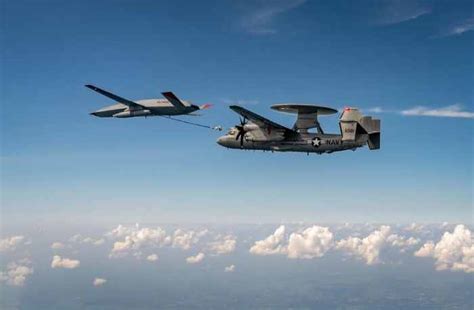
By choosing aerial refueling as the Stingray’s primary mission, the Navy has focused on one of the most persistent inefficiencies in modern carrier aviation.
Why the MQ-25A Stingray Matters to Carrier Operations
Aircraft carriers are often described as floating airbases, but every sortie launched from a carrier comes with fuel penalties. Catapult launches, high-power climbs, recovery patterns, bolters, and safety reserves all consume enormous amounts of fuel. Carrier air wings must constantly balance range, payload, and mission endurance.
For years, the Navy solved part of this problem by using F/A-18E/F Super Hornets as “buddy tankers.” These fighters carried external fuel tanks and hose-and-drogue refueling systems to top off other jets after launch or before long-range missions. It worked—but at a cost.
Every Super Hornet assigned to tanker duty is one less aircraft available for strike, escort, suppression of enemy air defenses, or fleet defense missions. In some deployments, as many as one-third of available strike fighters were diverted into support roles. That is an expensive use of a frontline combat aircraft.
The MQ-25A changes that equation.
Instead of sending a fighter to perform tanker duty, the Navy can now use a purpose-built unmanned aircraft designed specifically for endurance, fuel transfer, and persistence.
A Flying Gas Station Extending Combat Reach
The Stingray is expected to provide 15,000 pounds of fuel at distances up to 500 nautical miles from the carrier. That capability can nearly double the effective strike radius of aircraft such as the F-35C Lightning II and the Super Hornet.
In modern maritime warfare, distance matters. Potential adversaries are fielding longer-range missiles, integrated air defenses, and anti-access systems intended to push carriers farther from contested coastlines. If carrier aircraft cannot reach targets from safer standoff distances, the carrier’s strategic value is reduced.
The MQ-25A helps solve that problem by pushing usable combat range outward.
A Super Hornet launching with weapons can now meet a Stingray after departure, receive fuel, and proceed deeper into contested airspace. An F-35C can preserve internal fuel for tactical maneuvering rather than burning it simply to reach the fight. That means more time on station, more flexibility, and better survivability.
Rear Admiral Tony Rossi summarized the milestone clearly, stating that the MQ-25A is the first step in integrating unmanned aerial refueling onto the carrier deck and directly enabling manned fighters to fly farther and faster.
That is not marketing language—it is doctrine in motion.
More Than a Tanker: ISR and Persistent Surveillance
Although refueling is the headline mission, the Stingray also offers valuable intelligence, surveillance, and reconnaissance capability. Unmanned systems are ideal for missions often described by military planners as dirty, dangerous, and dull.
The aircraft can remain airborne for up to 10 hours, allowing it to monitor sea lanes, track contacts, relay targeting information, or provide battle damage assessment. Unlike a manned fighter, it does not impose pilot fatigue limitations in the same way, and it can loiter efficiently for long periods.
That endurance makes it useful in contested maritime zones where maintaining awareness is often as important as launching weapons. The Navy can place sensors farther forward while reducing risk to aircrew.
This secondary mission set hints at the broader future of carrier aviation. Today’s Stingray is primarily a tanker. Tomorrow’s deck-launched unmanned systems may carry electronic warfare packages, advanced sensors, or strike weapons.
Delays, Competition, and Program Development
The road to first flight was not perfectly smooth. The program originally aimed for earlier milestones, but development delays emerged from design complexity and supply chain pressures—issues common across aerospace manufacturing in recent years.
Boeing won the Navy’s Unmanned Carrier-Launched Airborne Surveillance and Strike competition in August 2018, defeating competitors including Lockheed Martin and General Atomics. That decision reflected Boeing’s experience with carrier aircraft integration and its ability to tailor a practical solution around refueling needs.
The first pre-production aircraft was delivered in 2024. That same year, USS George H.W. Bush became the first aircraft carrier equipped with a dedicated drone control center, laying the groundwork for routine MQ-25A operations at sea.
These steps matter because operating drones from carriers is not simply about the aircraft. It requires new deck procedures, command systems, maintenance workflows, data links, and training pipelines.
In short, the Stingray is changing the ecosystem of naval aviation, not just adding another airframe.
Safer Decks, Stronger Air Wings
Carrier aviation remains one of the most demanding environments in military flight. Every arrested landing carries risk, especially at night or in poor weather. Reducing the number of manned tanker sorties means reducing unnecessary launches and recoveries performed only to move fuel.
That has two major benefits: improved safety and reduced wear on expensive fighter fleets.
Super Hornets tasked heavily with tanker missions accumulate flight hours that shorten service life and increase maintenance burdens. Shifting those hours to the MQ-25A preserves fighter readiness for combat tasks.
The Navy plans to acquire 76 Stingrays, including 67 operational aircraft and nine test/developmental units. That scale suggests the service sees the program not as an experiment, but as a permanent part of future carrier operations.
The Beginning of the Unmanned Carrier Era
The first flight of the MQ-25A Stingray is best understood as an opening chapter. Naval aviation has repeatedly evolved through propulsion changes, angled decks, catapults, radar, jets, and stealth aircraft. Unmanned integration is the next major transition.
The Stingray may not be the most glamorous aircraft on the flight deck. It does not carry the public recognition of an F-35 or the raw power of a Super Hornet. Yet it may prove just as important because it enables those aircraft to perform at their full potential.
Sometimes the platform that changes warfare is not the one dropping bombs—it is the one making every other mission possible.