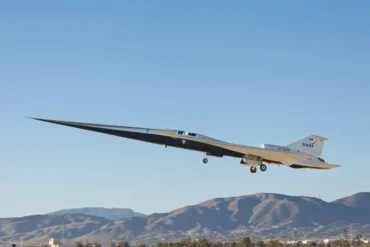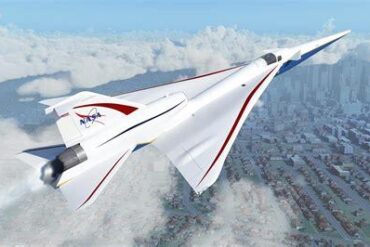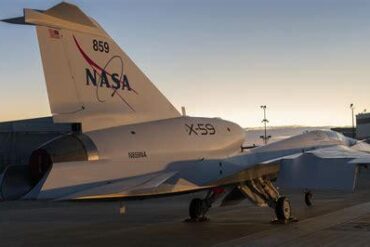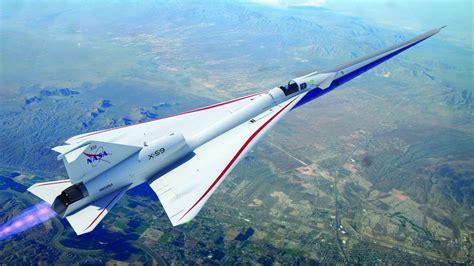
The NASA X-59 Quesst, an experimental supersonic aircraft developed by Lockheed Martin’s legendary Skunk Works, stands as a beacon of innovation aimed at reshaping the future of aviation. Conceived under the Low Boom Flight Demonstrator project in collaboration with NASA, the X-59’s primary mission isn’t merely speed—though it is fast—but rather, to revolutionize how we experience supersonic travel by drastically reducing the disruptive sonic boom that traditionally limits such aircraft.
At its core, the X-59 is an embodiment of quiet power. While previous supersonic aircraft such as the Concorde captured public imagination with speed records and luxury, they were grounded—quite literally—by the loud, window-rattling sonic booms that made them unviable over populated land. The X-59’s unique engineering directly addresses this obstacle, charting a new course for high-speed commercial aviation.
The X-59’s Supersonic Speed Profile
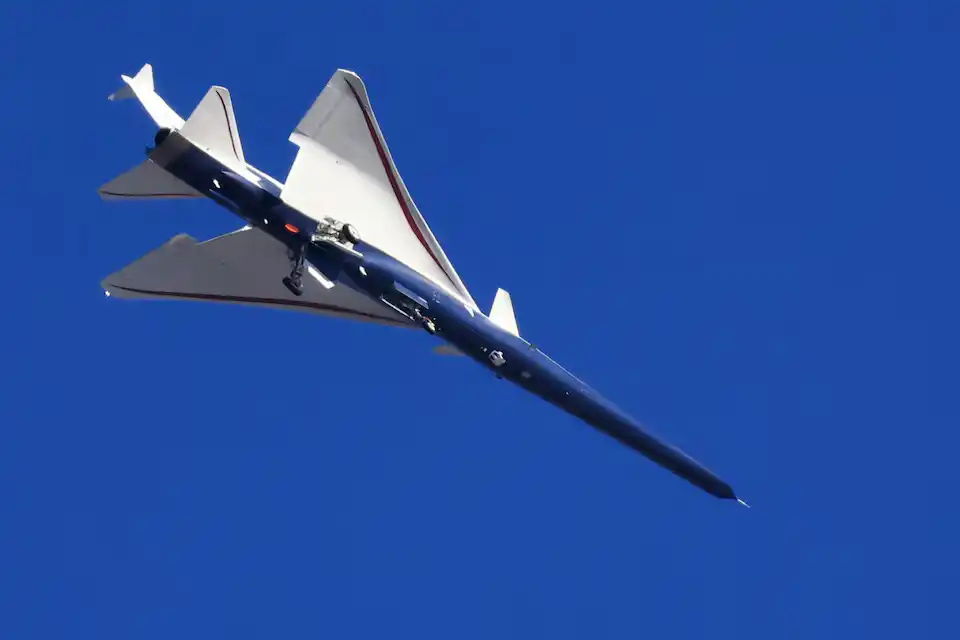
The X-59 Quesst is designed to cruise at Mach 1.4, equivalent to approximately 925 miles per hour (mph) at an operational altitude of 55,000 feet. This makes it significantly faster than commercial airliners, which typically cruise at Mach 0.85 (around 560 mph), and places it in a speed category closer to strategic bombers and modern fighter jets.
Though not intended to break speed records, the X-59 is no slouch. Its General Electric F414 engine, the same powerhouse that drives the F/A-18 Super Hornet, theoretically enables the aircraft to reach Mach 1.5—or 990 mph. This potential top speed situates it among elite aerial performers and underlines the aircraft’s capacity to bridge the gap between performance and purpose.
Importantly, the X-59 achieves this performance while prioritizing low acoustic impact, rather than raw speed. The ambition is clear: to create an aircraft capable of crossing land at supersonic speeds without disrupting the lives of those below.
Engineering a Sonic Whisper
The X-59’s most radical innovation lies in its aeroacoustic design. Traditional supersonic aircraft, including the Concorde, generated sonic booms exceeding 119 EPNdB (Effective Perceived Noise in Decibels)—loud enough to disturb communities, crack windows, and prompt strict regulations. The X-59 aims to reduce this auditory footprint to a mere 75 EPNdB, a sound comparable to a car door closing several houses away.
This feat is enabled by a meticulous approach to the aircraft’s shape and component integration:
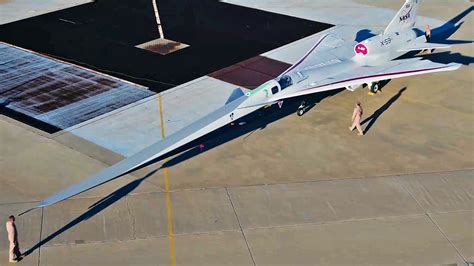
- The aircraft stretches nearly 100 feet in length, making it long and narrow.
- It has a compact wingspan under 30 feet, which assists in shaping shockwaves.
- An unusually elongated nosecone, accounting for nearly a third of the aircraft’s body, plays a pivotal role in controlling how sound propagates during supersonic flight.
- A canard-based configuration ensures air is funneled in specific ways to avoid coalescence of shock waves into a single boom.
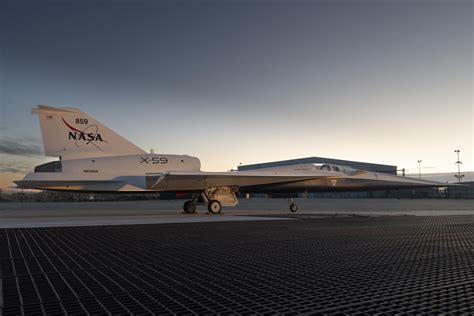
This nose, however, blocks the pilot’s view entirely. To counteract this, engineers have implemented an Enhanced Flight Vision System (EFVS)—a state-of-the-art 4K camera-based feed that transmits real-time forward visuals to the cockpit. This not only preserves pilot situational awareness but also showcases the aircraft’s marriage of physical and digital innovation.
Flight Testing and Data Gathering: The Quesst Mission
The name “Quesst”—short for Quiet Supersonic Technology—is more than branding. It defines the core mission: to test and validate a new generation of low-boom supersonic technologies. The data gathered from the X-59’s test flights will be shared with aviation authorities such as the FAA (Federal Aviation Administration) and ICAO (International Civil Aviation Organization). The aim is to help redefine supersonic flight regulations, particularly those that restrict it over land.
Should NASA prove that the X-59 can consistently fly at supersonic speeds with minimal ground-level noise impact, it could lead to the repeal or amendment of laws that have long prohibited such travel in many regions. In this scenario, future commercial airliners could operate transcontinental supersonic routes, cutting flight durations in half without disrupting populations.
Historical Context: Supersonic Travel’s Rise, Fall, and Revival
To fully appreciate the X-59’s significance, one must look back at its predecessor—the Concorde, the most iconic supersonic passenger jet in history. While it could fly at Mach 2.04 (1,354 mph), it was notoriously loud and expensive to operate. Moreover, it was barred from flying supersonically over land due to the deafening booms it produced. This limitation severely curtailed its commercial viability and ultimately contributed to its retirement in 2003.
The X-59 offers a vision of what the Concorde never achieved: quiet, sustainable, overland supersonic flight. While it doesn’t match the Concorde in top speed, its lower environmental and social footprint gives it the potential to accomplish something far more enduring—regulatory transformation and public acceptance.
Technical Specifications of the X-59 Quesst
To understand the aircraft’s promise, we must consider its full technical profile:
- Length: ~94 feet
- Wingspan: ~29.5 feet
- Engine: General Electric F414-GE-100
- Cruising Speed: Mach 1.4 (925 mph)
- Theoretical Top Speed: Mach 1.5 (990 mph)
- Operational Altitude: 55,000 feet
- Maximum Ground-Level Noise: Target 75 EPNdB
This combination of speed, precision design, and noise reduction makes the X-59 not just another testbed but a full-fledged prototype for the next era of supersonic transportation.
The Path Forward: From Experimental to Everyday
NASA and Lockheed Martin’s collaboration is not simply about building a high-tech aircraft; it is about creating an aviation ecosystem where quiet supersonic flight becomes commercially viable. The success of the X-59 could usher in a wave of next-generation aircraft built with civilian transportation in mind.
Several private aerospace companies are watching the Quesst project closely, with plans of their own for supersonic business jets and commercial airliners. However, they remain shackled by existing regulations. The X-59’s data could become the key that unlocks the next phase of global air mobility.
Moreover, the project illustrates how government and industry collaboration can produce meaningful innovation when focused on solving practical issues. Reducing a sonic boom to a mere thump—or even a whisper—could alter the global travel landscape, allowing supersonic jets to become as commonplace as today’s long-haul aircraft.
Why Speed Alone Isn’t the Goal
While it’s tempting to focus solely on the impressive top speed of the X-59, what truly matters is how that speed is delivered. Unlike its predecessors, which often prioritized breaking records or military utility, the X-59’s objective is social and environmental harmony.
To that end, the aircraft balances:
- Performance: Achieving high subsonic and low supersonic velocities efficiently.
- Noise Control: Ground-level impact is minimized to avoid community disruption.
- Sustainability: Future plans include considerations for sustainable aviation fuels (SAFs) and lower carbon footprints.
This trifecta of goals makes the X-59 a strategic pivot point in aerospace development. It’s not a fighter jet, nor a luxury transport—it is a policy-changer disguised as an aircraft.
Conclusion: A Quiet Revolution in the Sky
The NASA X-59 Quesst is more than a technological marvel—it’s a revolution in motion. With a theoretical top speed of Mach 1.5, a cruising performance of Mach 1.4, and an acoustic signature that could redefine public perceptions of supersonic flight, the X-59 stands at the edge of a new frontier.
Backed by the legacy of Skunk Works and the vision of NASA, this aircraft doesn’t just promise faster travel—it offers better travel. A future where crossing continents in hours doesn’t come at the cost of community peace is no longer science fiction. The sky, quite literally, is no longer the limit—it’s the beginning of something quieter, faster, and profoundly better.