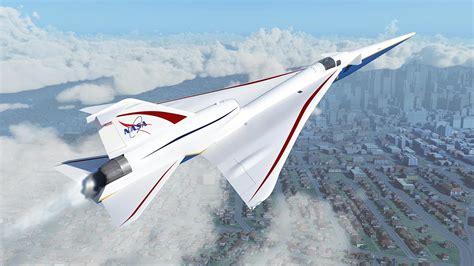
Supersonic flight has always carried a kind of mythic promise: cross oceans in hours, compress the world, arrive before jet lag knows what hit it. Yet for more than half a century, that promise has been shackled by a brutally simple problem—the sonic boom. Loud enough to rattle windows and nerves alike, it turned supersonic speed into a political and regulatory dead end. The NASA X-59 QueSST exists to snap that shackle, not by brute force, but by re-engineering how shockwaves behave in the air itself.
The X-59 is not a commercial airliner, not a prototype Concorde replacement, and not a luxury transport. It is something subtler and arguably more important: a flying physics experiment designed to prove that supersonic aircraft do not have to announce themselves with explosive noise. Instead of a boom, the X-59 aims to deliver something closer to a muted thump, quiet enough to be tolerated by people on the ground and, crucially, by regulators who write the rules of the sky.
This is why the aircraft matters. Not because it carries passengers, but because it carries evidence. Evidence that could finally separate supersonic speed from public outrage, and speed from prohibition. If that happens, aviation does not merely get faster—it gets permission.
The Sonic Boom Problem That Grounded an Entire Era
To understand why the X-59 is such a radical machine, it helps to understand why Concorde failed in regulatory terms even when it succeeded technologically. Concorde could cruise at Mach 2, cross the Atlantic in three hours, and do so with remarkable reliability. What it could not do was fly supersonic over land. The reason was the classic N-wave sonic boom, a pressure signature so sharp and abrupt that it arrived at the ground as two near-simultaneous explosions.
These booms were not a side effect. They were an unavoidable consequence of traditional supersonic aerodynamics. As an aircraft exceeds the speed of sound, it forces air molecules to move faster than they can naturally respond, piling pressure into shockwaves. Over distance, these shockwaves merge into a front and rear spike, forming the characteristic N-shaped pressure curve. Human ears interpret that curve as a violent double bang.
By the early 1970s, public tolerance for this phenomenon was exhausted. The United States banned civil supersonic flight over land in 1973, followed by similar restrictions in Europe and Asia. Overnight, roughly 90 percent of viable global routes vanished for supersonic aircraft. Concorde survived only by hopping oceans. The sonic boom did not merely annoy people; it erased markets.
The X-59 exists to attack this exact failure point—not with political arguments, but with acoustic data.
First Flight: A Quiet Aircraft Makes Noise in All the Right Ways
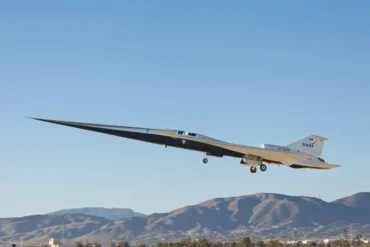
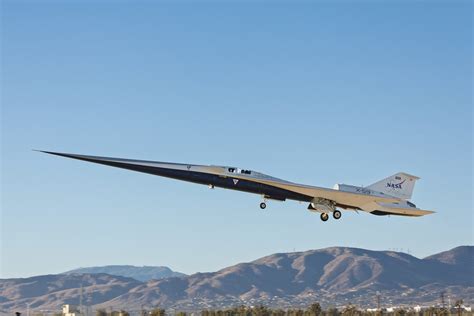
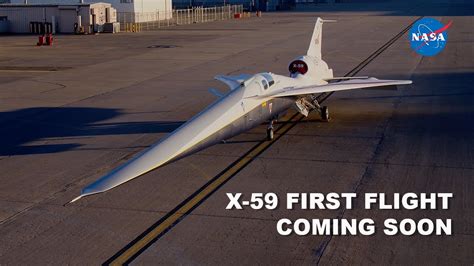
In October 2025, the X-59 completed its first flight from Lockheed Martin’s Skunk Works facility in Palmdale, California, landing at NASA’s Armstrong Flight Research Center. The flight was not supersonic, and it did not yet test the aircraft’s signature feature. What it did do was validate something more foundational: that this extremely unconventional airframe behaves exactly as predicted.
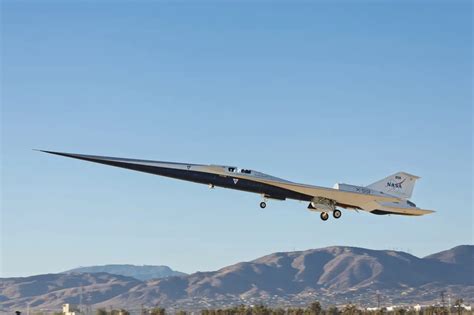
That matters because the X-59 is, aerodynamically, an oddity. Its proportions look almost exaggerated, as if drawn by an engineer determined to offend aesthetic sensibilities in the name of physics. Yet those proportions are not artistic. They are mathematical.
Skunk Works described the flight as proceeding “exactly as planned,” confirming basic handling qualities and air-data performance. In flight-test language, that is high praise. Predictability is everything when the next phase involves pushing the aircraft past Mach 1 in a very specific aerodynamic posture, at very specific altitudes, to sculpt sound itself.
Shock Shaping, Not Shock Elimination
The most important idea behind the X-59 is often misunderstood. The aircraft does not eliminate sonic booms. That would require violating the physics of supersonic flow. Instead, it practices shock shaping—the deliberate redistribution of pressure changes so they never pile up into a single explosive event.
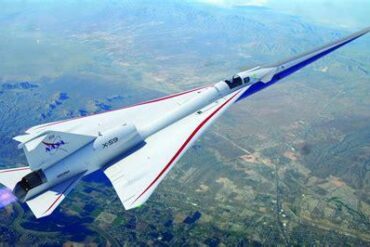
Traditional supersonic aircraft generate multiple strong shockwaves at the nose, canopy, inlets, wings, and tail. Over distance, these coalesce into the dreaded N-wave. The X-59 attacks that coalescence. Its extraordinarily long nose creates a gentle, gradual compression of air rather than an abrupt one. Each pressure rise is weaker, stretched out in time and space.
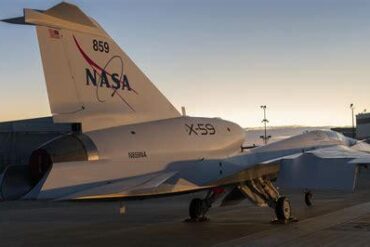
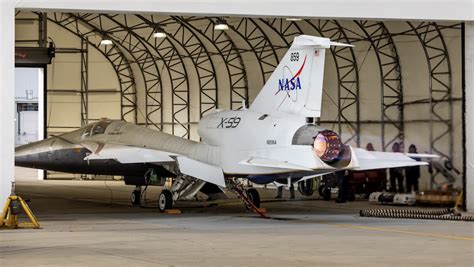
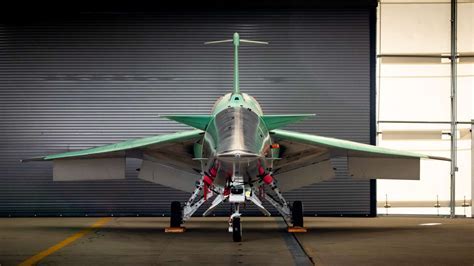
The engines, another critical noise source, are mounted on top of the fuselage rather than beneath it. This placement allows the aircraft’s own structure to shield the ground from intake and exhaust shockwaves, deflecting much of that acoustic energy upward. Additional shaping comes from carefully placed canards and a distinctive T-tail, which generate interference shocks that smooth the overall pressure signature even further.
The result is not an N-wave but an S-shaped pressure curve. To a person on the ground, this arrives not as “boom-boom” but as a single, subdued thump. NASA targets a loudness of roughly 75 to 85 PLdB, compared to Concorde’s 105 to 110 PLdB. That difference is not subtle. It is the difference between startling and ignorable.
Why the X-59 Will Be the First to Do This Successfully
Low-boom research is not new. NASA and others have studied it for decades using wind tunnels, computational fluid dynamics, and modified aircraft. What makes the X-59 different is that it is the first aircraft designed entirely around low-boom principles from day one, rather than adapted after the fact.
Every line of the airframe exists to serve the pressure signature. There is no passenger cabin to accommodate, no cargo volume to protect, no commercial compromise baked into the geometry. The cockpit is placed far back, so far that the pilot cannot see forward through a traditional windshield. Instead, the X-59 uses an external vision system, combining cameras and displays to provide situational awareness without ruining the nose’s acoustic function.
This level of design purity is why the aircraft can do something no previous supersonic jet has done: fly at supersonic speed while being deliberately quiet on the ground. It is also why the X-59 will almost certainly remain unique. It is a proof, not a product.
Turning Community Reaction Into Regulatory Ammunition
NASA’s mission does not end with flying quietly. The more important phase begins afterward. Once the X-59 performs sustained supersonic flights at its target altitude and speed, NASA plans to fly it over select U.S. communities, carefully measuring not just sound levels but human reactions.
Residents will be surveyed. Their responses—annoyance, indifference, surprise, or acceptance—will be cataloged alongside precise acoustic data. This pairing is crucial. Regulators do not write rules based on decibels alone; they write them based on perceived impact. A sound that measures loud but feels tolerable is politically survivable. A sound that measures moderate but feels violent is not.
The resulting dataset will be shared with the FAA and international bodies, providing something aviation has never had before: empirical, community-level evidence that supersonic flight over land can be acceptable. If new standards emerge from this, they will not be guesses. They will be defensible numbers, backed by real people hearing real aircraft.
The Executive Order and the Long Road to Rulemaking
In June 2025, a U.S. presidential executive order directed the FAA to repeal the blanket ban on civil supersonic flight over land and to begin crafting an interim, noise-based certification standard. Symbolically, this was enormous. Practically, it was the starting gun, not the finish line.
Regulatory change in aviation moves slowly by design. Safety, environmental impact, and international harmonization all take time. Even with political pressure, the FAA could take years to finalize new rules, and those rules would still need alignment—or at least acceptance—from European and Asian regulators.
This is where the X-59’s data becomes invaluable. Without it, regulators are arguing hypotheticals. With it, they are arguing from measurements, surveys, and repeatable results. The aircraft does not lobby. It testifies.
Why Scaling the X-59 Is So Hard
It is tempting to see the X-59 as a prototype airliner in disguise. That temptation should be resisted. Scaling this technology to a 50- to 100-seat commercial aircraft introduces conflicts that the demonstrator never has to face.
Passenger cabins demand volume, not slenderness. A needle-like nose works beautifully for shock shaping and terribly for seating, avionics, radar, and bird-strike protection. Larger wings generate more lift, but also stronger shockwaves if not managed with extreme precision. Engines powerful enough to carry dozens of passengers complicate top-mounted configurations and thermal management.
In short, low-boom shaping does not scale linearly. Every increase in size multiplies the complexity. Solving these problems is possible, but it requires advances in materials, modeling, and propulsion that go well beyond what the X-59 itself demonstrates. The aircraft proves feasibility, not convenience.
Why Sonic Booms Were Never the Only Problem
Even if the X-59 succeeds perfectly, it does not magically resurrect Concorde’s business case. Sonic booms were a major barrier, but they were not the only one. Concorde burned extraordinary amounts of fuel, especially painful during the 1970s oil crisis. It required intense maintenance due to thermal and structural fatigue. Its cabin was cramped, noisy, and offered little luxury beyond speed.
Modern supersonic developers claim advantages here: sustainable aviation fuel, advanced composites, digital design tools, and more efficient engines. These help, but they do not erase physics. Supersonic flight will always be less efficient than subsonic flight per passenger. The market must value time enough to pay for that inefficiency.
The X-59 does not solve economics. It solves permission.
The Quiet Thump as a Turning Point
If history is kind, the X-59 will be remembered not as an aircraft, but as a hinge. Before it, supersonic flight over land was politically impossible. After it, the debate shifts from “never” to “under what conditions.”
That shift matters. Aviation advances when technology gives regulators a reason to say yes. The X-59’s quiet sonic signature is not about nostalgia for Concorde or fantasies of Mach-speed commutes. It is about rewriting the acoustic contract between aircraft and the people beneath them.
Supersonic flight does not need to be silent. It just needs to be civil.