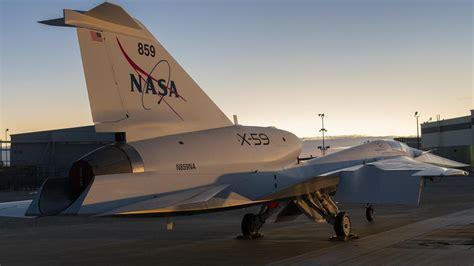
The Lockheed Martin X-59 Quesst represents a groundbreaking advancement in aerospace engineering, charting a path toward the return of supersonic commercial flight over land—this time without the deafening sonic booms that once made such ambitions untenable. Developed under NASA’s Low-Boom Flight Demonstrator (LBFD) program, the X-59 was conceived to test and validate technologies capable of suppressing the disruptive shockwave signature that typically accompanies aircraft traveling faster than sound.
The aircraft, formally named Quiet SuperSonic Technology (QueSST), is the result of an intricate collaboration between NASA and Lockheed Martin’s Skunk Works division. While it is purely experimental, the X-59 serves a purpose far greater than mere technical demonstration: it could provide the regulatory catalyst for a new era in high-speed air travel.
Origins and Strategic Mission
The genesis of the X-59 began in February 2016, when Lockheed Martin received a preliminary design contract. From the start, NASA’s aim was not merely to build a supersonic aircraft, but to develop one that could fly fast without creating disruptive noise. With this objective, the design process centered on creating an airframe capable of diffusing shockwaves before they merged into a sonic boom.
Initial wind tunnel testing of a 9% scale model occurred between February and April 2017, examining aerodynamics from Mach 0.3 to Mach 1.6. These trials were essential to determine the aircraft’s control stability and low-boom performance. The results fed into the Preliminary Design Review (PDR) conducted later that year.
By April 2018, NASA officially awarded Lockheed Martin a $247.5 million contract to fully design and construct the demonstrator, with original delivery planned for late 2021. The U.S. Air Force designated the aircraft X-59 QueSST in June 2018, affirming its place in the lineage of X-planes dedicated to pushing aviation boundaries.
Progress Through Rigorous Testing and Simulation
Wind tunnel evaluations continued in October 2018 using an 8%-scale model, testing static and dynamic conditions at extreme angles of attack—up to 88 degrees. These tests provided data on flight control, dynamic oscillations, and airflow visualization using laser-based techniques.
To simulate real-world noise effects, NASA turned to the F/A-18 Hornet, performing high-altitude dives from 50,000 feet over Galveston, Texas, producing low-boom effects. Simultaneously, community response surveys with acoustic sensors and public feedback were initiated to gauge the perception of sonic events, compensating residents who participated.
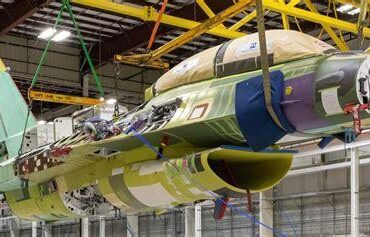
Lockheed Martin began machining parts in Palmdale, California by late 2018. Structural assembly gained momentum in May 2019, including validation of the External Vision System (XVS) on a King Air platform and inlet performance testing with a 9.5% model at NASA Glenn Research Center.
A critical design review in September 2019 led to the release of 80–90% of production drawings and authorized wing assembly for 2020. By December 2020, the aircraft was halfway through construction, with its first flight targeted for 2022—a milestone that later shifted to 2025 due to development delays and COVID-era disruptions.
Community Engagement and Global Standards
The X-59’s mission extends beyond engineering. Its data will shape international regulatory frameworks. Beginning between 2023 and 2025, the aircraft will perform community overflights across select U.S. regions to evaluate public response to its low-boom acoustic profile. Results from these studies will be submitted to ICAO’s Committee on Aviation Environmental Protection (CAEP13) and the FAA by 2027.
The eventual goal is to update existing regulations prohibiting commercial supersonic flight over land, potentially opening the door for next-generation supersonic airliners. If the X-59 proves its case, we may witness the first regulatory approval for quiet supersonic travel over populated areas as early as 2028.
Powerplant and Major Systems Integration
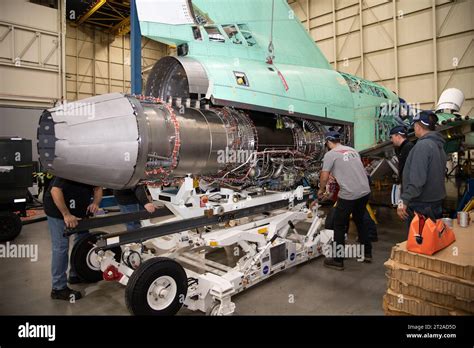
The General Electric F414-GE-100 engine, installed in November 2022, powers the X-59 with 22,000 pounds-force (lbf) of thrust, equipped with an afterburner. At 13 feet in length, this engine was originally developed for the F/A-18 Super Hornet and delivers both reliability and power in a relatively compact form.
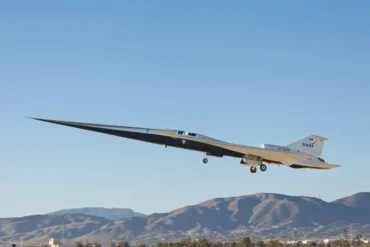
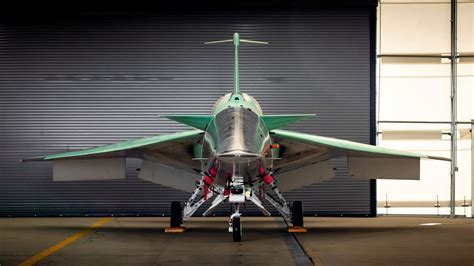
In August 2023, Lockheed Martin showcased the fully assembled X-59 in a rollout video, followed by a public unveiling in January 2024. Engine tests commenced in November 2024, with the highly anticipated first flight now slated for sometime in 2025.
Revolutionary Airframe and Quiet Supersonic Design
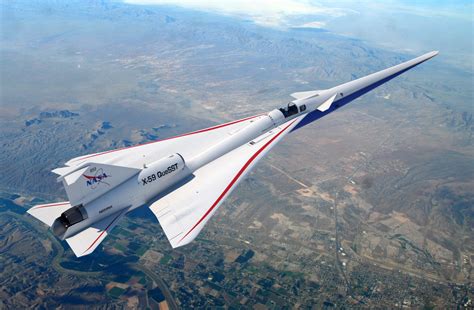
Measuring 99.7 feet in length with a 29.5-foot wingspan, the X-59 has a maximum takeoff weight of 32,300 pounds. Its sleek fuselage is built for Mach 1.5 top speed (990 mph) and a cruising speed of Mach 1.42 (940 mph), all at a cruising altitude of 55,000 feet.
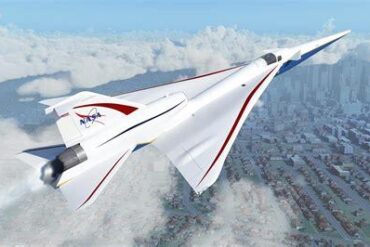
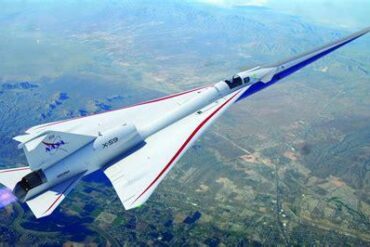
Key to its low-boom signature is the long, pointed nose and narrow airframe, which carefully manage the aircraft’s shockwave propagation. By preventing wave coalescence, the design reduces ground-level noise to 75 EPNdB, akin to the sound of a car door closing. This is a dramatic improvement over the 105–110 EPNdB booms produced by the Concorde.
Components like the cockpit canopy, ejection seat, and landing gear are sourced from existing aircraft—the Northrop T-38 Talon and the F-16 Fighting Falcon, respectively—maximizing efficiency and reliability.
Advanced Vision and Avionics Systems
Because of the flush cockpit design and extended nose, the X-59 offers no direct forward visibility. To compensate, it incorporates an Enhanced Flight Vision System (EFVS) built around a 4K forward-facing camera with a 33° by 19° field of view. This system feeds data into Collins Aerospace’s Pro Line Fusion avionics, a multi-display system that integrates navigation, terrain awareness, and supersonic boom projection.
Complementing the XVS, the Collins EVS-3600 provides long-wave infrared multispectral imaging, critical for safe takeoff, landing, and low-visibility operations. The entire sensor suite ensures that pilots retain full situational awareness despite the aircraft’s unconventional layout.

Outlook and Industry Impact
The X-59 QueSST is not simply a technological showpiece; it is a policy-altering, regulation-enabling tool. NASA’s strategic foresight in developing a quiet supersonic demonstrator reflects its commitment to ushering in a new era of faster-than-sound travel—one aligned with both public acceptance and environmental sensibility.
If successful, the X-59’s trials could pave the way for future aircraft that will reduce intercontinental flight times by half, offering travelers faster options without sacrificing comfort or environmental consciousness. Moreover, its advancements in shockwave management, aerodynamics, and digital flight systems may inform not just supersonic commercial aviation, but military and exploratory aircraft designs for decades to come.
As the X-59 prepares for its first real-world flights in 2025, the aerospace world watches with anticipation. The potential to rewrite the rules of atmospheric flight has never been closer to becoming a reality.