Venus Exploration Enters a New Era
While recent attention has focused heavily on the Moon through NASA’s Artemis program and the long-term goal of sending humans to Mars, another world is quietly becoming one of the most intriguing destinations in planetary science. That world is Venus, Earth’s closest planetary neighbor and arguably the most mysterious rocky planet in the solar system.
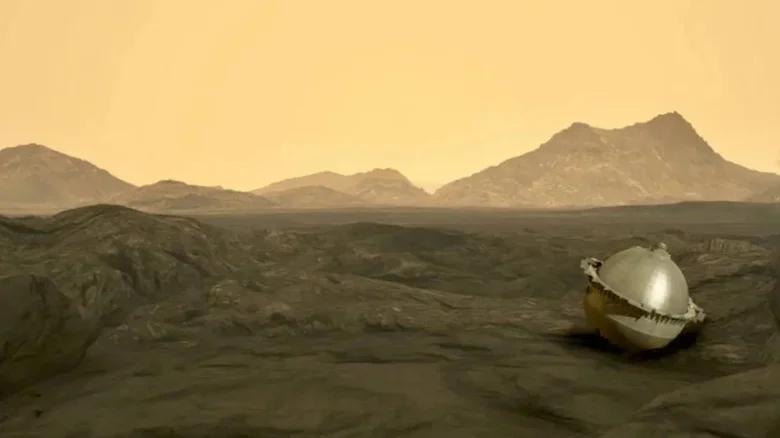
NASA is preparing to send its groundbreaking DAVINCI mission to Venus, with a targeted launch in the early 2030s. The mission represents humanity’s first attempt in decades to directly investigate Venus’ atmosphere and surface using modern technology. Most significantly, DAVINCI will deploy a descent probe into the planet’s hostile atmosphere, marking the first dedicated mission of its kind since the Soviet Venus landers of the 1980s.
The mission is not merely another planetary flyby. It is an effort to answer some of the biggest questions in planetary science: Did Venus once possess oceans? Could it have supported life? And how did a planet so similar to Earth become one of the most extreme environments in the solar system?
For scientists, DAVINCI is an opportunity to revisit a world that has remained largely unexplored for more than four decades.
Why Venus Remains One of the Solar System’s Greatest Mysteries
Venus is often referred to as Earth’s twin because the two planets are remarkably similar in size, mass, and overall composition. Yet the similarities largely end there.
Today, Venus is a hellish environment. Surface temperatures average around 872 degrees Fahrenheit (467 degrees Celsius), making the planet hotter than Mercury despite being farther from the Sun. Its atmosphere is composed primarily of carbon dioxide, creating a runaway greenhouse effect that traps enormous amounts of heat.
The pressure at the surface is equally extreme. Standing on Venus would expose an object to pressures approximately 93 times greater than those experienced at sea level on Earth. Combined with clouds containing sulfuric acid, these conditions create one of the most hostile environments known in the solar system.
Such extremes have made Venus extraordinarily difficult to explore. Unlike Mars, where robotic rovers can operate for years, Venus destroys spacecraft within hours or even minutes after landing. Every second of data collected on the planet is therefore incredibly valuable.
After decades of limited exploration, DAVINCI is poised to change that.
What Earlier Missions Revealed About Venus
Humanity’s first close-up look at Venus came in 1962 when Mariner 2 successfully flew past the planet. The mission shattered long-standing assumptions that Venus might resemble a tropical or ocean-covered version of Earth.
Instead, observations revealed a world hidden beneath dense clouds and subjected to extreme temperatures. The discovery fundamentally altered scientific understanding of planetary evolution.
Over the following decades, both American and Soviet missions dramatically expanded knowledge of Venus. NASA’s Pioneer Venus mission uncovered evidence suggesting that the planet may once have possessed significant quantities of water. These findings led researchers to propose that Venus might have enjoyed habitable conditions hundreds of millions—or even billions—of years ago.
Perhaps the most remarkable achievements came from the Soviet Venera program. Multiple Venera landers successfully descended through Venus’ atmosphere and transmitted data directly from the surface. Among them, Venera 13 became legendary after surviving for 127 minutes following its landing on March 1, 1982.
That survival time remains one of the greatest engineering accomplishments in planetary exploration. The spacecraft was originally expected to function for only about thirty minutes before Venus’ crushing heat and pressure overwhelmed its systems.
Even today, Venera 13 holds the record for the longest operational lifetime on the surface of Venus.
The Technology Behind NASA’s DAVINCI Mission
DAVINCI, short for Deep Atmosphere Venus Investigation of Noble Gases, Chemistry, and Imaging, represents a technological leap forward compared with every previous Venus mission.
Unlike spacecraft designed during the Cold War era, DAVINCI will carry advanced sensors, sophisticated imaging systems, and modern computing capabilities capable of processing vast amounts of information during descent.
One of the mission’s most exciting features is its ability to capture dramatically improved imagery of Venus. Modern cameras combined with advanced image-processing techniques and artificial intelligence will allow scientists to generate highly detailed three-dimensional topographic maps of the terrain below.
The result will be the most comprehensive visual survey of key regions ever obtained during an atmospheric descent through Venus.

Exploring Alpha Regio and Venus’ Ancient Past
A central objective of the mission is the investigation of Alpha Regio, one of the most intriguing geological regions on Venus.
Alpha Regio is a vast elevated area that some scientists believe may contain rocks formed through processes involving ancient water. If confirmed, such discoveries would strengthen the theory that Venus once possessed oceans, weather systems, and potentially even continental structures resembling those found on Earth.
High-resolution observations from DAVINCI could reveal whether the region contains geological signatures associated with long-term water interaction. Such evidence would help reconstruct Venus’ climatic history and explain how a potentially habitable world transformed into the furnace-like planet observed today.
Understanding this transformation extends far beyond our solar system. Thousands of exoplanets discovered around distant stars appear similar in size and composition to Venus. Learning why Venus evolved differently from Earth may help scientists determine whether those distant worlds could support life.
Could DAVINCI Break a 44-Year Survival Record?
Although the mission’s primary goal is scientific discovery rather than endurance, many researchers are eager to see how long DAVINCI’s descent probe can survive after reaching the surface.
Engineers have equipped the spacecraft with improved thermal protection systems, stronger insulation, and a more durable acid-resistant parachute designed to withstand Venus’ corrosive atmosphere. These upgrades are intended to maximize scientific return during descent and shortly after landing.
Officially, the probe is not expected to remain operational on the surface for extended periods. Yet history provides reason for optimism. Venera 13 exceeded its design expectations by nearly four times, surviving far longer than engineers initially predicted.
If DAVINCI demonstrates similar resilience, it could potentially surpass the famous 127-minute record established in 1982. Even a modest extension would provide scientists with additional precious minutes of data from one of the most challenging environments ever explored.
Why DAVINCI Could Transform Planetary Science
The importance of DAVINCI extends well beyond Venus itself. The mission has the potential to answer fundamental questions about planetary habitability, climate evolution, and the factors that determine whether a rocky world becomes life-friendly or life-hostile.
For decades, Venus has remained a largely forgotten frontier, overshadowed by Mars and the Moon. Yet its history may contain critical clues about Earth’s future and the nature of countless Earth-sized planets throughout the galaxy.
As NASA prepares to send its newest probe into territory not directly explored since the 1980s, scientists are anticipating discoveries that could reshape our understanding of planetary evolution. DAVINCI is not simply returning to Venus—it is reopening one of the most important investigations in modern space science.