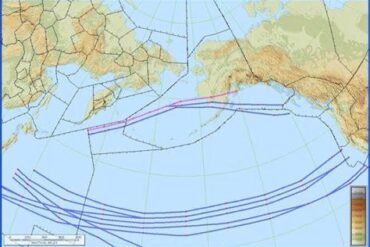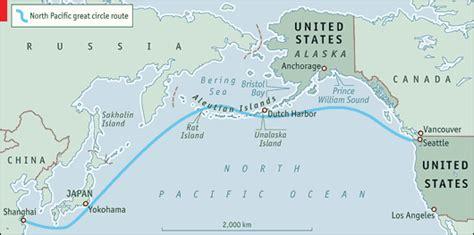
The North Pacific (NOPAC) Route System is a set of Air Traffic Service (ATS) routes that connect Alaska and Japan over the North Pacific. This system is designed to manage air traffic efficiently.
Traffic flow in the North Pacific is fairly predictable. Factors like consumer demand, time zones, winds aloft, and airport noise restrictions play key roles. Generally, eastbound flights are busiest from 0700Z to 2100Z, while westbound flights peak between 1200Z and 1900Z, and again from 2200Z to 0700Z.
The NOPAC Route System consists of five main ATS routes: R220, R580, A590, R591, and G344. These routes operate within an altitude range from FL180 to FL410. On days when airline dispatchers prefer the NOPAC routes due to favorable winds, route saturation may occur.
The two northernmost routes, R220 and R580, primarily serve westbound traffic. In contrast, the three southern routes mainly accommodate eastbound flights. However, R591 and G344 can also be used for westbound traffic crossing the Fukuoka/Anchorage FIR boundary during the early morning hours, specifically between 0000Z and 0600Z. For detailed altitude information by route and direction, it’s best to refer to the appropriate Jeppesen or alternative enroute manuals.
In the Fukuoka FIR, there are specific Oceanic Transition Routes (OTRs) for aircraft moving to or from the NOPAC Route System. While not as formalized, certain routes in the Anchorage FIR serve similar purposes. Operators should file their routes accordingly, both on and off the NOPAC routes. All flights within the FL180 to FL410 altitude band must be established on a NOPAC route before crossing the Fukuoka/Anchorage FIR boundary.