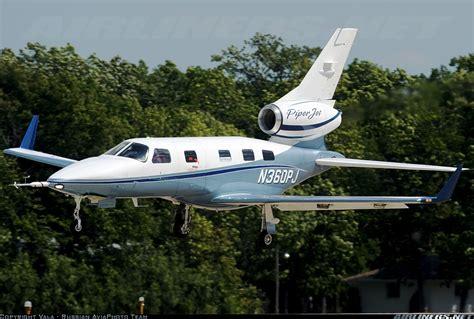
The story of the Piper PA-47 PiperJet is one of ambition, engineering creativity, and unfortunate timing. In an era when manufacturers were racing to dominate the emerging Very Light Jet (VLJ) market, Piper Aircraft attempted something radically different. Instead of following the conventional twin-engine layout used by competitors, Piper introduced a sleek business jet powered by a single turbofan mounted high inside the vertical stabilizer. It looked futuristic, promised lower operating costs, and carried the weight of one of general aviation’s most respected names.
Yet despite early excitement, hundreds of interested buyers, and a genuinely innovative engineering approach, the PiperJet never entered production. What remains today is one of the aviation industry’s most fascinating “what-if” projects — a jet that tried to reshape personal aviation before market realities and engineering complications brought the program to an end.
The aircraft may have disappeared from Piper’s future product lineup, but the legacy of the PA-47 continues to intrigue pilots, aviation historians, and business jet enthusiasts who still wonder whether Piper was simply ahead of its time.
Piper Aircraft’s Leap Into The Very Light Jet Market
For decades, Piper Aircraft built its reputation around practical and dependable piston-engine aircraft. Models such as the Piper Cub, Cherokee, and Seminole became staples of flight schools, private ownership, and general aviation fleets worldwide. By the early 2000s, however, the aviation market was changing rapidly.
Demand for personal business travel was surging. Entrepreneurs, corporate executives, and wealthy private owners wanted aircraft capable of delivering jet performance without the enormous operating expenses associated with traditional business jets. This demand gave birth to the VLJ category, a segment focused on compact jets that could operate efficiently with lower ownership costs.
Manufacturers rushed into the market. Eclipse Aviation introduced the Eclipse 500. Cessna launched the Citation Mustang. Embraer entered with the Phenom 100. Piper Aircraft could not afford to remain on the sidelines.
Instead of copying existing designs, Piper attempted to create a jet that would immediately stand apart from the competition.
The result was the Piper PA-47 PiperJet.
The aircraft was officially announced during the mid-2000s and immediately attracted attention throughout the aviation community. Its proposed price point of roughly $2.2 million positioned it aggressively within the VLJ segment, while the promise of dramatically lower fuel and maintenance costs generated serious interest from owner-pilots.
Piper reportedly secured around 180 pre-orders, an impressive achievement for a completely new aircraft platform.
But it was the aircraft’s configuration that truly captured headlines.
The Unusual Single-Engine Design That Defined The PiperJet
Unlike nearly every competing VLJ, the PiperJet used only one engine.
That alone was unconventional enough in the business jet market, where twin-engine redundancy had long been considered standard. Yet Piper pushed the concept even further by mounting the engine high within the aircraft’s tail structure.
From certain angles, the aircraft resembled a miniature version of the famous McDonnell Douglas DC-10, minus its wing-mounted engines. The single turbofan sat inside the vertical stabilizer, with the majority of the tail extending above it.
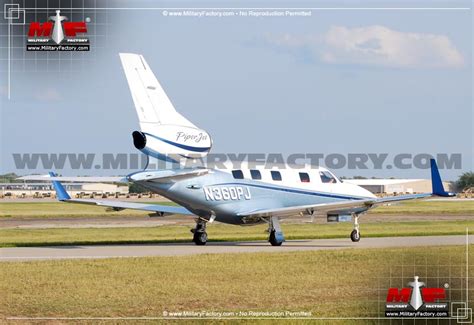
The decision was not merely stylistic. Piper’s engineers believed the configuration offered several major advantages.
First, a single engine would theoretically cut maintenance expenses dramatically. Turbofan engines are among the most expensive systems to operate and maintain on any aircraft. Reducing the engine count from two to one could significantly lower operating costs for private owners.
Second, fuel burn would also decrease. For buyers transitioning from turboprops or piston aircraft into the jet market, operational efficiency mattered almost as much as speed.
Third, the clean wing design improved aerodynamic efficiency and simplified structural engineering beneath the wings.
On paper, the concept appeared remarkably attractive.
However, placing the engine so high above the aircraft’s centerline introduced a series of aerodynamic complications that became increasingly difficult to solve.
Inside The Aerodynamic Challenges Of The PA-47
Aircraft stability depends heavily on balancing thrust, lift, and pitch moments around the fuselage. In most business jets, engines are positioned relatively close to the aircraft’s center of gravity. Piper’s design disrupted that balance.
Because the engine sat high inside the tail, thrust forces acted above the aircraft’s center of lift. This created an unusual behavior during power changes.
When pilots increased thrust, the aircraft tended to pitch downward. Reducing thrust produced the opposite effect, causing the nose to rise unexpectedly. These pitch changes could become uncomfortable, inefficient, and potentially hazardous if not carefully managed.
Piper initially attempted to solve the issue through automatic stabilizer adjustments tied directly to throttle movements. Whenever pilots changed engine power, the horizontal stabilizer would compensate by trimming in the opposite direction.
Although functional, the solution added complexity to the aircraft’s flight control logic.
Eventually, engine manufacturer Williams International became heavily involved in refining the concept.
The Williams FJ44 Engine And The Coandă Effect Solution
Powering the PiperJet was the Williams International FJ44-3AP turbofan, an engine capable of producing approximately 2,820 pounds of thrust. The FJ44 family already had a strong reputation within the light jet sector for reliability and efficiency.
Still, the engine itself was not the primary challenge.
The real problem was how its thrust interacted with the airframe.
Most aircraft using tail-mounted engines rely on carefully shaped S-ducts to align thrust more closely with the aircraft’s centerline. Piper’s compact fuselage dimensions made such a solution difficult.
Williams International instead developed a fascinating alternative based on the Coandă effect, a principle describing how airflow tends to follow curved surfaces.
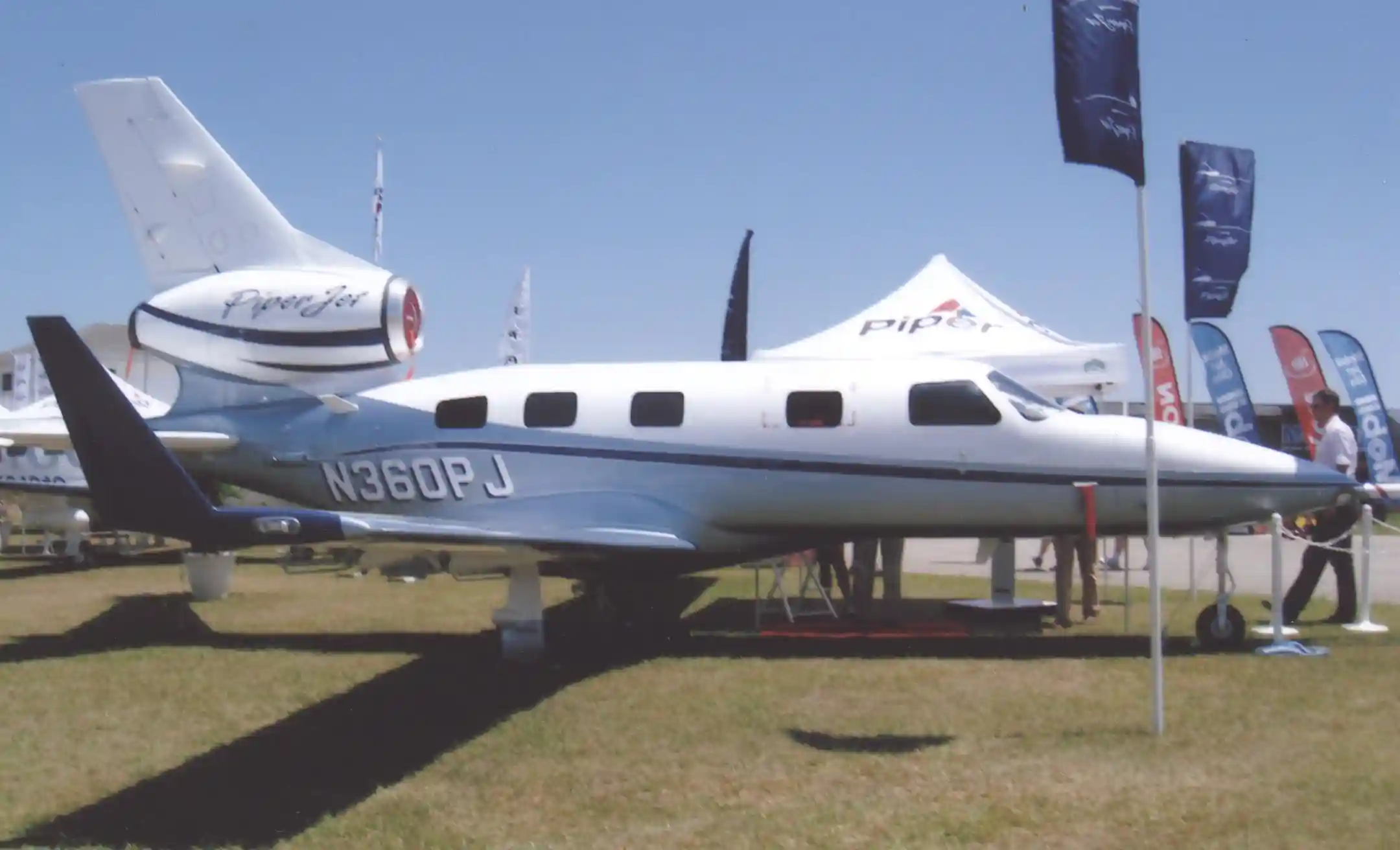
Engineers designed a passive thrust-vectoring nozzle with no moving parts. At lower speeds, where pitch instability became more pronounced, the nozzle naturally redirected airflow to counteract unwanted pitching tendencies. At higher cruise speeds, the system imposed only a minor thrust penalty estimated at roughly 2.2 percent.
The solution demonstrated genuine engineering ingenuity. It also highlighted how far Piper and Williams were willing to go to preserve the aircraft’s unique architecture.
Even today, aviation engineers frequently reference the PiperJet as an example of unconventional aerodynamic problem-solving within the VLJ category.
Cabin Design And Passenger Experience
Despite the radical engine placement, the PiperJet’s fuselage followed a relatively traditional business jet layout.
The aircraft featured a low-wing configuration with blended winglets designed to improve fuel efficiency and reduce drag. Its proportions placed it firmly within the VLJ segment while still offering enough interior room for practical executive travel.
The original PiperJet cabin was designed to accommodate approximately six occupants, including the pilot. Piper later revised the aircraft into an updated version known as the Piper Altaire, which featured a stretched fuselage and additional seating capacity.
The Altaire represented Piper’s attempt to reposition the aircraft slightly higher within the market by improving cabin comfort and expanding interior space.
Passengers would have benefited from several advantages associated with the single-engine configuration. With no wing-mounted engines, cabin noise levels were expected to remain relatively low, particularly near the forward seating area. The unobstructed wing design also improved external visibility while simplifying access around the aircraft during ground operations.
Dimensionally, the aircraft remained compact enough for operation at smaller regional airports:
- Length: 35 feet 8 inches
- Wingspan: 44 feet 3 inches
- Height: 15 feet 8 inches
These proportions made the aircraft suitable for owner-pilots seeking business jet capability without requiring large-airport infrastructure.
Performance Targets That Challenged Established Rivals
Piper understood that innovation alone would not guarantee success. The aircraft also needed competitive performance figures capable of matching established VLJ competitors.
The PiperJet’s projected specifications were respectable for its class.
The aircraft targeted a maximum cruise speed of approximately 360 knots, or about 410 miles per hour. While slightly slower than aircraft such as the Eclipse 500, which could reach roughly 370 knots, the difference was relatively minor for most business missions.
Range projections were even more impressive.
Piper aimed for a maximum range of approximately 1,300 nautical miles, enabling nonstop travel between many major business destinations across North America and Europe.
The aircraft also targeted a cruising altitude of 35,000 feet, placing it comfortably above commercial traffic congestion and adverse weather systems.
For prospective buyers, the combination of speed, range, and reduced operating costs created a compelling argument. Piper positioned the aircraft as a practical step up from high-performance turboprops while remaining substantially cheaper to operate than larger corporate jets.
Unfortunately, market conditions would soon shift dramatically.
From PiperJet To Piper Altaire
As development progressed, Piper rebranded the aircraft as the Piper Altaire following changes in company ownership. The manufacturer came under the control of the government-backed investment interests of the Sultan of Brunei, a transition that altered the company’s strategic direction.
The Altaire retained the defining single-engine tail-mounted layout but incorporated several refinements.
The cabin was enlarged. Cockpit systems were updated. Interior comfort became a greater focus. Piper attempted to move the aircraft slightly upscale while preserving the operational efficiency that originally defined the PiperJet concept.
Importantly, Piper reportedly allowed its earliest preorder customers to retain the original $2.2 million purchase price, even as development costs increased.
That decision reflected the company’s confidence in the program, but it also demonstrated the financial pressure mounting behind the scenes.
Developing a clean-sheet business jet is extraordinarily expensive. Certification requirements, aerodynamic testing, avionics integration, and production tooling can overwhelm even experienced aerospace manufacturers.
Then came the global financial crisis.
Why The Piper PA-47 Program Failed
The late-2000s economic downturn devastated the business aviation sector.
Corporate travel budgets collapsed. Private aircraft sales slowed dramatically. Financing became difficult to secure. Several ambitious VLJ manufacturers struggled to survive as investor confidence disappeared almost overnight.
The PiperJet entered the worst possible market environment.
At the same time, competing aircraft manufacturers already possessed stronger market positions and broader support networks. Piper faced increasing pressure to justify the PiperJet’s development costs while proving the aircraft could achieve sufficient sales volume.
The problem was not that the PiperJet lacked innovation.
The problem was that innovation alone could not overcome economic reality.
Although the single-engine design promised lower operating costs, buyers still questioned whether the aircraft delivered enough savings compared to more conventional twin-engine rivals. Safety perceptions also played a role. Many business jet customers remained hesitant about purchasing a single-engine jet, regardless of engineering assurances.
Ultimately, Piper canceled the program during the early 2010s before the aircraft could enter full production.
The decision ended one of the boldest projects in the company’s modern history.
The Lasting Legacy Of The PiperJet
Even though the Piper PA-47 never reached airline ramps or corporate hangars, its influence remains surprisingly relevant.
The aircraft demonstrated that established manufacturers were willing to challenge long-standing conventions within business aviation. It also highlighted the growing demand for efficient personal jets designed specifically for owner-operators.
Many ideas behind the PiperJet eventually resurfaced in later aircraft concepts emphasizing lower operating costs and simplified ownership experiences.
Perhaps the closest spiritual successor is the Cirrus Vision Jet, another single-engine personal jet that ultimately succeeded where Piper could not. The Vision Jet proved that there was indeed a viable market for simplified private jet ownership — but timing, certification strategy, and market positioning needed to align perfectly.
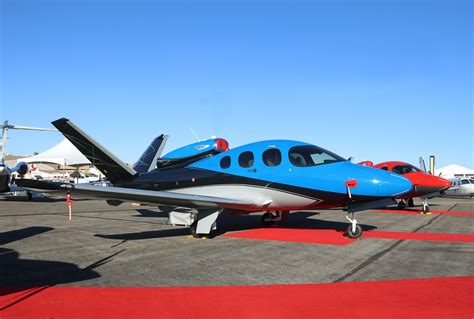
Today, the PiperJet survives primarily through prototype photographs, aviation archives, and lingering fascination among enthusiasts who admire ambitious aircraft that dared to be different.
It remains a striking reminder that aerospace innovation often walks a thin line between revolutionary success and commercial failure. Had economic conditions been more favorable, or had Piper solved its aerodynamic and certification hurdles earlier, the skies might look very different today.
Instead, the PA-47 became one of aviation history’s great unfinished stories — a sleek, futuristic business jet that came remarkably close to redefining private air travel before vanishing into the archives of experimental aviation history.