Aviation history is filled with machines that didn’t just push boundaries—they obliterated them. Yet, some of the most advanced aircraft ever conceived never transitioned beyond prototypes. These weren’t failures in the conventional sense. They were visionary platforms, often too far ahead of their time, overtaken by shifting geopolitics, emerging technologies, or economic realities that rendered them impractical before they could scale.
From Cold War nuclear strategies to the dream of commercial supersonic dominance, these aircraft represent billions in investment, decades of research, and breakthrough innovations that still shape modern aviation today. Each tells a story not just of engineering brilliance—but of timing, politics, and the brutal realities of technological evolution.
Northrop YB-49 Flying Wing: The Vision That Predicted Stealth Aviation
The Northrop YB-49 remains one of the most radical aircraft ever to leave the runway. Developed by Northrop Corporation in the late 1940s, it abandoned traditional aircraft architecture entirely. No fuselage. No tail. Just a massive, seamless wing integrating crew, payload, and engines.
This “flying wing” design offered unmatched aerodynamic efficiency. By eliminating unnecessary structures, it dramatically reduced drag and weight, enabling longer range and improved fuel efficiency—critical for early Cold War strategic bombers.
But what makes the YB-49 truly remarkable is what engineers didn’t fully understand at the time: it was inherently stealthy. Its smooth, blended shape minimized radar reflections decades before stealth technology became a formal military requirement.
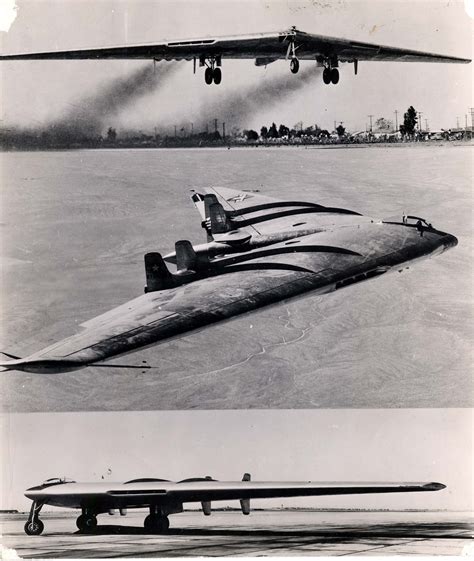
Despite its revolutionary design, the aircraft suffered from a fatal flaw—instability. Without modern flight computers, pilots struggled to maintain control, especially in yaw. Constant corrections were required, turning routine flight into a high-risk balancing act.
The program’s fate was sealed after a catastrophic crash in 1948, killing test pilot Glen Edwards and his crew. By 1950, the U.S. Air Force canceled the program in favor of the more conventional Convair B-36 Peacemaker.
Ironically, the YB-49’s design would be vindicated decades later with the introduction of the B-2 Spirit—a direct technological descendant made viable by digital fly-by-wire systems. The YB-49 didn’t fail; it simply arrived 40 years too early.
Boeing 2707: America’s Supersonic Dream That Never Took Off
During the 1960s, the race for supersonic passenger travel wasn’t just technological—it was geopolitical. The United States aimed to dominate the skies with the Boeing 2707, a commercial aircraft designed to outperform the Concorde in both speed and capacity.
Developed by Boeing, the 2707 was envisioned as a Mach 3 airliner capable of carrying up to 300 passengers—more than double Concorde’s capacity. It wasn’t just faster; it was designed to make supersonic travel economically viable on a massive scale.
Its most ambitious feature was the variable-geometry swing wing, allowing the aircraft to adapt its shape mid-flight. Extended wings improved lift during takeoff and landing, while swept-back wings reduced drag at supersonic speeds.
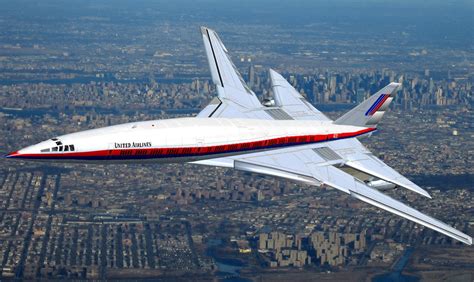
However, this innovation became its downfall. The swing-wing mechanism proved excessively heavy and complex, forcing engineers to abandon it mid-development in favor of a fixed delta wing—triggering delays and escalating costs.
At the same time, external pressures mounted. Sonic boom tests across the United States sparked public outrage, with thousands of complaints and even reports of structural damage. By 1973, supersonic flight over land was effectively banned.
The political climate turned hostile. Costs soared beyond $1 billion, and Congress withdrew support. In 1971, the program was terminated, triggering widespread layoffs and contributing to the infamous “Boeing Bust” in Seattle.
The Boeing 2707 stands as a powerful reminder that even the most ambitious engineering cannot survive without public and political backing.
Avro Canada CF-105 Arrow: The Interceptor That Shattered a Nation’s Aerospace Ambitions
The Avro Canada CF-105 Arrow wasn’t just an aircraft—it was a national symbol. Developed by Avro Canada, it represented the peak of Canadian engineering during the Cold War.
Designed to counter Soviet bombers over the Arctic, the Arrow was capable of near-Mach 2 speeds, exceptional altitude performance, and remarkable stability. But its true innovation lay beneath the surface.
It featured one of the earliest implementations of fly-by-wire control systems, along with an advanced computerized fire-control system—technologies that wouldn’t become standard until decades later.
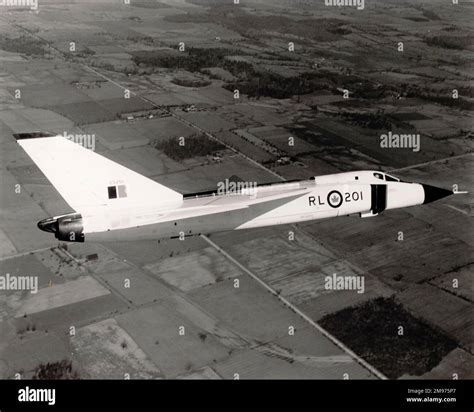
At its peak, the program employed over 14,000 people directly, with tens of thousands more in supporting industries. It was not just an aircraft—it was the backbone of Canada’s aerospace sector.
Then came February 20, 1959—“Black Friday.” The Canadian government abruptly canceled the program, citing rising costs and a shift toward missile-based defense systems. The decision reflected a broader strategic pivot: intercontinental ballistic missiles were replacing manned interceptors.
What followed was unprecedented. The government ordered the destruction of all aircraft, engines, and even blueprints. Nearly 30,000 people lost their jobs almost overnight.
Yet the Arrow’s legacy didn’t vanish—it migrated. Many of its engineers joined NASA, contributing to the Mercury, Gemini, and Apollo programs. The Arrow may have been dismantled physically, but its influence reached the Moon.
Northrop YF-23 Black Widow II: The Fighter That Lost the Future
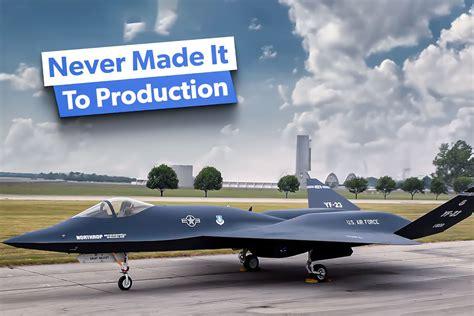
The Northrop YF-23, developed by Northrop Grumman, was arguably one of the most advanced fighter prototypes ever built. Created for the U.S. Air Force’s Advanced Tactical Fighter competition, it was designed with a clear philosophy: win before the enemy even knows you’re there.
Unlike traditional fighters focused on agility, the YF-23 emphasized stealth, speed, and survivability. It could exceed Mach 2.2 and operate at altitudes above 65,000 feet while maintaining supercruise—sustained supersonic flight without afterburners.
Its design was unmistakable. Diamond-shaped wings, a flattened fuselage, and carefully angled surfaces minimized radar detection. Its exhaust system reduced infrared signatures, making it harder to track with heat-seeking missiles.
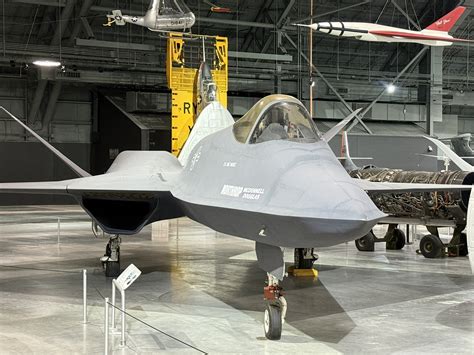
Despite outperforming its rival in stealth and speed, the YF-23 lost to the Lockheed YF-22 in 1991. The decision reflected prevailing military doctrine at the time, which still prioritized dogfighting maneuverability—an area where the YF-22 excelled due to thrust-vectoring capabilities.
There were also industrial considerations. Northrop was already heavily committed to the B-2 program, influencing the final decision.
In hindsight, many analysts argue the YF-23 was better aligned with modern air combat, where beyond-visual-range engagements and stealth dominance define superiority. It didn’t lose because it was inferior—it lost because the world hadn’t yet caught up to its philosophy.
North American XB-70 Valkyrie: The Mach 3 Giant That Became Obsolete Overnight
The North American XB-70 Valkyrie represents one of the most ambitious aircraft ever constructed. Designed by North American Aviation, it was intended to fly at Mach 3 at altitudes above 70,000 feet, outrunning any interceptor of its era.
Its engineering was nothing short of extraordinary. The aircraft utilized a massive delta wing with hinged wingtips, which could droop during supersonic flight to generate compression lift—effectively allowing the aircraft to ride its own shockwave.
Powered by six turbojet engines, the XB-70 was a masterpiece of high-speed aerodynamics and propulsion integration.
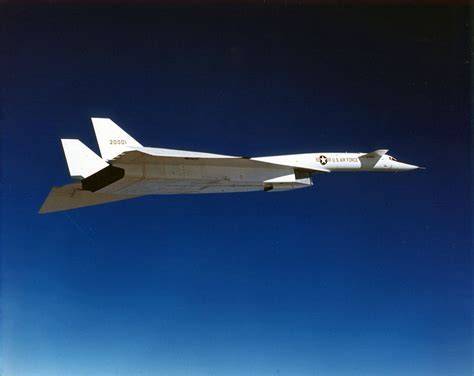
Yet even as it took to the skies, it was becoming obsolete. Advances in surface-to-air missile technology meant that high-altitude bombers were no longer safe. At the same time, intercontinental ballistic missiles offered a faster, more reliable method of nuclear delivery.
The program was canceled before full deployment, with only two prototypes built. One was lost in a midair collision in 1966, while the other continued as a research platform under NASA.
Despite its short operational life, the XB-70 provided invaluable data on supersonic flight, influencing future programs like the B-1 bomber and ongoing supersonic research.
Why These Aircraft Still Matter Today
Each of these aircraft underscores a powerful truth: technological superiority alone does not guarantee success. Timing, doctrine, economics, and politics often matter just as much as engineering brilliance.
Yet none of these projects were wasted efforts. Their innovations became the foundation for future breakthroughs:
- The YB-49 paved the way for stealth bombers
- The YF-23 anticipated modern stealth fighter doctrine
- The XB-70 advanced high-speed aerodynamics
- The CF-105 Arrow fueled the space race through its engineers
- The Boeing 2707 exposed the limits of commercial supersonic travel
What ties them together is not failure, but influence. These aircraft didn’t reach mass production—but they reshaped aviation in ways that continue to define modern aerospace engineering.
In aviation, being too early can be just as decisive as being wrong. And these machines prove that sometimes, the most groundbreaking ideas aren’t abandoned—they’re simply waiting for the future to catch up.