Understanding Point Merge: A Modern Approach to Traffic Sequencing
Point merge is a technique used to manage arrival traffic flows efficiently. It was created to handle high traffic levels without relying on radar vectoring. This reduces the workload for air traffic controllers while promoting continuous descent and optimal sequencing for aircraft.
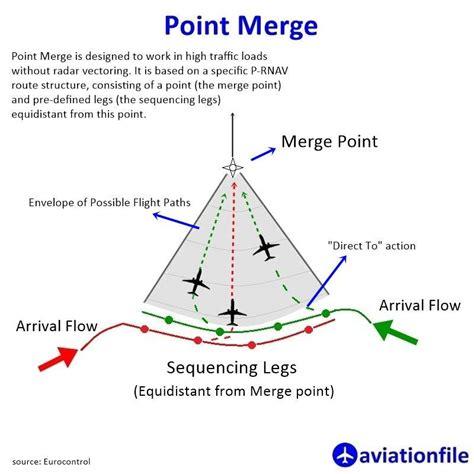
The point merge system is based on P-RNAV route structures. It consists of a merge point and pre-defined legs, which are arcs that keep aircraft equidistant from the merge point. Sequencing is achieved through ‘direct to’ instructions at the right moments. The legs help delay aircraft by extending their flight paths. No matter when the direct instruction is given, the distance flown until reaching the merge point remains constant.
Several methods exist for sequencing arrival traffic. Initially, radar vectoring was common. This provided flexibility but increased the controller’s workload due to the need for constant monitoring and communication. Later, PBN procedures were introduced in some terminal maneuvering areas (TMAs). These included path-stretching elements like ‘trombone-shaped’ routes, which feature multiple waypoints. While ‘direct to’ instructions between these waypoints resemble point merge, they lack standardization. Experience has shown that as traffic increases, controllers often revert to vectoring for final approaches.
The benefits of point merge are numerous. First, it reduces controller workload. Aircraft navigate on their own, requiring minimal intervention from controllers. In contrast, vectoring requires many instructions, ongoing monitoring, and careful timing for each intervention. If a controller becomes distracted and forgets about an aircraft, that plane will continue on its last vector, potentially disrupting the entire sequencing plan and leading to corrective actions.
Another advantage is improved pilot situational awareness. Pilots have a clearer understanding of their future flight path compared to vectoring scenarios. Additionally, point merge creates more orderly traffic flows. Once established, the flight sequencing is easy to maintain, as all aircraft follow the same path. There’s also better trajectory prediction, which enhances flight efficiency. After receiving the ‘direct to’ instruction, the distance to touchdown is known with high certainty, allowing for continuous descent.
Finally, point merge standardizes operations. Aircraft follow the arc, then a straight line to the merge point, and finally intercept the final approach track. Developed by the EUROCONTROL Experimental Centre (EEC) in 2006, point merge was first implemented in Oslo in 2011 and Dublin in 2012. Since then, it has spread beyond the ECAC area to about 50 airports across four continents, including cities like Istanbul, Tokyo, Shanghai, Mexico City, Moscow, and Kuala Lumpur.