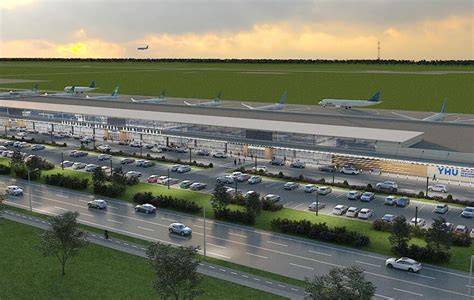
Montreal is trying something it once failed to achieve on a spectacular scale: building a second airport that passengers will actually use. On June 15, 2026, Montreal Metropolitan Airport (YHU), formerly known as Saint-Hubert Airport, opened a new $450 million commercial terminal designed to handle as many as four million passengers annually. Backed by Porter Airlines, Macquarie Asset Management, and the Canada Infrastructure Bank, the project represents a very different philosophy from the one that produced Mirabel Airport nearly five decades ago.
The contrast matters because Montreal’s aviation history contains one of the clearest warnings about airport planning anywhere in North America. Mirabel was conceived as the future of Canadian aviation, with enormous land reserves and ambitions to eventually handle tens of millions of passengers. Yet its location, roughly 55 kilometers from downtown Montreal, became one of its greatest weaknesses. Airlines were forced to divide operations, passengers disliked the distance, and the promised transformation of Montreal’s aviation system never materialized.
YHU is deliberately avoiding that formula. Instead of starting with a massive airport and hoping demand eventually catches up, Montreal Metropolitan Airport is beginning with an existing aviation facility, a relatively compact terminal, a limited domestic network, and an airline whose business model already depends heavily on convenience. The strategy is essentially the opposite of Mirabel: start with passengers and proven demand, then build around them.
The Mirabel Legacy Still Shapes Montreal Airport Planning
Mirabel’s failure was not simply a story about an airport that was too large. The deeper problem was the mismatch between infrastructure planning and passenger behavior. When the airport opened in 1975, planners envisioned a spectacular future in which Montreal’s aviation demand would grow dramatically and Mirabel would become the region’s dominant international gateway.
The airport had extraordinary room for expansion, but passengers had to travel approximately 34 miles, or 55 kilometers, from central Montreal. That distance might have been manageable if high-speed or convenient transportation links had developed as expected. Instead, travelers faced a journey that made the airport considerably less convenient than Dorval, the facility that would eventually become Montreal-Trudeau International Airport (YUL).
The problem became even more complicated when airlines had to divide their operations between the two airports. Connecting passengers faced additional inconvenience, while travelers booking flights had to pay attention to which airport their airline was using. An airport can have enormous runways and terminals, but if its location adds substantial friction to every trip, passengers have a powerful reason to choose another facility whenever an alternative exists.
By the early 2000s, most passenger operations had returned to Dorval. Mirabel ultimately lost its scheduled passenger service altogether, becoming one of aviation’s most recognizable examples of how a technically ambitious infrastructure project can struggle when location and passenger convenience are treated as secondary considerations.
YHU is being developed with that history firmly in view.
Why Montreal Metropolitan Airport Is Taking a Different Route
The most obvious difference is geography. Montreal Metropolitan Airport sits on Montreal’s South Shore, approximately 15 kilometers from downtown Montreal, rather than more than 50 kilometers away. That makes YHU far more closely connected to the metropolitan area it is intended to serve.
The new terminal covers approximately 226,000 square feet, or 21,000 square meters, and includes nine boarding bridges and a 900-seat passenger lounge. The facility can process as many as 15,000 passengers per day during peak periods, while the airport’s longer-term capacity target reaches four million passengers annually.
Those numbers sound substantial, but YHU is intentionally small compared with the major international hubs that dominate the world’s largest metropolitan areas. That is an important part of its strategy. The airport does not need to become another Toronto Pearson or Montreal-Trudeau to succeed. It needs to capture enough passengers who value its location and streamlined operation.
The distinction is fundamental. YHU is not designed to replace YUL. Montreal-Trudeau remains the region’s principal international airport, with the long-haul flights, global airline networks, connecting traffic, customs facilities, and extensive international infrastructure that YHU does not initially seek to duplicate.
Instead, Montreal is effectively testing whether two airports can coexist when they have clearly differentiated roles.
Porter Airlines Is The Key To YHU’s Strategy
Porter Airlines is central to the entire concept. The airline has expanded substantially beyond its original regional identity and is now the anchor carrier at YHU, launching the new terminal with 138 weekly flights to 12 domestic destinations.
That immediately gives Montreal Metropolitan Airport something Mirabel struggled to establish: a practical reason for passengers to use the airport from the moment it opens.
Porter’s fleet strategy also fits the airport’s intended role. The airline operates Embraer E195-E2 jets, which seat 132 passengers and provide sufficient range for longer domestic routes, alongside Bombardier Dash 8-400 turboprops suited to shorter regional markets. The combination allows Porter to adjust aircraft size and operating economics according to the demand of individual routes.
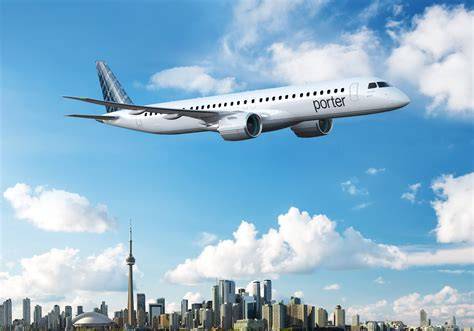
More importantly, Porter’s initial YHU network is overwhelmingly domestic. That is a significant departure from Mirabel’s original ambitions. Instead of trying to establish YHU immediately as a global gateway, Porter can concentrate on travelers who want to move around Canada efficiently.
For those passengers, international connectivity is not necessarily the deciding factor. A traveler heading from Montreal to Toronto, Halifax, Calgary, Vancouver, or another Canadian city may care much more about how long it takes to reach the airport, clear security, walk to the gate, and board the aircraft.
That is precisely the market Porter understands.
The $450 Million YHU Investment Is Smaller By Design
YHU’s approximately $450 million project cost also tells an important story. About $30 million of that investment was dedicated to airfield improvements, including taxiways, aprons, and supporting infrastructure required for expanded commercial operations.
The financing structure is another major difference from Montreal’s historical airport megaprojects. YHU Infrastructure Partners, a partnership involving Porter Aviation Holdings and Macquarie Asset Management, provides the primary private-sector investment, while the Canada Infrastructure Bank contributed a $90 million loan.
That structure does not eliminate risk. In some respects, it makes commercial performance even more important. Private investors have a direct financial incentive to ensure that the airport attracts passengers, supports viable airline operations, and develops sustainably.
This creates a fundamentally different development philosophy from building enormous capacity based primarily on forecasts of what passenger demand might eventually become. YHU has to demonstrate that its facilities work for travelers today while creating enough room for measured expansion tomorrow.
The airport therefore does not need to convince Montrealers that they will someday use a giant new facility. It needs to convince them that using YHU now is easier than using a larger airport for the right trips.
YHU Is Selling Time As Much As It Is Selling Flights
Perhaps the most interesting part of the YHU concept is that the airport is effectively selling time savings.
Modern airport travel can involve a surprising amount of wasted time. Passengers arrive early because they are uncertain how long security will take. They walk long distances through enormous terminals, wait in crowded gate areas, and sometimes spend more time navigating the airport than they spend actually getting to their aircraft.
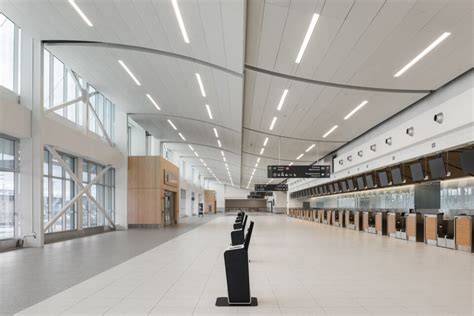
YHU is deliberately designed around the opposite experience. Its compact footprint and simplified domestic operation are intended to reduce the number of steps between the curb and the aircraft.
Airport executives have promoted the idea that passengers can arrive as little as 30 minutes before boarding under appropriate circumstances. Whether every traveler will eventually feel comfortable operating on such a tight schedule is another question, but the underlying proposition is clear: YHU wants airport convenience to become part of the product.
That philosophy has obvious parallels with Porter’s experience at Billy Bishop Toronto City Airport, where proximity to downtown and relatively quick passenger processing became central elements of the airport’s appeal.
At YHU, the same principle is being applied on a larger South Shore canvas. A passenger who can reach a nearby airport more easily, park or arrive at the terminal with less difficulty, clear security quickly, and walk a short distance to the gate may accept a slightly different flight schedule simply because the overall journey is less exhausting.
Domestic-Only Operations Reduce Complexity
Keeping YHU focused on domestic flights also provides an operational advantage. International airports require additional layers of infrastructure and processing, including customs, immigration, and other border-related procedures.
YHU does not initially need to carry that burden.
That allows the airport to concentrate its resources on the passenger journey it is actually trying to improve. Rather than spending heavily to recreate every function available at Montreal-Trudeau, YHU can focus on check-in, security, boarding, baggage handling, aircraft turnaround, and the other elements required for a smooth domestic operation.
This is where the airport’s smaller scale could become an advantage rather than a limitation.
A giant airport is extremely efficient at handling enormous volumes of passengers, but it is not automatically better for every traveler. For a passenger taking a straightforward domestic trip, a smaller airport can eliminate much of the complexity associated with a major international hub.
Can Montreal Finally Make A Two-Airport System Work?
The larger question is whether Montreal can sustain a genuine two-airport system without repeating the fragmentation that damaged Mirabel.
The answer will depend on whether the two airports develop distinct identities. Montreal-Trudeau has an established role as the region’s principal international gateway and long-haul hub. YHU can succeed without challenging that position if it develops into the preferred airport for selected domestic journeys.
That model already exists in several major metropolitan areas. Cities such as London, New York, Tokyo, and Paris have multiple airports serving different passenger markets, although each system has its own geography, transportation infrastructure, and operational challenges. The lesson is not that every city needs two airports. It is that multiple airports can coexist when passengers understand why each one exists.
YHU’s biggest advantage may therefore be its restraint. The airport is not promising to become Montreal’s new global gateway. It is not trying to erase Montreal-Trudeau from the map. It is offering something much simpler: another way to fly.
That makes the project’s success dependent on behavior rather than concrete. The terminal can be completed, gates can be opened, and aircraft can be scheduled, but passengers ultimately decide whether the concept works.
Porter And YHU Are Betting That Convenience Wins
The most important test for Montreal Metropolitan Airport will come as the initial novelty disappears. Passengers will compare actual travel times, schedules, fares, parking, public transportation, route frequency, and the reliability of Porter’s operation. If YHU consistently saves meaningful time, travelers have a practical reason to return.
Porter also has an opportunity to expand the airport’s appeal gradually. More destinations and higher frequencies can follow if the initial network produces sustainable demand. That creates a feedback loop that Mirabel never achieved: passenger adoption can drive expansion rather than expansion being expected to create passenger adoption.
This may ultimately be the most significant difference between Montreal’s two airport experiments.
Mirabel represented an enormous bet on what Montreal’s aviation future might become. YHU represents a more measured bet on what Montreal passengers are already telling airlines they want: convenient airports, efficient journeys, and domestic flights that do not require navigating an enormous international terminal.
The $30 billion disaster associated with Mirabel’s broader airport planning legacy remains a powerful reminder of what can happen when infrastructure becomes detached from passenger behavior. Montreal Metropolitan Airport cannot guarantee that history will never repeat itself. But by staying close to the city, starting with domestic demand, relying on an established airline, limiting initial scale, and emphasizing convenience over prestige, YHU is attempting something Mirabel never managed to achieve.
It is not trying to build the airport of Montreal’s imagined future.
It is trying to build the airport passengers will actually want to use.