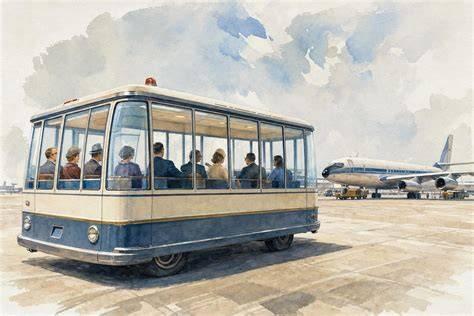
Washington Dulles International Airport has always been different from most major US airports. Its sweeping main terminal, designed by Finnish-American architect Eero Saarinen, was intended to represent the future of air travel when it opened in 1962. Yet one of its most recognizable features has survived for a very different reason: the airport’s unusual mobile lounges. These enormous bus-like vehicles were once an innovative answer to the problem of moving passengers between the terminal and distant concourses, but more than six decades later, they have become a symbol of Dulles’ aging infrastructure.
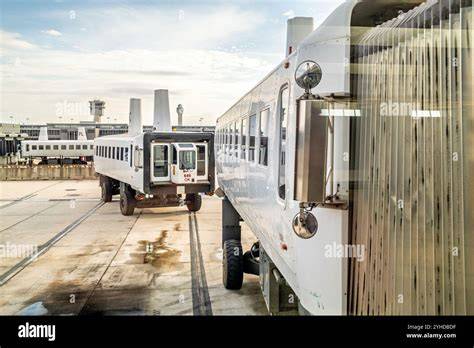
For passengers using the airport today, the mobile lounges can feel less like a futuristic transportation system and more like an inconvenient leftover from another era. They are large enough to carry substantial numbers of travelers, and their passenger cabins can be raised to aircraft-door level, but they still require passengers to board a vehicle, wait for it to fill, and travel across the airport instead of simply walking through a modern concourse or taking an automated train. Their continued operation has become particularly difficult for United Airlines, which operates its major Washington hub at Dulles and depends heavily on the airport’s infrastructure.
The frustration has reached the highest level of United’s management. United Airlines CEO Scott Kirby has described the mobile lounges as “terrible,” a blunt assessment that reflects a problem much larger than passenger inconvenience. The vehicles are tied to an airport layout that was conceived when jet bridges, automated people movers, and large interconnected concourses were not yet standard. What once represented technological ambition has gradually become an operational constraint, particularly as Dulles has expanded and United has increased its international presence.
Why Washington Dulles Still Uses Mobile Lounges
The basic concept behind Dulles’ mobile lounges was remarkably ambitious for the early 1960s. Rather than building conventional concourses directly around the terminal, the airport could keep aircraft away from the main building and transport passengers directly between the terminal and their aircraft. The mobile lounge itself functioned as a combination of bus and movable passenger terminal, with its elevated cabin designed to align with an aircraft door.
At the time, this arrangement made sense. Jet travel was still relatively new, airports were experimenting with entirely new layouts, and the rapid growth of commercial aviation demanded solutions that could handle aircraft parked away from terminal buildings. Dulles was designed around the idea that the airport of the future would operate differently from older facilities, and the mobile lounges were an important part of that vision.
The problem is that airport technology moved on. Jet bridges became increasingly common, allowing passengers to board aircraft directly from terminal buildings. Automated people movers also became a practical solution for moving travelers between distant airport facilities. Instead of transporting an entire passenger cabin to the aircraft, modern airports increasingly brought the passenger to the gate using trains, moving walkways, buses, and enclosed pedestrian connections.
Dulles adopted some of those technologies as well. Its AeroTrain now provides an automated connection between major portions of the airport, dramatically changing how passengers move through the complex. But the mobile lounges survived because Dulles’ physical design remained heavily dependent on them, particularly around the aging Concourses C and D.
The Aging Concourses Behind United’s Frustration
The mobile lounges cannot really be separated from the condition of Dulles’ United-dominated facilities. Concourses C and D were originally conceived as temporary structures, yet the temporary solution has remained in service for decades. Although the facilities have received upgrades, their basic limitations remain visible to passengers.
The concourses have low ceilings, limited space, and relatively restricted dining and retail options compared with newer airport facilities. More importantly, the layout does not provide the same seamless passenger circulation found at many modern international hubs. Concourse D also lacks an AeroTrain connection, increasing the importance of the mobile lounges for passengers traveling through that part of the airport.
That creates an especially frustrating situation for United because the airline is the principal operator at Concourses C and D. The airline can modernize its aircraft, improve its lounges, add connectivity, and invest in a more sophisticated onboard product, yet passengers can still find themselves standing inside an aging airport vehicle before reaching their gate.
The issue is not simply aesthetic. Every additional transfer introduces another stage into a passenger’s journey. Travelers must leave one building, wait for transportation, board a mobile lounge, and then continue toward another part of the airport. When passenger volumes are high, the experience can become crowded and slow. For international travelers making tight connections, the additional movement is particularly unwelcome.
Why Scott Kirby’s “Terrible” Comment Matters
Kirby’s criticism is significant because United has a direct economic interest in fixing Dulles’ infrastructure. The airline is not merely another customer using the airport. Dulles functions as one of United’s important US hubs and serves as its principal international gateway in the Washington region.
United has also increasingly emphasized its role as a major international carrier serving the nation’s capital. That makes the passenger experience at Dulles strategically important. Travelers arriving in Washington from Europe, Asia, the Middle East, or other international markets are effectively being introduced to the region through an airport where some of the passenger-processing and transportation systems still reflect the early jet age.
For Kirby, therefore, the mobile lounges represent more than an outdated airport curiosity. They are part of a broader infrastructure problem that can limit United’s ability to grow efficiently. The airline has been planning to expand its international footprint from Dulles, making the need for additional gates, better passenger circulation, and more modern facilities increasingly urgent.
Dulles also has a strategic advantage that may become more important as other major US hubs face capacity limitations. United’s Newark operation remains the larger long-haul hub because of the enormous New York market, but Newark has limited room for further expansion. Dulles gives United another major East Coast platform from which to operate international flights, particularly to destinations that can support Washington-area demand.
Dulles’ $22.5 Billion Modernization Plan
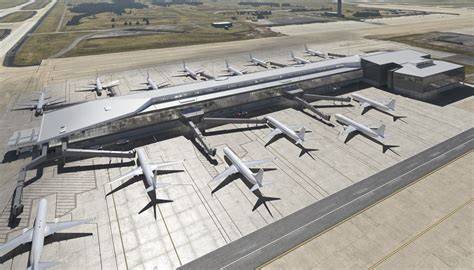
The long-term answer to the mobile lounge problem is not simply replacing the vehicles with newer buses. The Metropolitan Washington Airports Authority has approved a $22.5 billion redevelopment plan designed to fundamentally reshape Dulles.
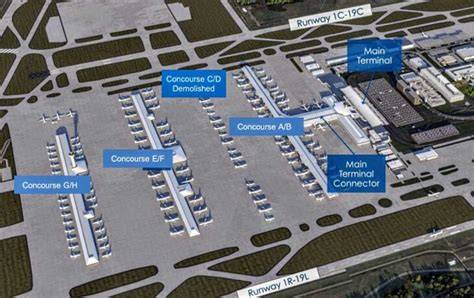
The project is expected to transform the airport’s terminal and concourse system over the coming years. The Main Terminal is scheduled for a major expansion beginning in late 2027, with the project estimated at approximately $6.2 billion. The existing facilities will also be reorganized, expanded, and renamed as the airport moves toward a more coherent concourse configuration.
The most important change for passengers is the planned creation of a much more connected airport. A new pedestrian tunnel will link the Main Terminal with all four concourses, while the AeroTrain network will be expanded to serve the airport’s future configuration. These connections are intended to reduce the airport’s dependence on the mobile lounges.
Under the current plan, the temporary C/D structures will eventually disappear. New facilities will take their place, providing more gates, better passenger circulation, modern concessions, and improved international-processing capabilities.
Concourse E Will Be the First Major Step
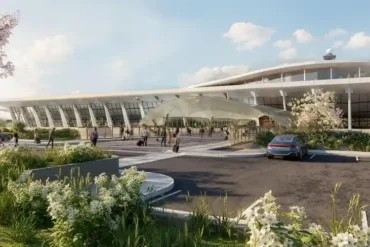
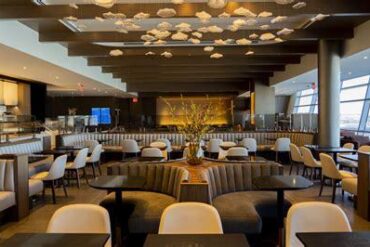
The transformation is already beginning to become visible with the arrival of Concourse E. A ribbon-cutting ceremony is scheduled for October 8, 2026, following construction that began in 2024. The first phase will include 14 gates for United Airlines, 17 concession locations, a United Club, and an AeroTrain station.
That combination is particularly important because it directly addresses several weaknesses of the current C/D facilities. Passengers will gain access to a newer building with improved amenities and a direct connection to the airport’s automated transportation system.
Concourse E is not the final form of the redevelopment. It is expected to expand with additional gates and eventually receive its own Customs and Border Protection facility. That would reduce pressure on the existing international-processing infrastructure, which currently handles substantial passenger volumes through facilities associated with the older terminal configuration.
United is expected to concentrate many international operations in Concourse A because of its proximity to the International Arrivals Building. This arrangement could shorten passenger movements for international travelers while allowing the newer facilities to absorb additional growth.
The airline also plans to construct a new Polaris lounge along the connector between the Main Terminal and the A/B area, further reinforcing the airport’s shift toward a more modern international-hub experience.
The Mobile Lounges Will Not Disappear Overnight
Despite the ambitious redevelopment plans, passengers should not expect to see the mobile lounges disappear immediately. Dulles currently operates 49 mobile lounges, consisting of 19 original vehicles dating from the early 1960s and 30 later “PlaneMates” introduced during the 1970s.
Some of these vehicles are therefore more than half a century old.
The airport is extending their useful lives while the new infrastructure is constructed. They will continue serving passengers traveling to Concourse D and the International Arrivals Building during the transition. The current timetable calls for their eventual retirement in 2034, meaning the original concept will have survived for more than 70 years.
That timeline illustrates just how deeply the mobile lounges are embedded in Dulles’ design. Replacing them requires rebuilding major parts of the airport rather than simply purchasing a new fleet of buses.
Why the $22.5 Billion Price Tag Is Controversial
Modernizing Dulles comes with a substantial financial challenge. The $22.5 billion price tag is enormous for an airport that handled around 29 million passengers in 2025. Other major US airports serve considerably larger passenger populations, raising questions about how the enormous investment will ultimately be recovered.
One concern is the possibility of significantly higher airline costs. Estimates have suggested that airport charges could eventually rise by as much as $90 per enplaned passenger, although the final financial impact remains uncertain. Higher airport costs can ultimately influence ticket prices and may be particularly challenging for lower-cost airlines operating on thinner margins.
Kirby has pushed back against the idea that higher costs necessarily translate directly into proportionally higher fares. His argument is that the redevelopment should enable Dulles to handle more flights and passengers, allowing infrastructure expenses to be distributed across a larger traffic base.
The construction plan itself is also not completely locked down. The main construction contracts are expected to be awarded in 2027, and design concepts could still change before work advances into later phases.
Dulles Is Finally Moving Beyond the 1960s
The irony of Dulles is that its most famous architectural feature and its most frustrating operational feature came from the same era. Saarinen’s Main Terminal remains an architectural landmark, while the mobile lounges were once celebrated as an innovative transportation solution. Both were products of a time when airports were being redesigned around the possibilities of the jet age.
But aviation has continued to evolve while parts of Dulles have remained anchored in that original concept. Today’s passengers expect fast connections, spacious terminals, automated transportation, abundant concessions, and straightforward access to gates. United’s ambitions for Dulles also require infrastructure capable of supporting a much larger international operation.
That is why Kirby’s “terrible” description resonates beyond a complaint about uncomfortable airport buses. The mobile lounges have become a shorthand for an airport system that is finally being rebuilt around modern passenger movement rather than 1960s transportation concepts.
When the redevelopment is eventually completed, travelers will no longer need to rely on those distinctive elevated vehicles to navigate the airport. The mobile lounges will likely remain an important part of Dulles history, but their retirement will mark the end of an unusually long experiment in airport design—and a major step toward turning United’s Washington hub into the modern international gateway the airline increasingly needs.