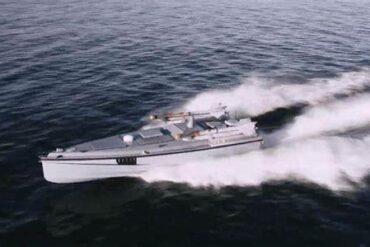
The U.S. Army is exploring a small uncrewed surface vessel that could operate in one of the most difficult maritime environments: the surf zone where waves break directly onto the coastline. A study involving Ocean Power Technologies’ WAM-V 8 USV suggests the compact drone could give Army mariners a safer way to investigate shallow, hazardous waters without immediately putting boats, crews, or divers at risk.
The Army’s interest reflects a broader expansion of unmanned systems beyond conventional aerial drones. Although the service is primarily associated with land operations, it operates watercraft for logistics, coastal missions, and beach operations. A highly maneuverable surface drone could extend those capabilities into areas where larger vessels struggle because of shallow water, breaking waves, submerged obstacles, and unpredictable coastal conditions.
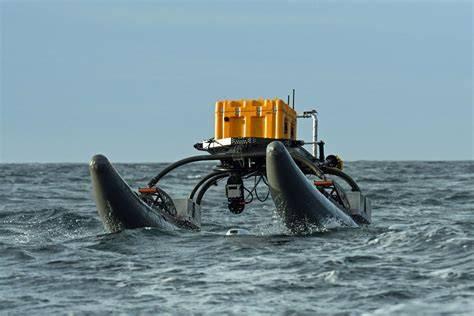
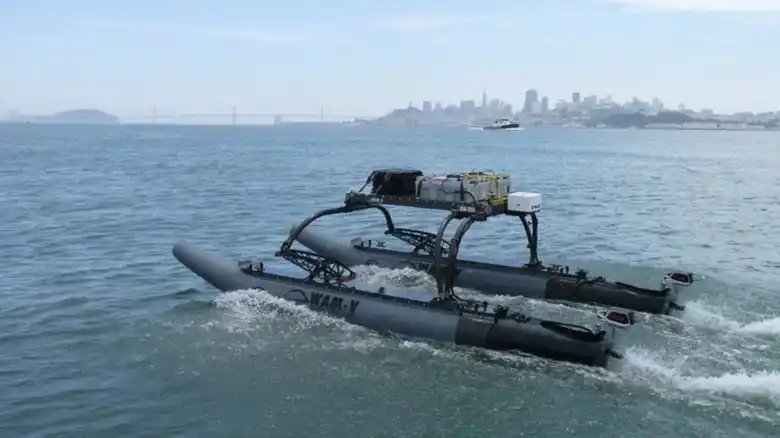
The WAM-V 8 is particularly suited to this role because it draws only about four inches of water. Measuring roughly eight feet long and four feet wide, the vessel is small enough to be transported in the back of a pickup truck and can also be disassembled for easier movement. During a weeklong Army evaluation, the craft was tested against requirements focused on operating through surf and approaching the shoreline.
WAM-V 8 Could Map Dangerous Coastal Waters
The Army Engineer Research and Development Center’s Coastal and Hydraulics Laboratory is seeking an unmanned system capable of working directly in breaking waves. That capability could make the WAM-V 8 valuable for coastal mapping, particularly when engineers need detailed information about shorelines, sandbars, shallow channels, and underwater hazards before sending larger vessels into unfamiliar waters.
The drone can carry a 100-pound payload, while its unloaded weight is approximately 340 pounds. Two 1,100-watt electric motors powered by lithium-ion batteries provide propulsion, with endurance reaching about 10 hours at three knots. Its catamaran configuration uses inflatable pontoons and a suspension system designed to let the two hulls move with waves while maintaining stability.
Sonar Could Detect Hidden Underwater Hazards
One of the most important capabilities is the vessel’s ability to carry sonar equipment. Mounted through a system resembling a camera gimbal, the sonar can scan the seafloor for potential hazards that may not be visible from the surface. That could allow Army personnel to identify dangerous areas without sending divers into potentially lethal conditions.
Beyond reconnaissance, the USV could support C4ISR missions, counter-uncrewed aerial systems activities, mine detection, and coastal engineering. It could even help move food, fuel, or equipment toward shore when a conventional port is unavailable, while first scouting the approach route.
The Army has completed its initial testing, but procurement is not guaranteed. The results of the weeklong study have not been publicly released, and additional evaluation will be necessary. Still, the WAM-V 8 demonstrates how a relatively small unmanned vessel could give the Army access to dangerous coastal waters that have traditionally remained difficult and risky to explore.