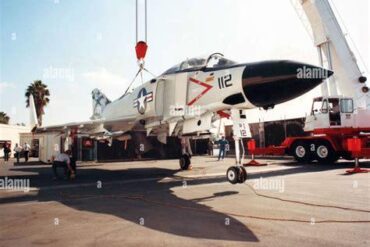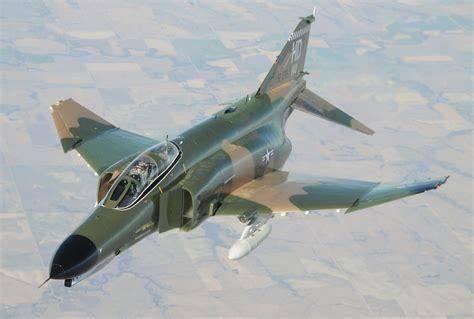
The McDonnell Douglas F-4 Phantom II remains one of the most recognizable fighter aircraft of the Cold War era, but its imposing appearance was backed by extraordinary performance. Designed in the 1950s around the idea that future air combat would be dominated by radar, missiles, altitude, and speed, the Phantom was built to intercept threats before they could get close. Its enormous size, twin-engine layout, and heavy weapons load made it look more like a compact bomber than a conventional fighter, yet it could accelerate rapidly and reach speeds that remain impressive decades after its first flight.
The answer to the question “How fast can the F-4 Phantom fly?” is approximately Mach 2.23, or more than twice the speed of sound under suitable conditions. That figure placed the Phantom among the world’s fastest fighter aircraft when it entered service. It was not simply fast for its generation; its speed became one of the aircraft’s defining characteristics. Even after newer generations of fighters appeared, the F-4 remained capable of exceeding the maximum speeds of several modern combat aircraft, including the Boeing F/A-18 and Lockheed Martin F-35.
The Phantom’s speed was closely connected to the philosophy behind its original design. In the 1950s, military planners increasingly believed that radar-guided missiles could transform air combat. Instead of relying primarily on guns and close-range maneuvering, an interceptor could detect an enemy at long distance, climb rapidly to altitude, accelerate toward the target, and launch missiles before a traditional dogfight developed. The F-4 was therefore engineered around high speed, rapid acceleration, powerful radar, and high-altitude performance.
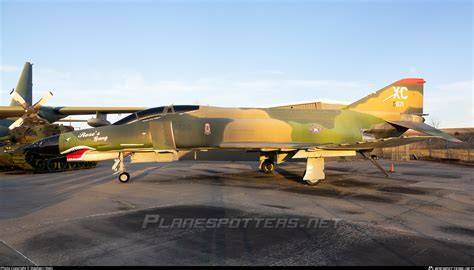
F-4 Phantom II Top Speed and Performance
The F-4 Phantom II could reach a maximum speed of approximately Mach 2.23, depending on the specific variant, altitude, configuration, and operating conditions. At high altitude, where the thinner atmosphere reduced aerodynamic drag, the aircraft could exploit the enormous thrust generated by its two General Electric J79 afterburning turbojet engines.
Each engine produced roughly 17,000 pounds of afterburning thrust, giving the large Phantom an extraordinary power reserve. The F-4 had a maximum takeoff weight exceeding 27 tons, yet its engines could propel it to more than twice the speed of sound. That combination was particularly remarkable because the aircraft was never a small, lightweight interceptor. It was a large twin-engine platform capable of carrying substantial quantities of fuel, missiles, bombs, and other equipment.
Speed was only one part of the Phantom’s performance. Its acceleration was also highly regarded by pilots. The J79 engines allowed the aircraft to build speed quickly, while the afterburners provided the additional thrust needed for high-speed interception and rapid climbs. The aircraft could also decelerate quickly when the engines were brought back from maximum power, making its performance more flexible than its large dimensions might suggest.
The Phantom’s maximum climb rate was approximately 41,000 feet per minute, allowing it to gain altitude at an extraordinary rate. In 1961, an F-4 climbed beyond 66,443 feet, establishing a sustained-altitude record. Across its development and testing period, the Phantom established 16 new flight-performance records, reinforcing its reputation as one of the most advanced aircraft of its era.
Why Was the F-4 Phantom Designed to Fly So Fast?
The Phantom’s extraordinary speed made sense when viewed through the military requirements of the 1950s. The United States Navy originally wanted a carrier-based interceptor capable of reaching Mach 2 while carrying sophisticated radar and missile systems. The aircraft therefore needed enough thrust to climb rapidly and enough speed to intercept incoming aircraft before they could reach their targets.
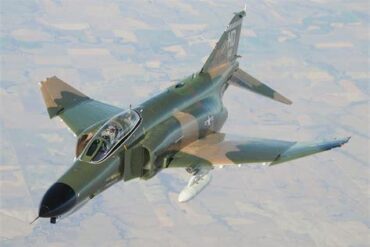
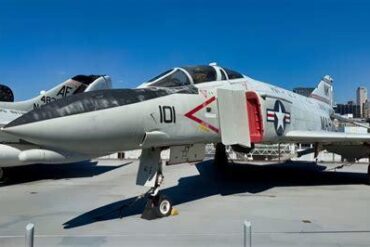
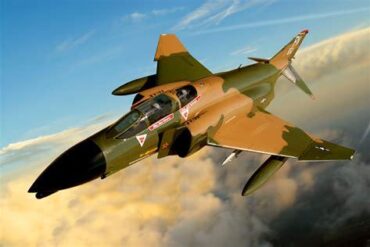
The resulting design was unlike many earlier fighters. The Phantom had a large fuselage, swept wings, twin vertical tails, and two powerful engines mounted within the rear portion of the aircraft. Its shape was heavily influenced by the need to carry fuel, radar equipment, weapons, and powerful engines while still achieving supersonic performance.
The aircraft’s AN/APQ-series radar system was central to this concept. Designers expected the Phantom to detect enemy aircraft at considerable distances, with the target appearing on a radar display rather than as a clearly visible aircraft. Air-to-air missiles would then be used to destroy the opponent before visual-range combat became necessary.
That philosophy explains an unusual feature of early F-4s: they were delivered without an internal cannon. At the time, many planners believed that missile technology had made traditional fighter guns increasingly unnecessary. The Phantom’s combination of radar, missiles, altitude, and speed represented what many designers expected the next generation of air warfare to look like.
The F-4 Phantom’s Speed in the Vietnam War
The Phantom’s high-speed performance proved valuable during the Vietnam War, but combat exposed weaknesses in the assumptions behind its original design. The aircraft had been optimized for long-range interception, while the conflict frequently forced American crews into visual-range engagements with smaller and more maneuverable North Vietnamese MiG fighters.
The F-4 could still accelerate rapidly and reach very high speeds, but maximum speed alone did not determine the outcome of a dogfight. At close range, the aircraft’s large size and heavy weight could become disadvantages. Smaller aircraft such as the MiG-21 could turn more tightly, while Phantom crews were initially not trained to the same extent for the type of close-range maneuvering that became necessary.
The aircraft’s missile systems also presented problems. Early missiles were less reliable than designers had hoped, and the Phantom’s radar had difficulty distinguishing friendly aircraft from hostile aircraft in certain combat situations. As a result, crews sometimes found themselves fighting at much shorter ranges than originally anticipated.
The absence of an internal cannon became particularly important. If missiles failed or could not be employed effectively, an early Phantom had limited options in a close-range engagement. External gun pods were introduced as an interim solution, but they were not considered ideal.
These experiences demonstrated an important lesson about fighter design: speed cannot replace maneuverability, weapons flexibility, pilot training, or situational awareness. The F-4 was extremely fast, but Vietnam showed that the fastest possible aircraft was not automatically the most effective fighter in every type of air combat.
How Later F-4 Variants Improved Combat Performance
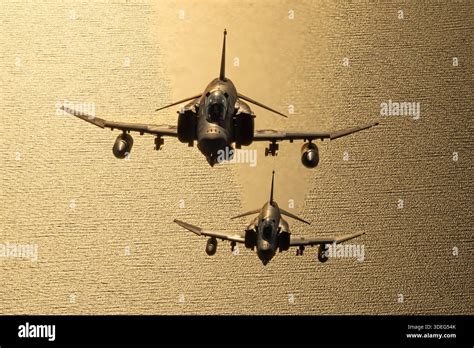
The F-4 evolved significantly as the United States learned from combat experience. One of the most important developments was the introduction of an internal cannon on the F-4E. Instead of relying entirely on missiles and external gun pods, the aircraft could carry an internally mounted M61 Vulcan Gatling cannon for close-range engagements.
The F-4E also incorporated leading-edge slats, which improved maneuverability at high angles of attack. There was a trade-off, however. The aerodynamic changes that improved handling also reduced the aircraft’s ultimate top-speed potential. This illustrates an important characteristic of fighter development: maximizing speed and maximizing maneuverability are not always compatible goals.
Later aircraft such as the F-4S received additional improvements, including aerodynamic modifications and smokeless engines. The latter addressed one of the Phantom’s most recognizable weaknesses. Early J79 engines produced conspicuous black smoke, making the aircraft easier to spot visually during combat. Improved engines reduced that signature while retaining the aircraft’s powerful performance.
The engines themselves remained central to the Phantom’s capabilities. The J79-GE-17A used on major F-4 variants generated approximately 17,845 pounds of thrust, while the J79-GE-10B used on the F-4S produced about 17,900 pounds. Two such engines gave the aircraft the acceleration needed to exploit its high-speed design.
How Fast Was the F-4 Compared With Other American Fighters?
A top speed of Mach 2.23 placed the F-4 Phantom II among the fastest American fighters ever built. However, several later aircraft exceeded it.
The F-15 Eagle, for example, was capable of approximately Mach 2.5. The F-14 Tomcat could reach about Mach 2.34, while the F-22 Raptor has a published maximum speed of approximately Mach 2.25. These figures show that the Phantom remained remarkably competitive in raw speed even as fighter technology advanced dramatically.
Interestingly, the F-4’s successor in the broader evolution of American air superiority thinking was not designed simply to be faster. The experience of Vietnam helped demonstrate that maneuverability and energy management were critical. The F-15 was therefore developed with an emphasis on energy-maneuverability, powerful engines, low wing loading, and large control surfaces.
The result was an aircraft that combined exceptional maneuverability with a top speed higher than that of the Phantom. The F-15 could reach Mach 2.5 while being specifically designed to dominate air-to-air engagements rather than simply intercept targets at high altitude.
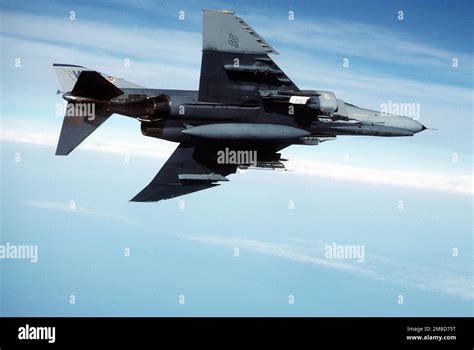
Why the F-4 Was So Fast Despite Its Size
The Phantom’s dimensions make its Mach 2.23 capability especially impressive. It was not an aircraft designed around minimal weight. It carried two engines, substantial internal fuel, radar equipment, a large weapons payload, and enough structure to operate from aircraft carriers in many versions.
The answer was engine power combined with an aerodynamic configuration optimized for high-speed flight. The J79 turbojets provided enormous thrust when their afterburners were engaged, allowing the Phantom to overcome the increasing drag associated with supersonic flight.
At high altitude, the aircraft could exploit thinner air and lower aerodynamic resistance. This was exactly the environment in which its original interceptor concept made the most sense. The Phantom could climb rapidly, accelerate toward an incoming target, and use its radar and missiles to attack without necessarily entering a turning fight.
Its speed also gave crews an important tactical option: disengagement. An aircraft with strong acceleration and a high maximum speed could sometimes use those characteristics to break contact or rapidly change the geometry of an engagement.
The F-4 Phantom’s Lasting Legacy
Nearly 5,200 F-4 Phantom IIs were produced between 1958 and 1981, making it the most widely produced American supersonic fighter of its era. It served with the United States Navy, Marine Corps, and Air Force, while numerous allied nations also operated the aircraft.
The Phantom became much more than the high-speed naval interceptor originally envisioned. It evolved into a fighter-bomber, reconnaissance aircraft, air-defense platform, and specialized aircraft for different missions and operators. Its ability to adapt helped keep it relevant long after newer aircraft had entered service.
The United States Navy retired the F-4 in 1986, while the Marine Corps continued operating it until 1992. The Air Force retained Phantom IIs for operational duties until 1997, and modified examples continued flying in other roles afterward. The final American F-4s were eventually retired as target drones in 2016.
The aircraft’s longevity is remarkable because its original concept belonged to a very different era of air combat. Yet its Mach 2.23 top speed, powerful twin engines, high climb rate, heavy weapons capacity, and enormous operational flexibility allowed it to remain useful for decades.
Was the F-4 Phantom Really One of the Fastest Fighters?
Yes. The F-4 Phantom II’s Mach 2.23 top speed placed it firmly among the fastest operational fighter aircraft of its generation and still makes it an impressive performer by historical standards. Its raw speed was not the only reason for its success, but it was fundamental to the aircraft’s original identity.
The Phantom demonstrated both the strengths and limitations of designing a fighter around speed. It could climb rapidly, accelerate aggressively, operate at very high altitude, and reach targets at extraordinary speeds. But Vietnam demonstrated that air combat could not always be reduced to radar range, missile range, and maximum velocity.
That lesson shaped the next generation of American fighters. The F-15 placed far greater emphasis on maneuverability and energy management while retaining a higher maximum speed. Later fighters added increasingly sophisticated sensors, electronic warfare systems, precision weapons, and stealth technology, changing the meaning of fighter performance once again.
Even so, the Phantom remains an extraordinary achievement of 1950s engineering. Nearly seven decades after its first flight, its ability to reach Mach 2.23 still stands as one of the defining characteristics of the aircraft. The F-4 Phantom II was large, loud, heavily armed, and famously fast—and its speed helped make it one of the most enduring military aircraft of the Cold War.