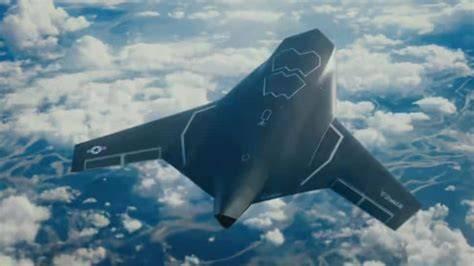
America’s next generation of autonomous combat aircraft is taking shape around a radically different idea: a fighter jet that does not need a runway or aircraft carrier catapult to launch. Shield AI’s X-BAT is being developed as an autonomous, vertical-takeoff-and-landing (VTOL) aircraft designed to operate from ships, islands, and remote forward bases.
Rather than replacing traditional crewed fighters, the X-BAT is intended to complement them as part of a distributed network of uncrewed combat aircraft. Its ability to operate independently of conventional airfields could become particularly important as the U.S. military prepares for conflicts in which major bases and aircraft carriers may be targeted.
The aircraft is still in development, but Shield AI describes the X-BAT as a runway-independent AI fighter jet. Its proposed combination of autonomous flight, long range, weapons capacity, and VTOL capability could give commanders another way to generate combat power in locations where conventional fighters cannot easily operate.
X-BAT Brings Vertical Takeoff to an AI Fighter
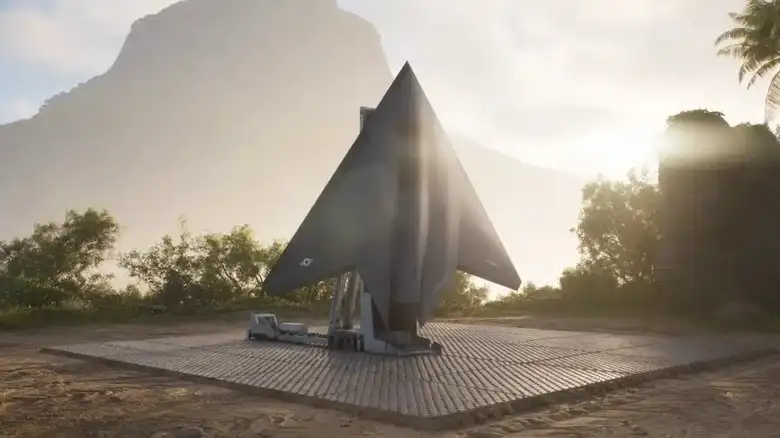
The most distinctive feature of the X-BAT is its ability to take off and land vertically. Instead of requiring a conventional runway, the aircraft is designed around a launch and recovery system that allows it to operate from austere locations.
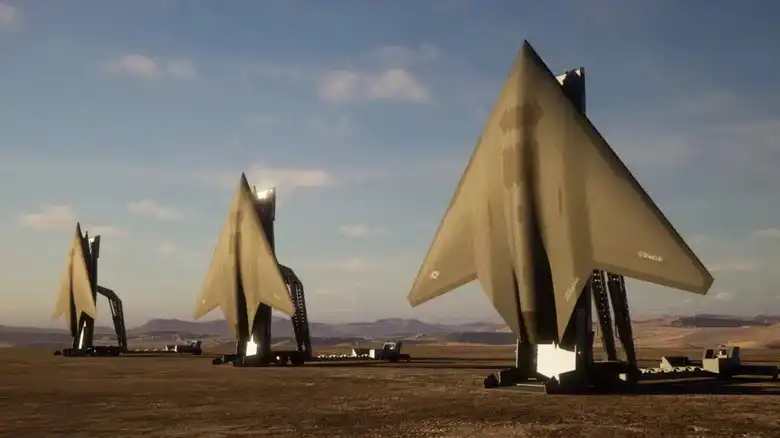
Shield AI’s concept uses a towed trailer system that moves the aircraft from a compact position into its launch configuration. The company says the X-BAT could transition from its packed state into the air within only a few minutes, potentially allowing it to operate from locations that would be unsuitable for conventional tactical aircraft.
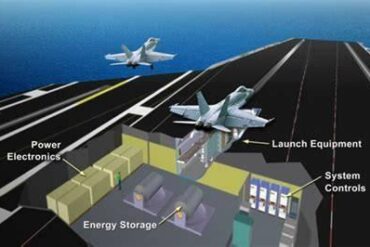
That capability also has implications for naval aviation. Three X-BATs are expected to fit within roughly the same deck space occupied by one crewed fighter. A ship could therefore potentially carry substantially more autonomous aircraft without requiring the same amount of deck capacity associated with conventional fighters.
AI Allows the X-BAT to Fight Without GPS
The aircraft’s autonomy is built around Shield AI’s Hivemind artificial intelligence system. Unlike remotely piloted drones that depend heavily on continuous communications with operators, the X-BAT is designed to make decisions onboard.
This could become critical in a heavily contested electromagnetic environment. Shield AI says Hivemind can allow the aircraft to operate without communications or Global Navigation Satellite System signals, giving the X-BAT the ability to continue its mission even when GPS is jammed or communications links are disrupted.
A single human commander could potentially control a group of X-BATs, turning the aircraft into a distributed force rather than simply another remotely controlled drone. The concept fits closely with the broader development of collaborative combat aircraft designed to extend the reach and effectiveness of crewed fighters.
Long Range and Heavy Weapons Capacity
Shield AI’s planned specifications make the X-BAT considerably more ambitious than a conventional small drone. The aircraft is expected to measure approximately 26 feet long, with a 39-foot wingspan and a service ceiling exceeding 50,000 feet.
Its projected combat radius is approximately 1,150 miles, while total range is listed at 2,302 miles. Those figures would allow the X-BAT to operate far beyond the immediate vicinity of a forward base, although actual performance will depend on the final design and operational configuration.
Power is expected to come from a GE Aerospace F110 engine, a propulsion system already associated with aircraft such as the F-15EX. Shield AI also intends for the X-BAT to perform both air-to-air and ground-attack missions, with additional sensors potentially supporting electronic warfare operations.
The aircraft’s internal weapons bay is planned to accommodate up to 2,000 pounds of weapons, while external hardpoints could support larger strike weapons. Specific weapon combinations have not yet been disclosed.
A New Model for Distributed Airpower
The X-BAT is not yet a flying aircraft, and production is not expected to fully begin until 2029. Shield AI nevertheless envisions production reaching as many as 150 aircraft annually by the early 2030s.
Its importance may ultimately come less from any single performance figure than from the operational concept behind it. A fighter that can launch without a runway, operate without GPS, and work as part of an autonomous team could allow the U.S. military to distribute combat aircraft across a much wider network of locations.
That would make the X-BAT an especially intriguing development in the future of AI-powered military aviation. Instead of concentrating expensive crewed fighters aboard vulnerable carriers and major air bases, commanders could deploy large numbers of autonomous aircraft from dispersed and difficult-to-target positions.
The aircraft still has to prove that its ambitious design can work in practice. But if Shield AI can deliver the promised combination of VTOL operation, autonomy, range, and weapons capacity, the X-BAT could represent a significant step toward a future where an advanced fighter does not need an aircraft carrier—or even a conventional runway—to enter combat.