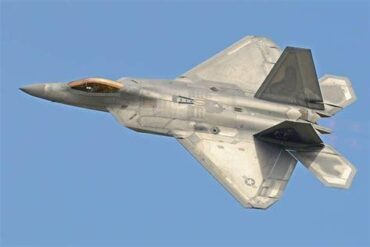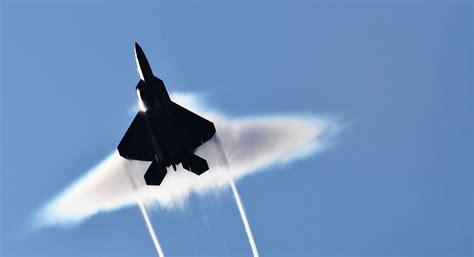
The F-22 Raptor occupies a unique place in military aviation history. More than two decades after its introduction, it remains the only fighter jet in the United States Air Force capable of sustained supercruise while carrying a full combat load. This extraordinary ability allows the aircraft to fly faster than the speed of sound without engaging fuel-hungry afterburners, giving it a decisive edge in range, survivability, response time, and combat effectiveness.
While newer aircraft have entered service and sixth-generation concepts continue to evolve, the F-22’s combination of stealth, speed, maneuverability, and advanced propulsion remains unmatched within the U.S. Air Force inventory. The aircraft was designed from the beginning to dominate the skies against the most sophisticated adversaries imaginable, and its supercruise capability is one of the defining reasons why it continues to be regarded as the benchmark for air superiority.
The Meaning of Supercruise and Why It Changes Air Combat
Supercruise refers to the ability of an aircraft to maintain supersonic flight without the use of afterburners. Most fighter jets can exceed Mach 1, but they typically require afterburners to do so. Afterburners inject additional fuel into the engine exhaust stream, creating a dramatic increase in thrust at the cost of enormous fuel consumption and a significantly larger infrared signature.
For most fighters, supersonic flight is therefore a temporary condition. Pilots activate afterburners during combat maneuvers, interceptions, or short-duration dashes before reducing speed to preserve fuel. The F-22 changes this equation entirely.
Instead of relying on afterburners, the Raptor can maintain speeds exceeding Mach 1.5 and approaching Mach 1.8 using engine power alone. This allows the aircraft to travel vast distances at supersonic speeds while consuming considerably less fuel than conventional fighters operating in afterburner mode.
The battlefield implications are enormous. A fighter that can arrive faster, remain on station longer, and engage opponents while minimizing detectable signatures possesses a significant operational advantage. In modern warfare, where seconds often determine success or failure, supercruise can mean the difference between intercepting a threat and arriving too late.
After several decades of technological advancement, no other fighter in the U.S. Air Force has replicated the F-22’s unique blend of stealth and sustained supersonic performance.
The Revolutionary Origins of the F-22 Raptor
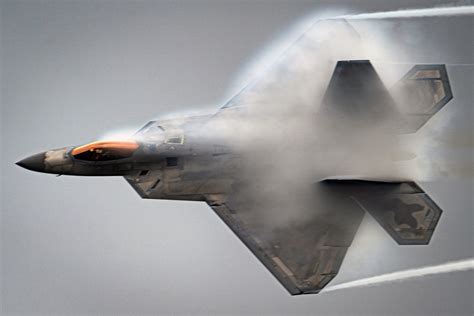
The F-22 emerged from the Advanced Tactical Fighter program during the final years of the Cold War. American planners anticipated future confrontations with increasingly capable Soviet aircraft such as the Sukhoi Su-27 Flanker and the Mikoyan MiG-29 Fulcrum.
Rather than developing an incremental improvement over existing platforms, the U.S. Air Force sought a revolutionary aircraft capable of dominating future air battles for decades. The result was a platform that integrated low-observable stealth technology, advanced avionics, unprecedented maneuverability, and an entirely new propulsion system.
Developed by Lockheed Martin’s legendary Skunk Works division in partnership with Boeing and Pratt & Whitney, the F-22 became the world’s first operational fifth-generation fighter aircraft. When it entered service in 2005, it represented a dramatic leap beyond anything flying elsewhere in the world.
Its stealth characteristics reduced radar detection. Its sensor fusion improved situational awareness. Its thrust-vectoring engines delivered extraordinary agility. Yet among all these innovations, supercruise stood out as one of the aircraft’s most strategically important capabilities.
The ability to remain supersonic without sacrificing endurance transformed how the aircraft could be employed across an entire theater of operations.
The Pratt & Whitney F119: The Engine Behind the Legend
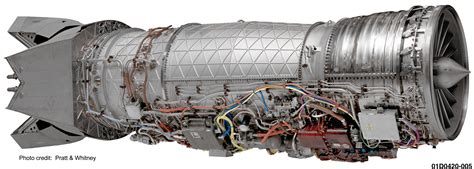
At the heart of the F-22 sits the remarkable Pratt & Whitney F119 turbofan engine. Producing approximately 35,000 pounds of thrust per engine, the twin-engine arrangement gives the Raptor extraordinary performance across the entire flight envelope.
The F119 was not merely an evolution of previous engines. It represented a complete redesign aimed at achieving unprecedented levels of power, reliability, stealth, and efficiency.
Compared with earlier engines such as the F100 used in the F-15 Eagle and F-16 Fighting Falcon, the F119 incorporated fewer components, reducing maintenance requirements while increasing operational reliability. Engineers also integrated advanced materials capable of withstanding extreme temperatures associated with sustained high-speed flight.
Most importantly, the engine generated sufficient dry thrust to allow continuous supersonic flight without requiring afterburners.
This achievement required years of research, testing, and engineering innovation. Designers needed to balance thrust output, thermal management, stealth requirements, fuel efficiency, and durability within a highly compact package.
The result remains one of the most advanced fighter engines ever placed into operational service.
Thrust Vectoring Gives the Raptor Its Fearsome Agility
The F119 engine introduced another groundbreaking feature: operational thrust vectoring.
Unlike traditional fighter engines that direct thrust straight backward, the F-22’s two-dimensional thrust-vectoring nozzles can move up and down by approximately 20 degrees. This allows the aircraft to manipulate airflow and thrust independently of aerodynamic control surfaces.
The effect is extraordinary maneuverability, particularly at high angles of attack where conventional fighters begin to lose effectiveness.
The aircraft can execute post-stall maneuvers that would be impossible for many competitors. Pilots can rapidly change nose position, point weapons at targets from unconventional angles, and maintain control during aggressive dogfighting scenarios.
Although some foreign aircraft employ three-dimensional thrust vectoring, the F-22’s system was carefully optimized for stealth and aerodynamic efficiency. Its rectangular nozzle design contributes to reduced radar observability while simultaneously helping manage infrared emissions.
This integration of stealth and maneuverability remains one of the Raptor’s defining engineering achievements.
Why Supercruise Provides a Massive Tactical Advantage
The value of supercruise extends far beyond simply flying fast.
In modern combat operations, speed influences nearly every aspect of mission effectiveness. Aircraft capable of sustained supersonic travel can respond to threats more quickly, reposition across operational theaters faster, and spend less time exposed during transit.
For the F-22, supercruise creates multiple battlefield advantages simultaneously.
First, it reduces fuel consumption compared to afterburning flight. This allows pilots to preserve valuable fuel reserves for combat operations rather than wasting them during transit.
Second, it reduces infrared visibility. Afterburners produce extremely hot exhaust plumes that can be detected by enemy sensors from considerable distances. Operating without afterburners helps the F-22 maintain a lower observable profile.
Third, it increases survivability. A stealth aircraft moving at sustained supersonic speeds becomes an exceptionally difficult target to track, intercept, and engage.
Finally, supercruise allows the aircraft to dictate engagement conditions. Pilots can choose when to enter combat, when to disengage, and how rapidly to reposition within contested airspace.
The combination of stealth and sustained speed effectively compresses an opponent’s decision-making timeline, creating a powerful operational advantage.
More Than an Air Superiority Fighter
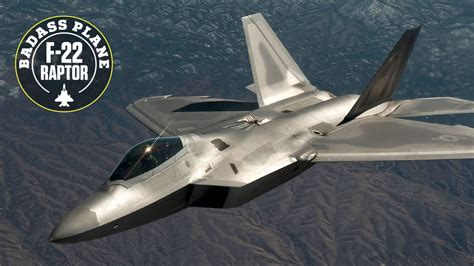
The F-22 was originally conceived as a pure air superiority platform. During development, designers embraced a philosophy similar to that used for the F-15 Eagle: prioritize dominance in air-to-air combat above all else.
As global security requirements evolved after the Cold War, however, the aircraft acquired multirole capabilities.
The Raptor’s internal weapons bays proved capable of carrying precision-guided munitions while maintaining stealth characteristics. These bays can accommodate GBU-32 Joint Direct Attack Munitions as well as Small Diameter Bombs, enabling precision strike missions against ground targets.
Its first combat deployment demonstrated this flexibility. Rather than engaging enemy fighters, the aircraft conducted strike operations against ISIS targets in Syria.
Despite this evolution, air superiority remains the aircraft’s primary mission. Every aspect of its design—from its radar and sensors to its flight performance and weapons integration—continues to emphasize dominance in aerial combat.
The Challenge of Operating a Small Elite Fleet
Despite its unmatched capabilities, the F-22 program faced significant political and budgetary pressures.
Initial plans envisioned a fleet of approximately 750 aircraft. Following the collapse of the Soviet Union and changing defense priorities, procurement numbers steadily declined. Ultimately, only 187 operational aircraft were produced.
The production line officially closed in 2011.
This limited fleet size created long-term sustainment challenges. Specialized manufacturing equipment was dismantled or repurposed. Suppliers moved on to other programs. Replacement components became increasingly difficult to source.
A phenomenon often described as “vanishing vendor syndrome” emerged, where original suppliers either ceased production or disappeared entirely.
Compounding these issues, the aircraft’s stealth coatings require extensive maintenance. Many materials and processes date back to the 1990s, increasing labor demands and operating costs.
Mission-capable rates have fluctuated over the years, reflecting the difficulties associated with sustaining a highly sophisticated but relatively small fleet.
Modernization Efforts Are Extending the Raptor’s Relevance
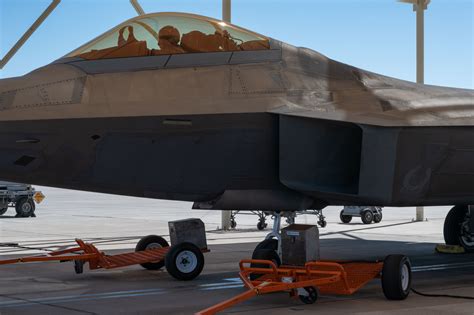
Recognizing the aircraft’s continued importance, the U.S. Air Force has invested heavily in modernization programs designed to keep the F-22 operational into the next decade.
These upgrades include improvements to radar systems, avionics, communications architecture, electronic warfare capabilities, and weapons integration.
One of the most significant enhancements is the introduction of a helmet-mounted display system. For years, the absence of such a system represented a notable capability gap compared with aircraft such as the F-35 and modernized F-16 variants.
The new helmet enables pilots to designate targets simply by looking at them, dramatically improving situational awareness and weapon employment efficiency. It also enhances the effectiveness of advanced missiles such as the AIM-9X Sidewinder.
Beyond cockpit improvements, modernization programs are preparing the aircraft to function as a networked command node within future combat environments.
The Raptor is increasingly expected to coordinate operations involving autonomous systems, sensor networks, and collaborative combat aircraft.
The Super Raptor Vision and Future Air Dominance
The next phase of the aircraft’s evolution is often referred to as the “Super Raptor” concept.
Rather than focusing solely on traditional fighter performance metrics, this initiative seeks to transform the F-22 into a highly connected battlefield quarterback capable of managing manned and unmanned assets simultaneously.
Future upgrades are expected to strengthen data-sharing capabilities, sensor fusion performance, electronic warfare effectiveness, and interoperability with emerging systems.
The aircraft’s role will increasingly extend beyond shooting down enemy fighters. Instead, it will serve as a central node within a larger ecosystem of combat platforms operating across multiple domains.
This approach aligns closely with the broader transformation occurring throughout modern air forces worldwide.
The Coming Arrival of the Boeing F-47
Although the F-22 remains unmatched in several key areas, its eventual successor is already taking shape.
The U.S. Air Force selected Boeing to develop the F-47 Next Generation Air Dominance fighter, a sixth-generation platform designed to redefine aerial warfare.
Lessons learned from decades of Raptor operations are directly influencing the new aircraft’s design philosophy. Advanced stealth technologies, artificial intelligence integration, autonomous teaming capabilities, next-generation sensors, and revolutionary propulsion systems are expected to form the foundation of the F-47.
Until that aircraft reaches operational service, however, the F-22 continues to carry the burden of maintaining American air superiority against increasingly sophisticated threats.
Why the F-22 Still Stands Alone
The F-22 Raptor remains one of the most extraordinary combat aircraft ever built. Its combination of stealth, thrust vectoring, advanced sensors, and unmatched supercruise capability continues to distinguish it from every other fighter in the U.S. Air Force inventory.
While newer aircraft offer valuable capabilities in networking, strike operations, and mission flexibility, none can replicate the Raptor’s ability to sustain supersonic flight without afterburners while carrying a full combat load.
That capability translates into greater range, lower fuel consumption, reduced infrared visibility, faster response times, and enhanced operational flexibility. It allows the aircraft to reach the fight sooner, remain there longer, and engage opponents on terms of its choosing.
As the United States transitions toward sixth-generation air combat systems, the F-22 remains the aircraft against which all others are measured. Decades after its debut, it still represents the pinnacle of air superiority design—and the only fighter in the U.S. Air Force capable of true operational supercruise.